
Species
American oystercatcher
Haematopus palliatus
A striking black-and-white shorebird with a heavy orange bill, which opens oysters and clams on Georgia's shores.
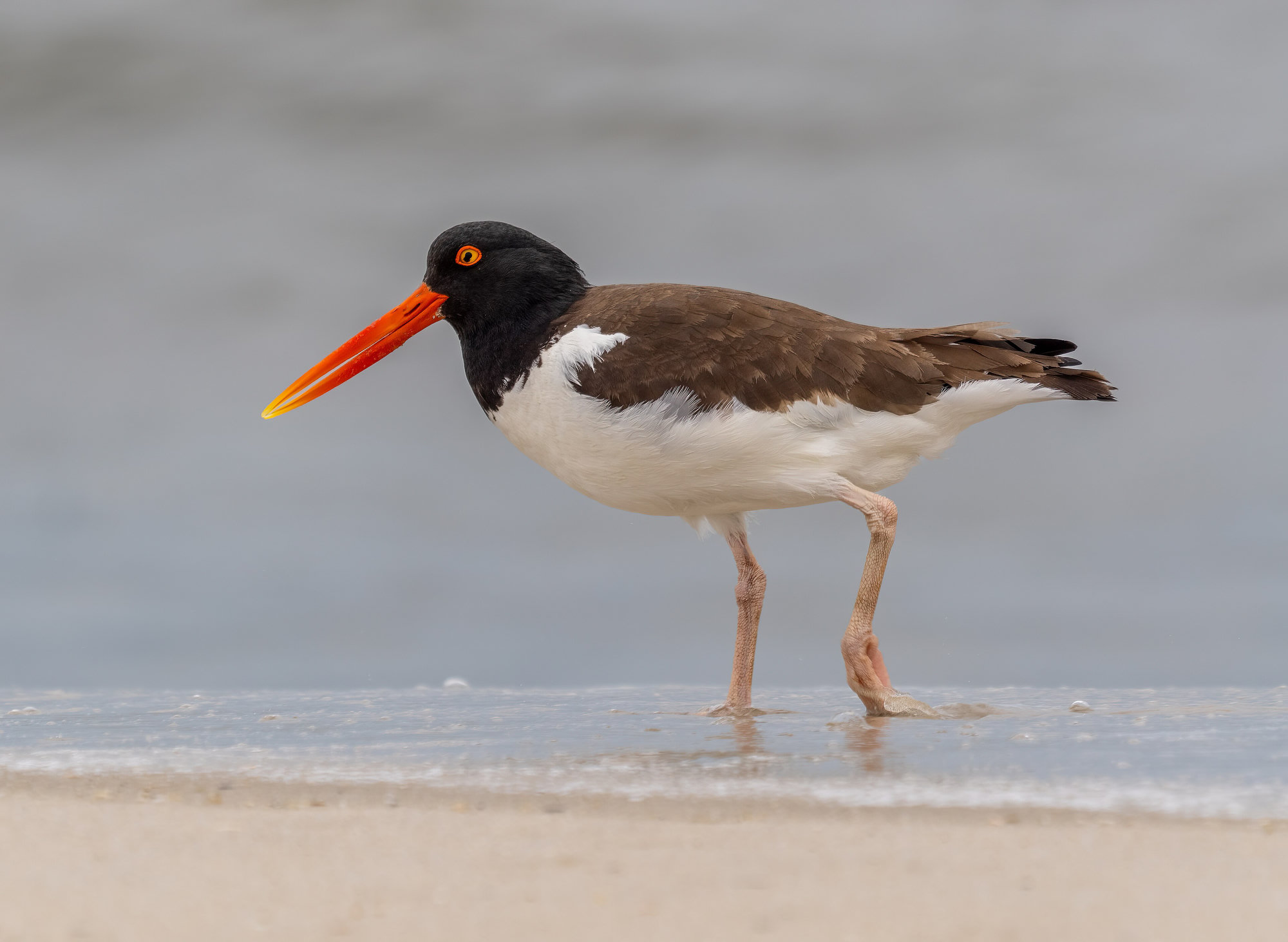
Photo Rhododendrites (opens in a new tab) / Wikimedia Commons, CC BY-SA 4.0 (opens in a new tab)
At a glance
- Size
- About 40 to 44 cm long
- Weight
- About 400 to 700 g
- Habitat
- Beaches, oyster reefs, sandbars and salt marshes
- Diet
- Oysters, clams, mussels, crabs and worms
- In Georgia
- A resident on the coast; winter flocks gather on sandbars
- Voice
- A loud, piercing "wheep"
- Rabies vector
- No
Identification
- Key marks
- Black head; brown back; white belly; long, bright orange-red bill; yellow eye with a red ring; pale pink legs
- Told apart from
- Black skimmer, which has a knife-like red-and-black bill and black back
- Where to look
- Oyster reefs, beaches and sandbars at low tide
Behaviour
Oystercatchers open shellfish by stabbing the bill between the shells and cutting the muscle that holds them shut, or by hammering. Pairs often stay together for years and defend beach territories loudly.
Why they matter
American oystercatchers depend on healthy oyster reefs and undisturbed beaches, and they declined sharply in the twentieth century. Georgia's barrier islands support an important share of the Atlantic coast population, and their numbers show how well beaches are shared between people and nesting birds.
Reproduction and lifecycle
Nest — A shallow scrape in sand on the beach or among shells
Eggs — Usually two or three
Incubation — About 24 to 29 days
Chicks — Leave the nest within a day, but depend on parents for food for weeks
Flight — At about five weeks
Lifespan — Wild birds over twenty years are recorded
Living around people
- Eggs and chicks on the beach are nearly invisible; posted nesting areas protect them.
- Dogs off lead on beaches flush adults, leaving eggs to overheat or be taken.
- Oystercatchers are fed by their parents longer than most shorebirds, so a chick alone for a moment is not orphaned.
Misconceptions
- A chick sitting still on the sand is abandoned. It is hiding; its parents are close by and will return when people leave.
Related species
Seasonal activity
When this species is breeding, and when there are nests on the ground. Mowing during the shaded months is how most nests are found.
| Jan | Feb | Mar | Apr | May | Jun | Jul | Aug | Sep | Oct | Nov | Dec | |
|---|---|---|---|---|---|---|---|---|---|---|---|---|
| Breeding | Jan: no | Feb: no | Mar: no | Apr: no | May: no | Jun: no | Jul: no | Aug: no | Sep: no | Oct: no | Nov: no | Dec: no |
| Active nests | Jan: no | Feb: no | Mar: no | Apr: no | May: no | Jun: no | Jul: no | Aug: no | Sep: no | Oct: no | Nov: no | Dec: no |
| Notes | Winter flocks on sandbars | Pairs forming | Pairs on territories | Nesting | Nesting | Chicks | Chicks | Young flying | Flocks forming | Winter flocks | Winter flocks | Winter flocks |
Where it lives
Recorded in 34 states and provinces. Each one links to the other animals there, and to the rehabilitators licensed for them.
United States
If you found one
Answer a few questions and you will get a specific answer for what you are looking at.
I found an animal