
Species
Wilson's plover
Anarhynchus wilsonia
A thick-billed plover that nests on Georgia's beaches and hunts fiddler crabs on the flats.
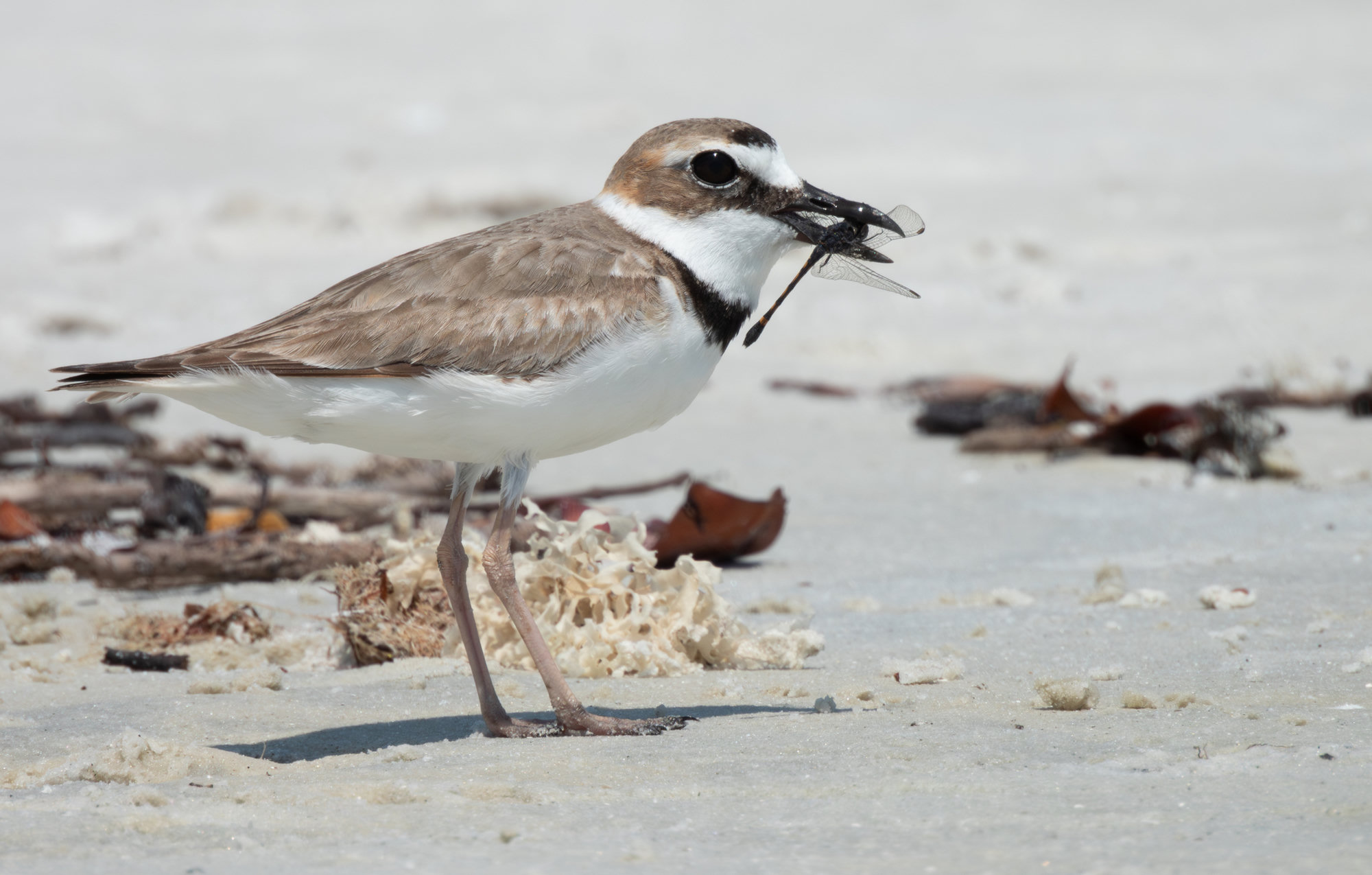
Photo Rajan Rao (opens in a new tab) / iNaturalist, CC BY 4.0 (opens in a new tab)
At a glance
- Size
- About 16 to 20 cm long
- Weight
- About 55 to 70 g
- Habitat
- Beaches, sandflats and the edges of salt marshes
- Diet
- Mostly fiddler crabs; also insects and worms
- In Georgia
- A summer resident on the coast; a few winter
- Voice
- A sharp "whit"
- Rabies vector
- No
Identification
- Key marks
- Heavy, all-black bill; brown back; one broad breast band, black in males and brown in females; pinkish legs
- Told apart from
- Semipalmated plover, which has a small orange-and-black bill
- Told apart from
- Killdeer, which has two breast bands and a long tail
- Where to look
- Beaches and sandflats near marsh edges, March to September
Behaviour
Wilson's plovers hunt fiddler crabs on sandflats and at the edges of marshes, running them down and swallowing them whole or pulling off the legs.
Why they matter
Wilson's plovers nest on open beaches and are sensitive to disturbance. Georgia's barrier islands hold an important share of the breeding population on the Atlantic coast, making the state important to the species' future.
Reproduction and lifecycle
Nest — A scrape in sand near dunes
Eggs — Usually three
Incubation — About 23 to 25 days
Chicks — Leave the nest within hours and feed themselves
Flight — At about three to four weeks
Lifespan — Several years
Living around people
- Beach nesting areas that are roped off protect eggs and chicks that would otherwise be stepped on.
- Adults feigning injury are drawing people away from chicks; the kind response is to leave the area.
Misconceptions
- A chick alone on the sand has been abandoned. Plover chicks feed themselves and hide when danger comes; parents stay close.
Related species
Seasonal activity
When this species is breeding, and when there are nests on the ground. Mowing during the shaded months is how most nests are found.
| Jan | Feb | Mar | Apr | May | Jun | Jul | Aug | Sep | Oct | Nov | Dec | |
|---|---|---|---|---|---|---|---|---|---|---|---|---|
| Breeding | Jan: no | Feb: no | Mar: no | Apr: no | May: no | Jun: no | Jul: no | Aug: no | Sep: no | Oct: no | Nov: no | Dec: no |
| Active nests | Jan: no | Feb: no | Mar: no | Apr: no | May: no | Jun: no | Jul: no | Aug: no | Sep: no | Oct: no | Nov: no | Dec: no |
| Notes | A few wintering | A few present | Arriving | Nesting | Nesting | Chicks | Chicks | Young flying | Leaving | Few remain | Mostly gone | A few present |
Where it lives
Recorded in 26 states and provinces. Each one links to the other animals there, and to the rehabilitators licensed for them.
United States
If you found one
Answer a few questions and you will get a specific answer for what you are looking at.
I found an animal