
Species
Killdeer
Charadrius vociferus
The plover of parking lots and ball fields, which fakes a broken wing to lead danger away from its eggs.
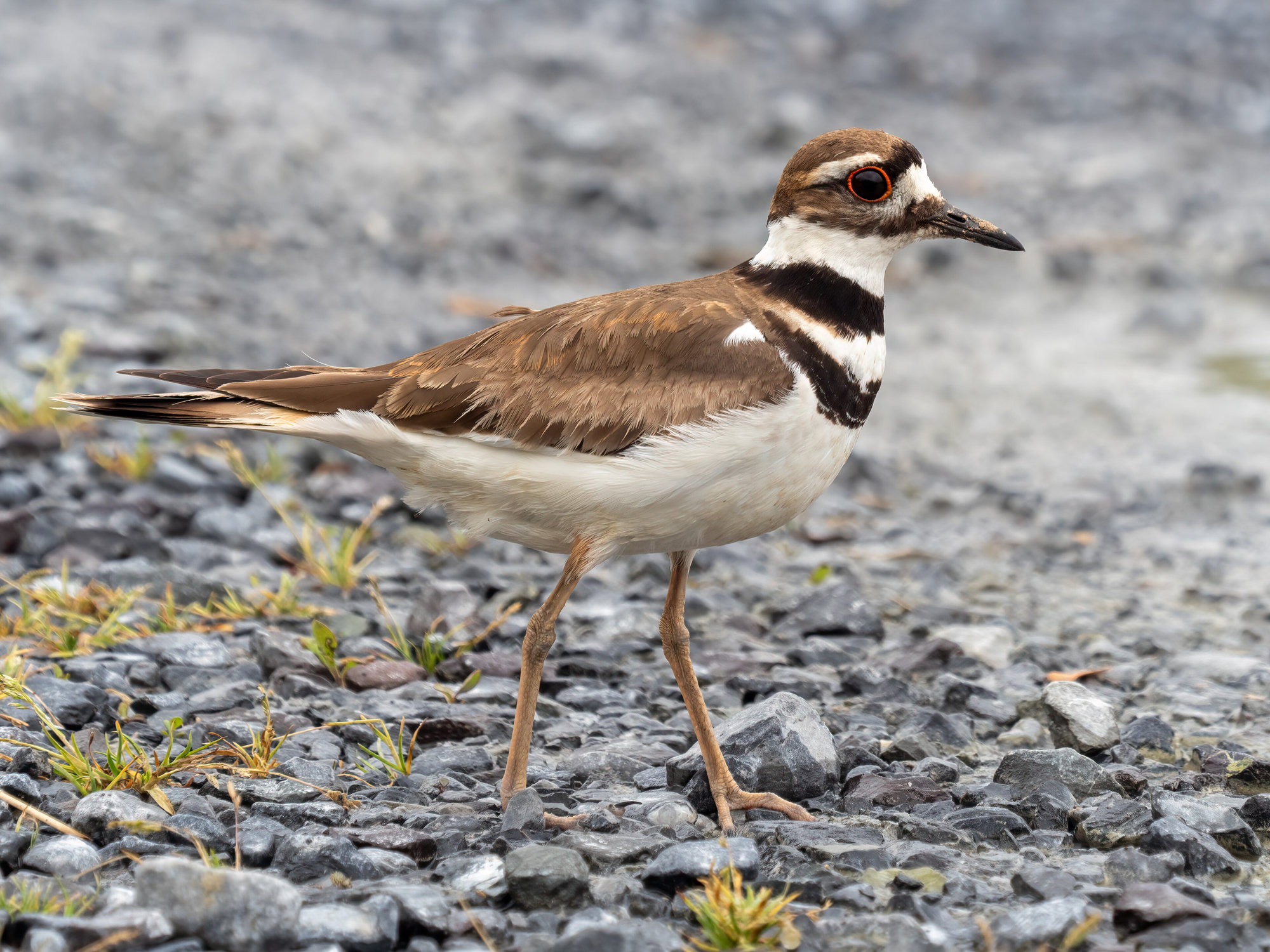
Photo Rhododendrites (opens in a new tab) / Wikimedia Commons, CC BY-SA 4.0 (opens in a new tab)
At a glance
- Size
- About 20 to 28 cm long
- Weight
- About 70 to 130 g
- Habitat
- Fields, lawns, gravel roofs, parking lots, ball fields and pond edges
- Diet
- Insects, worms, snails and crayfish
- In Georgia
- Common resident statewide
- Voice
- A loud, repeated "kill-deer" or "dee-dee-dee"
- Rabies vector
- No
Identification
- Key marks
- Brown back; white belly; two black bands across the breast; orange rump seen in flight; long tail
- Told apart from
- Semipalmated plover, which is smaller with one breast band and lives on beaches
- Where to look
- Almost any open ground, even far from water
Behaviour
Killdeer run in short bursts across open ground, stopping to snatch insects. When a person or animal approaches the nest, an adult drags a wing, spreads its tail and calls, pretending to be injured to lure the intruder away.
Why they matter
Killdeer eat many insects in fields and lawns. They are one of the few shorebirds that have adapted readily to people, nesting on gravel car parks, roofs and ball fields — which also puts them in harm's way.
Reproduction and lifecycle
Nest — A scrape on bare gravel or ground, sometimes lined with pebbles
Eggs — Usually four
Incubation — About 22 to 28 days
Chicks — Covered in down with one breast band; leave the nest within a day and feed themselves
Flight — At about three to four weeks
Lifespan — Wild birds over ten years are recorded
Living around people
- A killdeer nest in a gravel lot or driveway can be protected with a few cones for three to four weeks until the chicks leave.
- The "broken wing" is an act; there is no need to chase or catch the bird.
- Chicks run and hide; a chick alone is almost always being watched by a parent.
Misconceptions
- A killdeer dragging its wing is injured. It is performing a distraction display to protect its eggs or chicks.
- Chicks alone on the ground are lost. Killdeer chicks feed themselves from hatching and are guarded from a distance.
Related species
Seasonal activity
When this species is breeding, and when there are nests on the ground. Mowing during the shaded months is how most nests are found.
| Jan | Feb | Mar | Apr | May | Jun | Jul | Aug | Sep | Oct | Nov | Dec | |
|---|---|---|---|---|---|---|---|---|---|---|---|---|
| Breeding | Jan: no | Feb: no | Mar: no | Apr: no | May: no | Jun: no | Jul: no | Aug: no | Sep: no | Oct: no | Nov: no | Dec: no |
| Active nests | Jan: no | Feb: no | Mar: no | Apr: no | May: no | Jun: no | Jul: no | Aug: no | Sep: no | Oct: no | Nov: no | Dec: no |
| Notes | Flocks in fields | Pairs forming | Nesting begins | Nesting | Chicks | Second nests | Chicks | Young flying | Flocks | Flocks | Flocks | Flocks |
Where it lives
Recorded in 95 states and provinces. Each one links to the other animals there, and to the rehabilitators licensed for them.
United States
- Alabama
- Alaska
- Arizona
- Arkansas
- California
- Colorado
- Connecticutbreeding
- Delawarebreeding
- District of Columbia
- Florida
- Georgia
- Idahobreeding
- Illinoisbreeding
- Indianabreeding
- Iowabreeding
- Kansasbreeding
- Kentucky
- Louisiana
- Mainebreeding
- Maryland
- Massachusettsbreeding
- Michiganbreeding
- Minnesotabreeding
- Mississippi
- Missouribreeding
- Montanabreeding
- Nebraskabreeding
- Nevada
- New Hampshirebreeding
- New Jersey
- New Mexico
- New Yorkbreeding
- North Carolina
- North Dakotabreeding
- Ohiobreeding
- Oklahoma
- Oregon
- Pennsylvaniabreeding
- Rhode Islandbreeding
- South Carolina
- South Dakotabreeding
- Tennessee
- Texas
- Utah
- Vermontbreeding
- Virginia
- Washington
- West Virginia
- Wisconsinbreeding
- Wyomingbreeding
Canada
Mexico
- Aguascalientes
- Baja California
- Baja California Sur
- Campechein winter
- Chiapasin winter
- Chihuahua
- Coahuila
- Colimain winter
- Durango
- Guanajuato
- Guerrero
- Hidalgo
- Jalisco
- Mexico City
- Michoacan
- Morelos
- Nayarit
- Nuevo Leon
- Oaxaca
- Puebla
- Queretaro
- Quintana Rooin winter
- San Luis Potosi
- Sinaloa
- Sonora
- State of Mexico
- Tabascoin winter
- Tamaulipas
- Tlaxcala
- Veracruzin winter
- Yucatanin winter
- Zacatecas
If you found one
Answer a few questions and you will get a specific answer for what you are looking at.
I found an animal