
Species
Royal tern
Thalasseus maximus
A large orange-billed tern with a shaggy black crest, a year-round sight along Georgia's beaches.
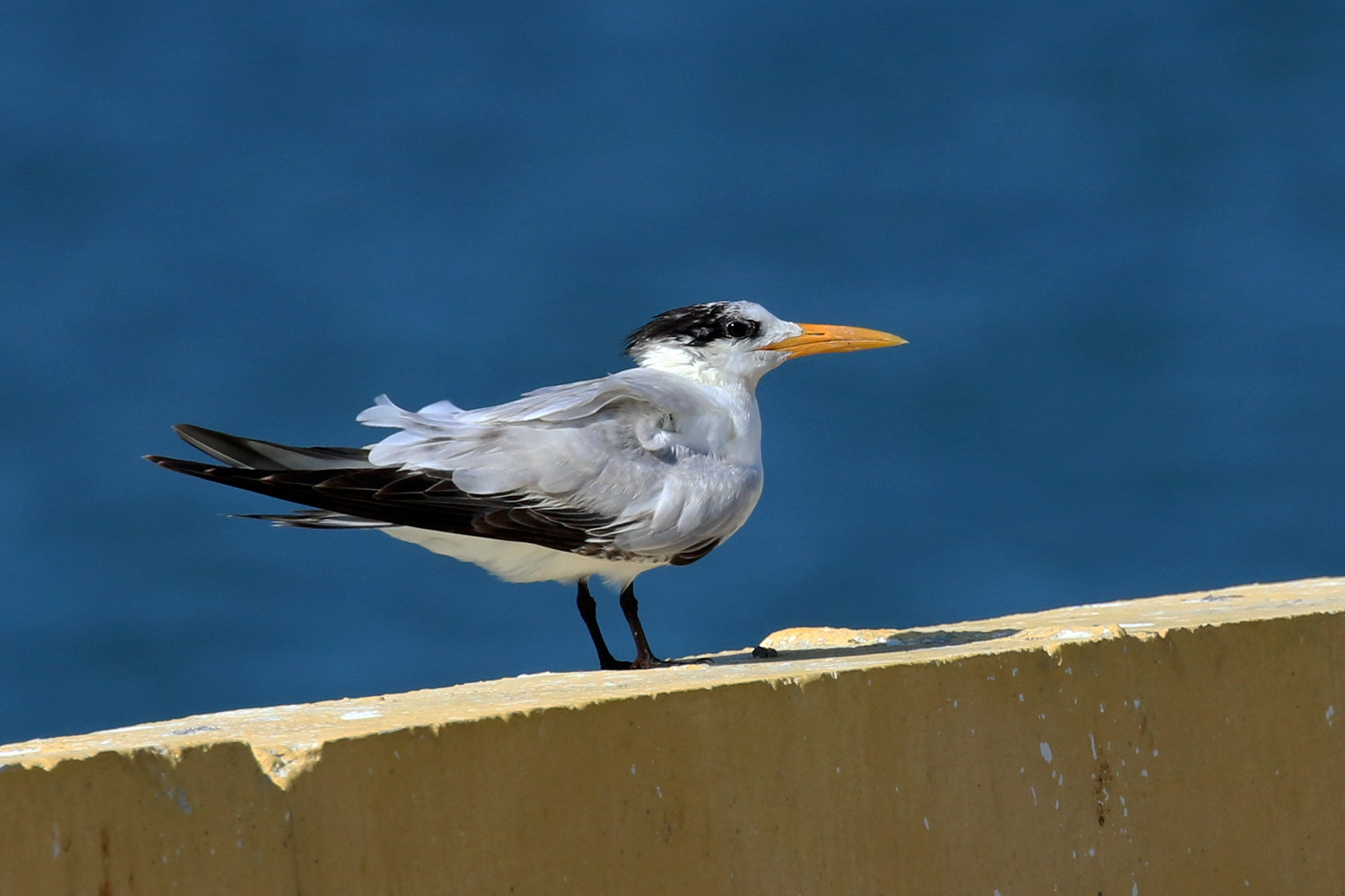
Photo Charles J. Sharp (opens in a new tab) / Wikimedia Commons, CC BY-SA 4.0 (opens in a new tab)
At a glance
- Size
- About 45 to 50 cm long
- Weight
- About 350 to 500 g
- Habitat
- Beaches, inlets and coastal waters
- Diet
- Fish, crabs and shrimp
- In Georgia
- Common on the coast all year; nests in large colonies
- Voice
- A loud, rolling "keer-reet"
- Rabies vector
- No
Identification
- Key marks
- Large; bright orange bill; shaggy black crest, often reduced to a patch at the back of the head outside the breeding season
- Told apart from
- Caspian tern, which has a thick red bill and dark undersides to the wingtips
- Told apart from
- Sandwich tern, which has a black bill with a yellow tip
- Where to look
- Beaches and sandbars all year
Behaviour
Royal terns plunge-dive for fish and nest in dense colonies, where chicks gather in groups called creches. Parents find their own chick among thousands by voice.
Why they matter
Royal terns are among the most familiar birds of Georgia's beaches. Their colonies on remote sandbars and islands are among the most important on the Atlantic coast.
Reproduction and lifecycle
Nest — A scrape in sand in dense colonies
Eggs — Usually one
Incubation — About 28 to 31 days
Chicks — Gather in creches; each fed by its own parents
Flight — At about four to five weeks
Lifespan — Wild birds over twenty years are recorded
Living around people
- Tern colonies are extremely sensitive to disturbance; posted islands are closed for good reason.
- A young tern on the beach being fed by an adult is normal.
Misconceptions
- A chick alone on the beach is lost. Tern parents find their own chick even in a crowd.
Related species
Seasonal activity
When this species is breeding, and when there are nests on the ground. Mowing during the shaded months is how most nests are found.
| Jan | Feb | Mar | Apr | May | Jun | Jul | Aug | Sep | Oct | Nov | Dec | |
|---|---|---|---|---|---|---|---|---|---|---|---|---|
| Breeding | Jan: no | Feb: no | Mar: no | Apr: no | May: no | Jun: no | Jul: no | Aug: no | Sep: no | Oct: no | Nov: no | Dec: no |
| Active nests | Jan: no | Feb: no | Mar: no | Apr: no | May: no | Jun: no | Jul: no | Aug: no | Sep: no | Oct: no | Nov: no | Dec: no |
| Notes | Present on the coast | Present | Present | Colonies forming | Nesting | Chicks in creches | Chicks | Young flying | Families on beaches | Present | Present | Present |
Where it lives
Recorded in 32 states and provinces. Each one links to the other animals there, and to the rehabilitators licensed for them.
United States
If you found one
Answer a few questions and you will get a specific answer for what you are looking at.
I found an animal