
Species
Yellow-billed cuckoo
Coccyzus americanus
A slender, secretive bird of leafy woods that eats hairy caterpillars other birds refuse.
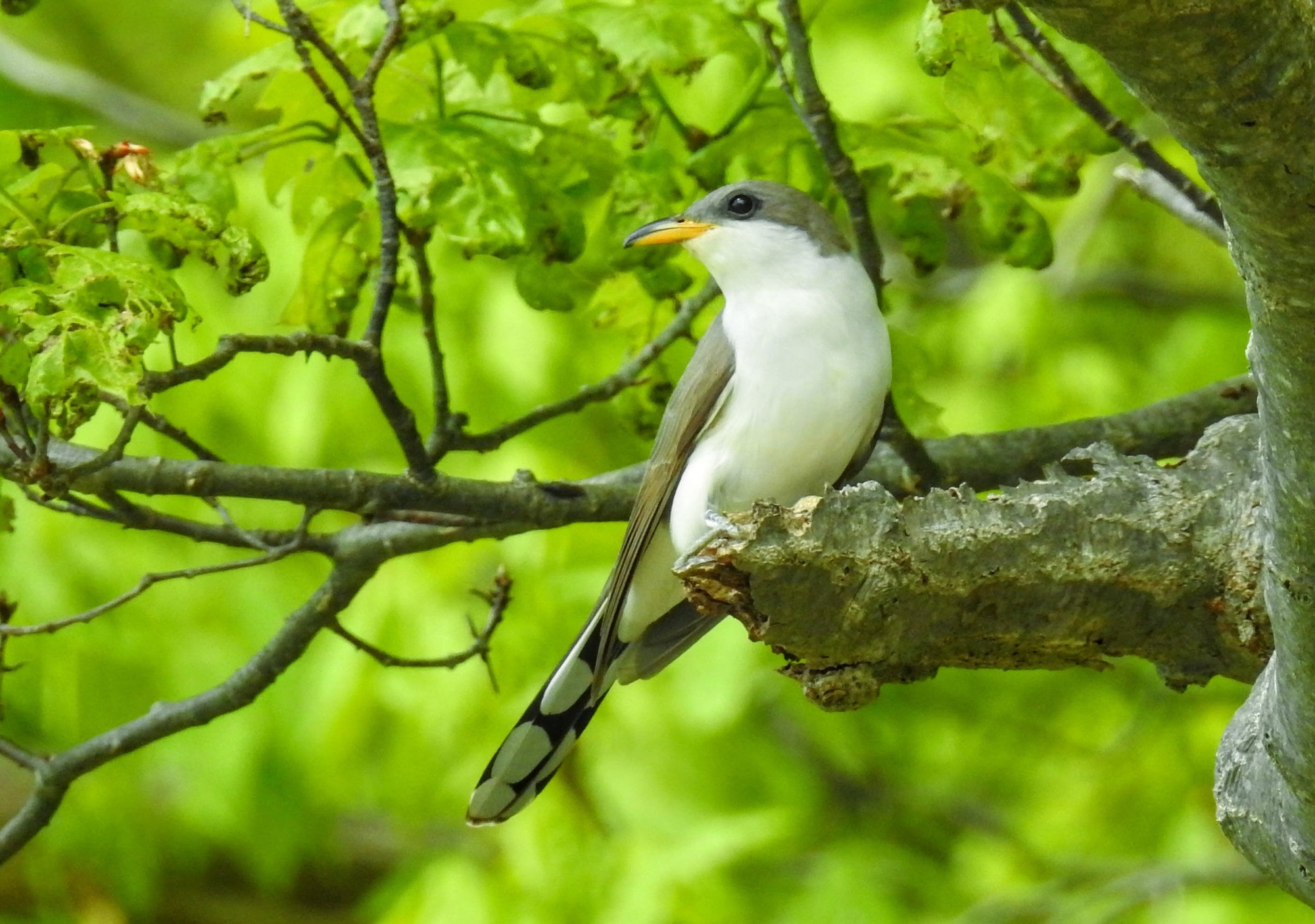
Photo Unknown photographer (opens in a new tab) / iNaturalist, CC0 1.0 (opens in a new tab)
At a glance
- Size
- About 26 to 30 cm long
- Weight
- About 55 to 65 g
- Habitat
- Woodland edges, thickets, riverside trees and orchards
- Diet
- Mostly large caterpillars, including hairy and spiny ones; also cicadas and katydids
- In Georgia
- A common summer resident, late April to October
- Voice
- A hollow, knocking "ka-ka-ka-ka-kow-kow-kowlp", often before rain
- Rabies vector
- No
Identification
- Key marks
- Long, slender brown and white bird; curved bill with a yellow lower half; long tail with bold white spots beneath; rufous wings in flight
- Told apart from
- Black-billed cuckoo, which has a dark bill, a red eye-ring and small tail spots
- Told apart from
- Mourning dove, which has a small straight bill and a plain grey tail
- Where to look
- Dense leafy trees; usually heard rather than seen
Behaviour
Yellow-billed cuckoos move slowly and quietly through dense leaves, pausing to look for caterpillars. When caterpillar outbreaks happen, they gather to feed on them and may lay more eggs.
Unlike the European cuckoo, they usually raise their own young, though they sometimes lay eggs in other birds' nests.
Why they matter
Yellow-billed cuckoos eat the hairy tent caterpillars and spongy moth caterpillars that most birds avoid. They periodically shed the lining of their stomachs to get rid of the hairs that collect there. Their numbers rise and fall with caterpillar outbreaks, making them a natural check on forest pests.
Reproduction and lifecycle
Nest — A flimsy platform of twigs in a shrub or tree
Eggs — Usually two to four
Incubation — About 9 to 11 days, one of the shortest of any bird
Nestlings — Grow very fast and climb out of the nest at about 7 to 9 days
Flight — About three weeks after hatching
Lifespan — A few years
Living around people
- Spraying woods and gardens for caterpillars removes their main food.
- Cuckoos often hit windows during migration.
Misconceptions
- All cuckoos lay their eggs in other birds' nests. North American cuckoos usually raise their own young.
- The "rain crow" really predicts rain. It calls often on hot, humid days before storms, but it calls in dry weather too.
Related species
Seasonal activity
When this species is breeding, and when there are nests on the ground. Mowing during the shaded months is how most nests are found.
| Jan | Feb | Mar | Apr | May | Jun | Jul | Aug | Sep | Oct | Nov | Dec | |
|---|---|---|---|---|---|---|---|---|---|---|---|---|
| Breeding | Jan: no | Feb: no | Mar: no | Apr: no | May: no | Jun: no | Jul: no | Aug: no | Sep: no | Oct: no | Nov: no | Dec: no |
| Active nests | Jan: no | Feb: no | Mar: no | Apr: no | May: no | Jun: no | Jul: no | Aug: no | Sep: no | Oct: no | Nov: no | Dec: no |
| Notes | In South America | In South America | In South America | Arriving late in the month | Arriving; pairs forming | Nesting | Nesting | Late nests; young fledging | Migrating south | Last birds leaving | In South America | In South America |
Where it lives
Recorded in 62 states and provinces. Each one links to the other animals there, and to the rehabilitators licensed for them.
United States
- Alabamabreeding
- Arizonabreeding
- Arkansasbreeding
- Coloradobreeding
- Connecticutbreeding
- Delawarebreeding
- District of Columbiabreeding
- Floridabreeding
- Georgiabreeding
- Illinoisbreeding
- Indianabreeding
- Iowabreeding
- Kansasbreeding
- Kentuckybreeding
- Louisianabreeding
- Mainebreeding
- Marylandbreeding
- Massachusettsbreeding
- Michiganbreeding
- Minnesotabreeding
- Mississippibreeding
- Missouribreeding
- Nebraskabreeding
- Nevadabreeding
- New Hampshirebreeding
- New Jerseybreeding
- New Mexicobreeding
- New Yorkbreeding
- North Carolinabreeding
- North Dakotabreeding
- Ohiobreeding
- Oklahomabreeding
- Pennsylvaniabreeding
- Rhode Islandbreeding
- South Carolinabreeding
- South Dakotabreeding
- Tennesseebreeding
- Texasbreeding
- Vermontbreeding
- Virginiabreeding
- West Virginiabreeding
- Wisconsinbreeding
Mexico
- Baja California Surbreeding
- Campechepassing through
- Chiapaspassing through
- Chihuahuabreeding
- Coahuilabreeding
- Durangobreeding
- Nuevo Leonbreeding
- Pueblapassing through
- Quintana Roopassing through
- San Luis Potosibreeding
- Sinaloabreeding
- Sonorabreeding
- Tabascopassing through
- Tamaulipasbreeding
- Veracruzbreeding
- Yucatan
If you found one
Answer a few questions and you will get a specific answer for what you are looking at.
I found an animal