
Species
Black-billed cuckoo
Coccyzus erythropthalmus
A shy, dark-billed cuckoo that passes through Georgia on migration and nests in the northern mountains.
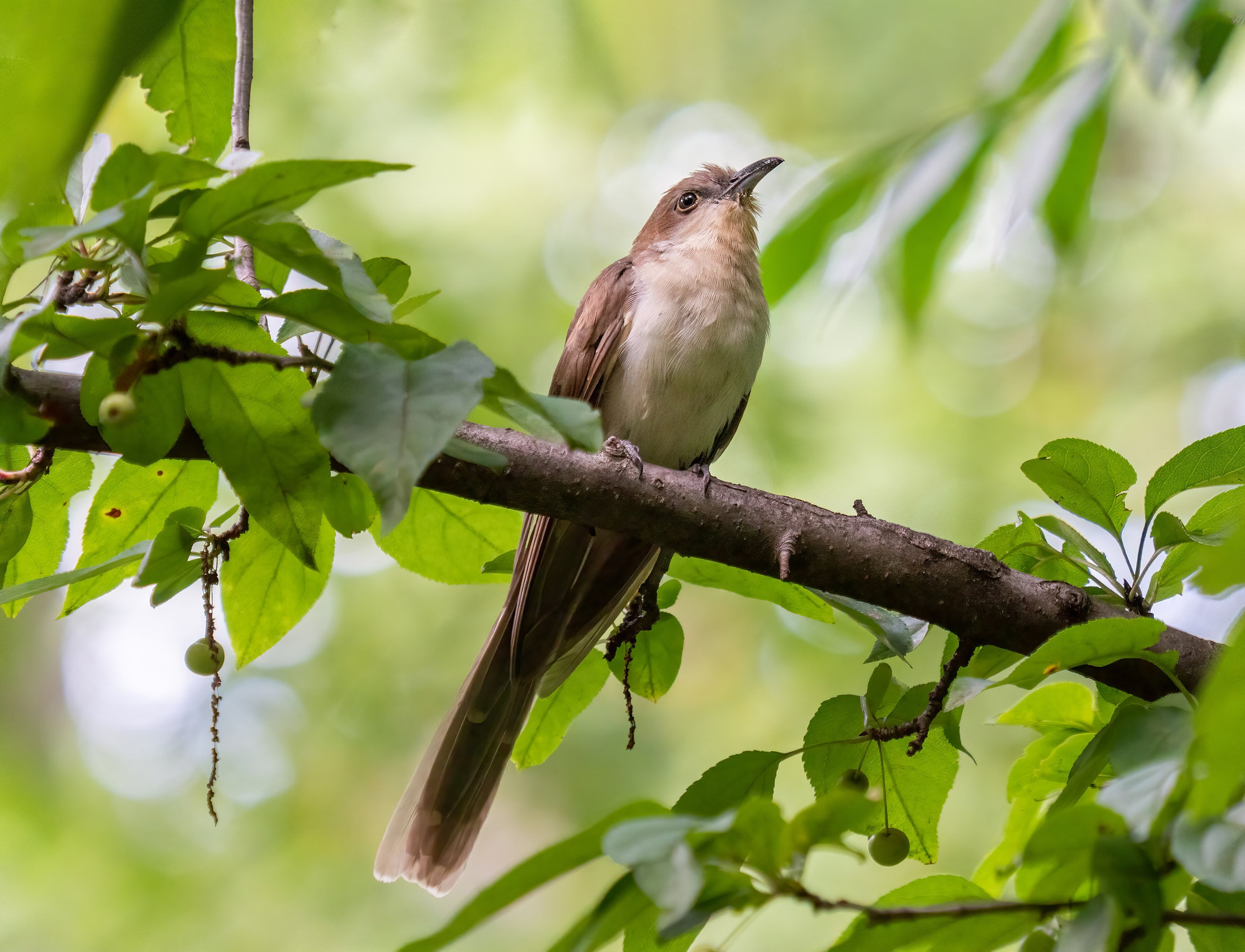
Photo Rhododendrites (opens in a new tab) / Wikimedia Commons, CC BY-SA 4.0 (opens in a new tab)
At a glance
- Size
- About 28 to 31 cm long
- Weight
- About 40 to 65 g
- Habitat
- Woodland thickets and forest edges
- Diet
- Mostly caterpillars, including hairy ones
- In Georgia
- An uncommon migrant; a few nest in the mountains
- Voice
- A soft, repeated "cu-cu-cu" in groups of three or four
- Rabies vector
- No
Identification
- Key marks
- Slender brown and white bird; dark bill; red ring around the eye; small white spots under the tail
- Told apart from
- Yellow-billed cuckoo, which has a yellow lower bill, rufous wings and bold white tail spots
- Where to look
- Dense thickets during migration in May and September
Behaviour
Black-billed cuckoos move quietly through dense growth looking for caterpillars. They sometimes lay eggs in the nests of other birds, including yellow-billed cuckoos, but usually raise their own.
Why they matter
Like its yellow-billed relative, this cuckoo eats hairy caterpillars that most birds avoid, and its numbers follow outbreaks of forest caterpillars. It has declined in much of its range, and it depends on thickets and young woods that many landscapes lose.
Reproduction and lifecycle
Nest — A small platform of twigs in a shrub
Eggs — Usually two or three
Incubation — About 10 to 13 days
Nestlings — Climb out of the nest about a week after hatching
Flight — At about three weeks
Lifespan — A few years
Living around people
- Cuckoos strike windows during migration.
- Insecticide spraying removes the caterpillars they depend on.
Misconceptions
- Cuckoos are only in clocks and Europe. Two species live in Georgia and are heard far more than seen.
Related species
Seasonal activity
When this species is breeding, and when there are nests on the ground. Mowing during the shaded months is how most nests are found.
| Jan | Feb | Mar | Apr | May | Jun | Jul | Aug | Sep | Oct | Nov | Dec | |
|---|---|---|---|---|---|---|---|---|---|---|---|---|
| Breeding | Jan: no | Feb: no | Mar: no | Apr: no | May: no | Jun: no | Jul: no | Aug: no | Sep: no | Oct: no | Nov: no | Dec: no |
| Active nests | Jan: no | Feb: no | Mar: no | Apr: no | May: no | Jun: no | Jul: no | Aug: no | Sep: no | Oct: no | Nov: no | Dec: no |
| Notes | In South America | In South America | In South America | In South America | Migrants passing north; a few settle in the mountains | Nesting in the north and mountains | Nesting | Young fledging | Migrants passing south | Last migrants | In South America | In South America |
Where it lives
Recorded in 49 states and provinces. Each one links to the other animals there, and to the rehabilitators licensed for them.
United States
- Alabamapassing through
- Arkansasbreeding
- Connecticutbreeding
- Delawarebreeding
- District of Columbiapassing through
- Floridapassing through
- Georgiapassing through
- Illinoisbreeding
- Indianabreeding
- Iowabreeding
- Kansasbreeding
- Kentuckybreeding
- Louisianapassing through
- Mainebreeding
- Marylandbreeding
- Massachusettsbreeding
- Michiganbreeding
- Minnesotabreeding
- Mississippipassing through
- Missouribreeding
- Montanabreeding
- Nebraskabreeding
- New Hampshirebreeding
- New Jerseybreeding
- New Yorkbreeding
- North Carolinabreeding
- North Dakotabreeding
- Ohiobreeding
- Pennsylvaniabreeding
- Rhode Islandbreeding
- South Dakotabreeding
- Tennesseebreeding
- Texaspassing through
- Vermontbreeding
- Virginiabreeding
- West Virginiabreeding
- Wisconsinbreeding
Canada
If you found one
Answer a few questions and you will get a specific answer for what you are looking at.
I found an animal