
Species
Wild turkey
Meleagris gallopavo
North America's largest game bird, back from near extinction and now found in every county in Georgia.
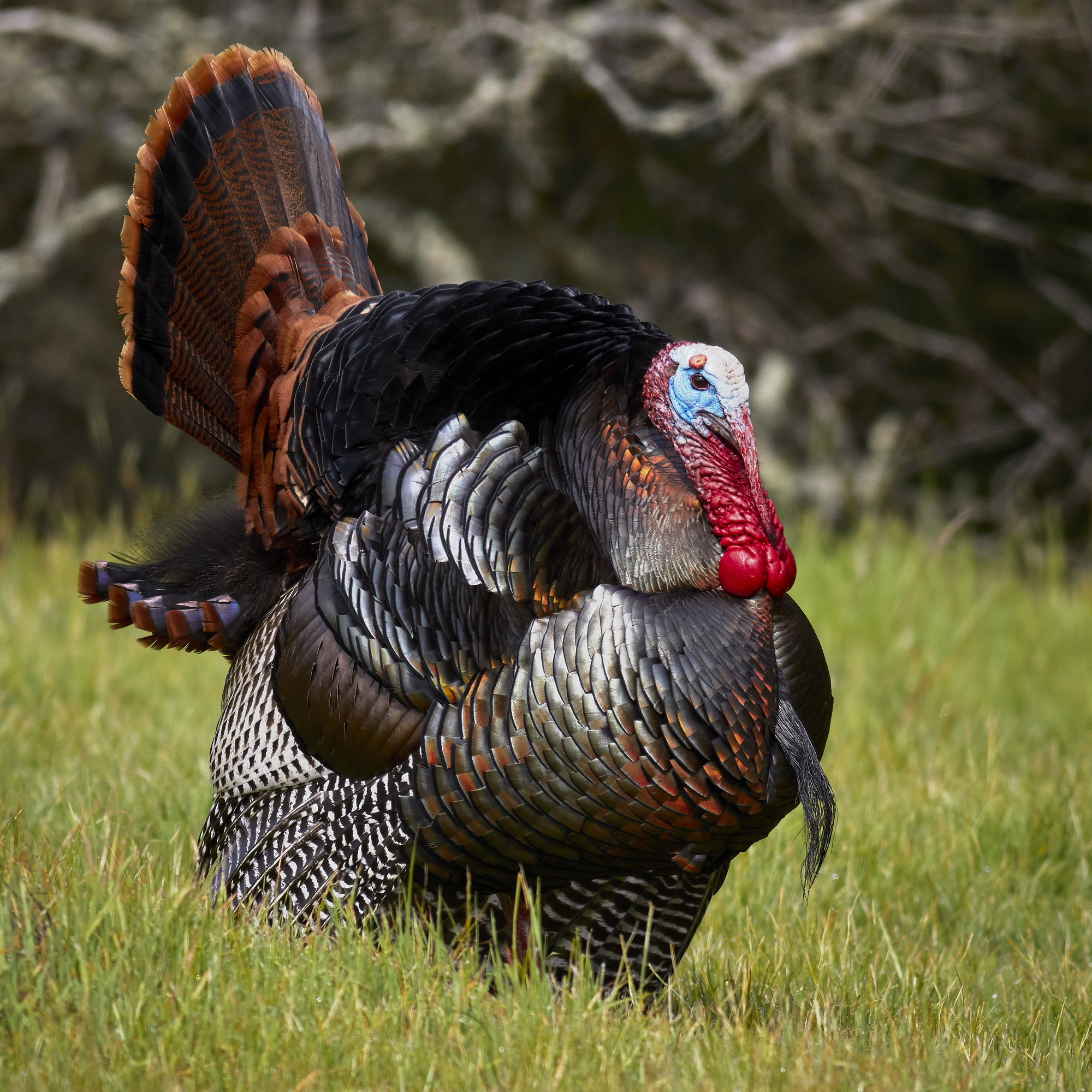
Photo Frank Schulenburg (opens in a new tab) / Wikimedia Commons, CC BY-SA 4.0 (opens in a new tab)
At a glance
- Size
- Males about 1 to 1.2 m long; females smaller
- Weight
- Males about 5 to 11 kg; females about 2.5 to 5 kg
- Habitat
- Woodland mixed with fields and clearings
- Diet
- Acorns, seeds, fruit, insects, and small animals such as lizards
- In Georgia
- Common resident statewide
- Voice
- The male's gobble; clucks, purrs and yelps
- Rabies vector
- No
Identification
- Male
- Huge, dark, bronze-iridescent body; bare blue-and-red head; a hair-like "beard" on the breast; fans a rounded tail in display
- Female
- Smaller and duller, with a greyish head
- Told apart from
- Domestic turkeys, which are usually white or heavier and cannot fly well
- Told apart from
- Black vultures on the ground, which are smaller with a bare grey head and short tail
- Where to look
- Field edges and open woods at dawn and dusk
Behaviour
Turkeys feed on the ground by day and fly up to roost in trees at night. In spring, males gobble at dawn and strut with fanned tails and puffed feathers to court females.
Females raise the young alone, and several hens and their poults often travel together in summer.
Why they matter
By the early 1900s wild turkeys had been hunted out of much of their range, with only scattered flocks left in Georgia. Protection and restocking brought them back, and today they live in every county in the state. They spread acorn and seed crops through the woods and scratch up leaf litter in ways that turn over the forest floor.
Reproduction and lifecycle
Nest — A shallow scrape on the ground, hidden in brush or tall grass
Eggs — Usually 10 to 12
Incubation — About 28 days, by the hen alone
Poults — Leave the nest within a day and feed themselves; they can fly up to low roosts at about two weeks
Family — Young stay with the hen through their first autumn
Lifespan — Usually a few years; some over ten
Living around people
- Turkeys cross roads in flocks; slowing down for the rest when one crosses saves lives.
- Mowing hayfields in May and June destroys nests; a later first cut helps.
- A turkey that sees its reflection in a car or window may peck at it; covering the reflection ends it.
Misconceptions
- Wild turkeys cannot fly. They fly well in short bursts and roost high in trees.
- A poult alone has been abandoned. Poults scatter and hide when disturbed; the hen calls them back.
Related species
Seasonal activity
When this species is breeding, and when there are nests on the ground. Mowing during the shaded months is how most nests are found.
| Jan | Feb | Mar | Apr | May | Jun | Jul | Aug | Sep | Oct | Nov | Dec | |
|---|---|---|---|---|---|---|---|---|---|---|---|---|
| Breeding | Jan: no | Feb: no | Mar: no | Apr: no | May: no | Jun: no | Jul: no | Aug: no | Sep: no | Oct: no | Nov: no | Dec: no |
| Active nests | Jan: no | Feb: no | Mar: no | Apr: no | May: no | Jun: no | Jul: no | Aug: no | Sep: no | Oct: no | Nov: no | Dec: no |
| Notes | Winter flocks | Flocks; first gobbling | Gobbling and strutting | Hens nesting | Incubating; first poults | Hens with poults | Poults growing | Broods merge | Family flocks | Flocks feeding on acorns | Winter flocks | Winter flocks |
Where it lives
Recorded in 66 states and provinces. Each one links to the other animals there, and to the rehabilitators licensed for them.
United States
- Alabama
- Arizona
- Arkansas
- California
- Colorado
- Connecticut
- Delawarebreeding
- District of Columbia
- Florida
- Georgia
- Hawaiiintroduced
- Idaho
- Illinois
- Indiana
- Iowa
- Kansas
- Kentucky
- Louisiana
- Maine
- Maryland
- Massachusetts
- Michigan
- Minnesota
- Mississippi
- Missouri
- Montana
- Nebraska
- Nevada
- New Hampshire
- New Jersey
- New Mexico
- New York
- North Carolina
- North Dakota
- Ohio
- Oklahoma
- Oregon
- Pennsylvania
- Rhode Island
- South Carolina
- South Dakota
- Tennessee
- Texas
- Utah
- Vermont
- Virginia
- Washington
- West Virginia
- Wisconsin
- Wyoming
If you found one
Answer a few questions and you will get a specific answer for what you are looking at.
I found an animal