
Species
Tundra swan
Cygnus columbianus
A big white swan of the far north that reaches Georgia only occasionally in winter.
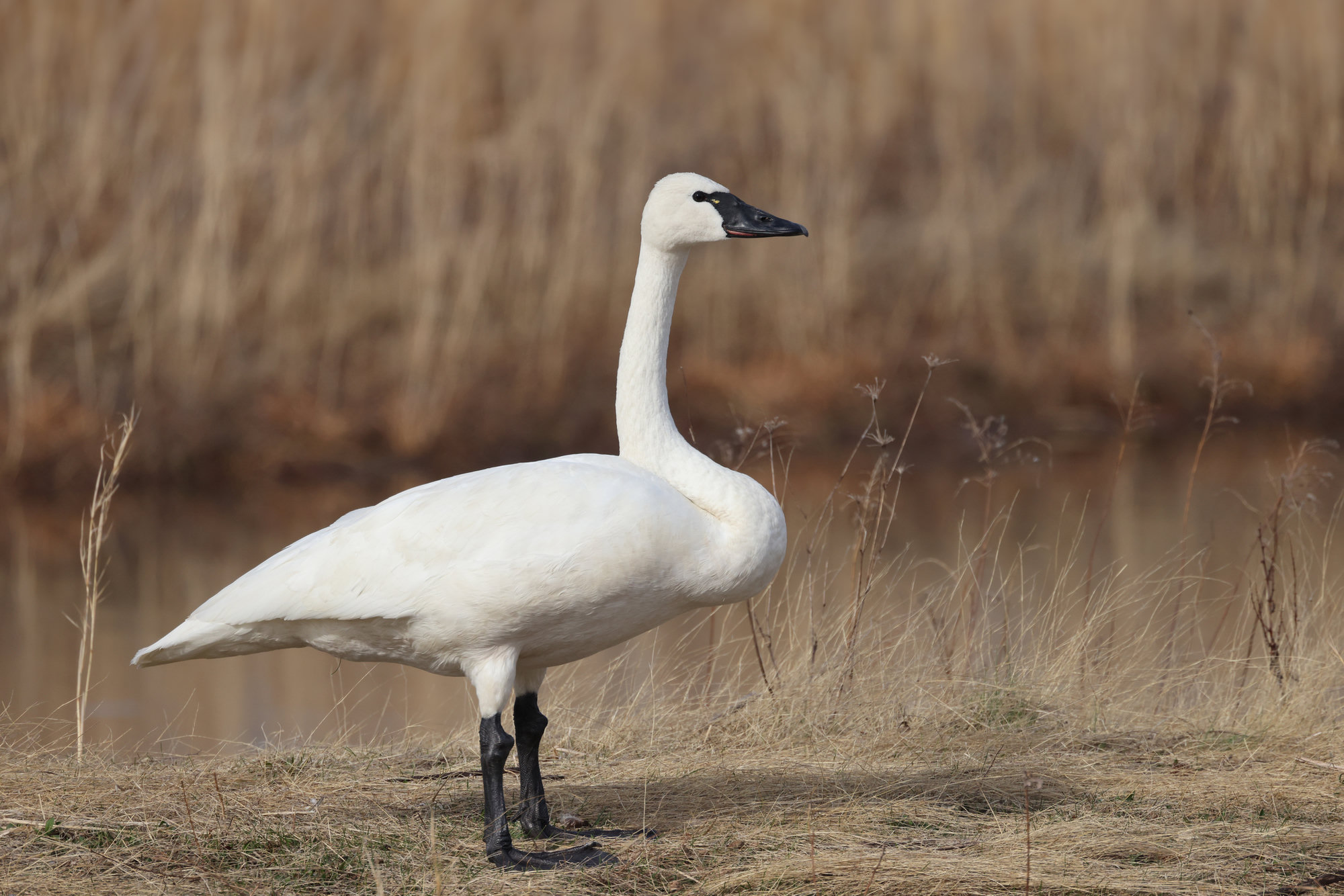
Photo Unknown photographer (opens in a new tab) / iNaturalist, CC0 1.0 (opens in a new tab)
At a glance
- Size
- About 1.2 to 1.5 m long; wingspan about 1.9 m
- Weight
- About 4 to 9 kg
- Habitat
- Lakes, reservoirs and large ponds in winter
- Diet
- Aquatic plants, roots, tubers and waste grain
- In Georgia
- A rare winter visitor, usually one or a few birds on a lake
- Voice
- A high, soft, whistling "woo-ho"
- Rabies vector
- No
Identification
- Key marks
- All white; black bill, usually with a small yellow spot in front of the eye; straight neck held upright
- Young
- Grey-brown with a pinkish bill
- Told apart from
- Mute swan, an escaped or feral bird, which has an orange bill with a black knob and often holds its neck in an S-curve
- Told apart from
- Snow goose, which is much smaller with black wingtips
- Where to look
- Large reservoirs and lakes, December to February
Behaviour
Tundra swans feed by reaching below the surface with their long necks to pull up roots and plants. They migrate in family groups, and the young stay with their parents all winter. Most of the eastern population winters on the Chesapeake Bay and in North Carolina, and Georgia birds are usually strays from those flocks.
Why they matter
Tundra swans make one of the longest migrations of any North American waterfowl, from the Arctic coast to the mid-Atlantic, stopping at the same lakes year after year. Their need for large, undisturbed wetlands along the way makes them a measure of how well that chain of wetlands is holding up.
Reproduction and lifecycle
Nest — A large mound of plants near water on the tundra
Eggs — Usually three to five
Incubation — About 31 to 40 days
Cygnets — Leave the nest soon after hatching, guarded by both parents
Flight — At about two to three months
Pairs — Usually for life
Lifespan — Wild birds over twenty years are recorded
Living around people
- A swan on a Georgia lake in winter is as likely to be a wild tundra swan as an escaped mute swan; a wild one keeps its distance.
- Swans hit power lines in poor light; a swan grounded near a road or line may be injured.
Misconceptions
- Any swan in Georgia is someone's pet. Wild tundra swans reach the state in most winters.
Related species
Seasonal activity
When this species is breeding, and when there are nests on the ground. Mowing during the shaded months is how most nests are found.
| Jan | Feb | Mar | Apr | May | Jun | Jul | Aug | Sep | Oct | Nov | Dec | |
|---|---|---|---|---|---|---|---|---|---|---|---|---|
| Breeding | Jan: no | Feb: no | Mar: no | Apr: no | May: no | Jun: no | Jul: no | Aug: no | Sep: no | Oct: no | Nov: no | Dec: no |
| Active nests | Jan: no | Feb: no | Mar: no | Apr: no | May: no | Jun: no | Jul: no | Aug: no | Sep: no | Oct: no | Nov: no | Dec: no |
| Notes | Wintering | Wintering; some start north | Migrating north | Moving north through the Great Lakes region | Nesting in the Arctic | Incubating | Cygnets hatched | Cygnets growing | Young learning to fly | Migration south begins | Arriving on the mid-Atlantic coast | A few reach Georgia |
Where it lives
Recorded in 42 states and provinces. Each one links to the other animals there, and to the rehabilitators licensed for them.
United States
- Alabamain winter
- Alaskabreeding
- Californiain winter
- Coloradoin winter
- Delawarein winter
- Georgiain winter
- Idahoin winter
- Illinoisin winter
- Indianain winter
- Iowain winter
- Marylandin winter
- Michiganin winter
- Minnesotain winter
- Missouriin winter
- Montanain winter
- Nevadain winter
- New Jerseyin winter
- New Mexicoin winter
- New Yorkin winter
- North Carolinain winter
- North Dakotapassing through
- Ohioin winter
- Oregonin winter
- Pennsylvaniain winter
- Rhode Islandin winter
- South Carolinain winter
- South Dakotain winter
- Tennesseein winter
- Utahin winter
- Virginiain winter
- Washingtonin winter
- West Virginiain winter
- Wisconsinin winter
- Wyomingin winter
If you found one
Answer a few questions and you will get a specific answer for what you are looking at.
I found an animal