
Species
Swainson's thrush
Catharus ustulatus
A spectacled brown thrush whose upward-spiralling song passes over Georgia on spring and autumn nights.
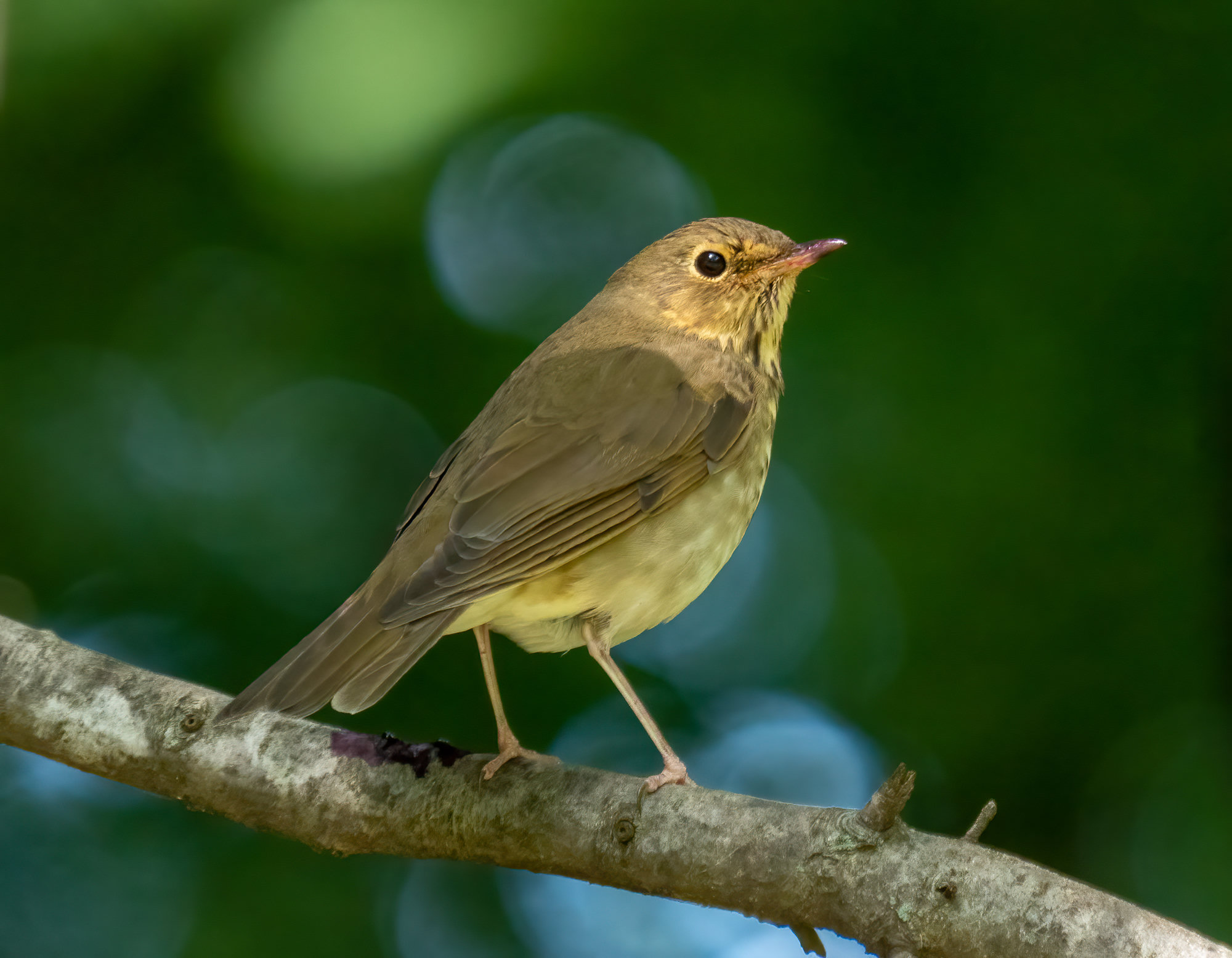
Photo Rhododendrites (opens in a new tab) / Wikimedia Commons, CC BY-SA 4.0 (opens in a new tab)
At a glance
- Size
- About 16 to 20 cm long
- Weight
- About 23 to 45 g
- Habitat
- Northern and mountain forests; any woods on migration
- Diet
- Insects and berries
- In Georgia
- A common migrant, May and September to October
- Voice
- A rising, spiralling song; a liquid "whit" call
- Rabies vector
- No
Identification
- Key marks
- Olive-brown above; buff spectacles; spotted breast
- Told apart from
- Gray-cheeked thrush, which lacks buff spectacles
- Told apart from
- Hermit thrush, which has a reddish tail
- Where to look
- Woods with berry-bearing shrubs during migration
Behaviour
Swainson's thrushes migrate at night and feed on insects and berries by day. Their night-flight calls can be heard overhead.
Why they matter
Swainson's thrushes eat many insects and spread berry seeds. They depend on stopover woods along their migration.
Reproduction and lifecycle
Nest — A cup in a shrub or small tree
Eggs — Usually three or four
Incubation — About 10 to 14 days
Chicks — Fed by both parents
Lifespan — Several years
Living around people
- Berry-bearing native shrubs feed migrating thrushes.
- Lights at night draw migrants into buildings.
Misconceptions
- Spotted brown thrushes are all wood thrushes. Several species pass through Georgia.
Related species
Seasonal activity
When this species is breeding, and when there are nests on the ground. Mowing during the shaded months is how most nests are found.
| Jan | Feb | Mar | Apr | May | Jun | Jul | Aug | Sep | Oct | Nov | Dec | |
|---|---|---|---|---|---|---|---|---|---|---|---|---|
| Breeding | Jan: no | Feb: no | Mar: no | Apr: no | May: no | Jun: no | Jul: no | Aug: no | Sep: no | Oct: no | Nov: no | Dec: no |
| Active nests | Jan: no | Feb: no | Mar: no | Apr: no | May: no | Jun: no | Jul: no | Aug: no | Sep: no | Oct: no | Nov: no | Dec: no |
| Notes | In South America | In South America | In South America | Migrating north | Migrants in Georgia | Nesting in the north | Nesting | Migrating south | Migrants | Migrants | In South America | In South America |
Where it lives
Recorded in 78 states and provinces. Each one links to the other animals there, and to the rehabilitators licensed for them.
United States
- Alabamapassing through
- Alaskabreeding
- Arizonapassing through
- Arkansaspassing through
- Californiabreeding
- Coloradobreeding
- Connecticutpassing through
- Delawarepassing through
- District of Columbiapassing through
- Floridapassing through
- Georgiapassing through
- Idahobreeding
- Illinoispassing through
- Indianapassing through
- Iowapassing through
- Kansaspassing through
- Kentuckypassing through
- Louisianapassing through
- Mainebreeding
- Marylandpassing through
- Massachusettsbreeding
- Michiganbreeding
- Minnesotabreeding
- Mississippipassing through
- Missouripassing through
- Montanabreeding
- Nebraskapassing through
- Nevadabreeding
- New Hampshirebreeding
- New Jerseypassing through
- New Mexicobreeding
- New Yorkbreeding
- North Carolinapassing through
- North Dakotapassing through
- Ohiopassing through
- Oklahomapassing through
- Oregonbreeding
- Pennsylvaniapassing through
- Rhode Islandpassing through
- South Carolinapassing through
- South Dakotabreeding
- Tennesseepassing through
- Texaspassing through
- Utahbreeding
- Vermontbreeding
- Virginiapassing through
- Washingtonbreeding
- West Virginiabreeding
- Wisconsinpassing through
- Wyomingbreeding
Canada
If you found one
Answer a few questions and you will get a specific answer for what you are looking at.
I found an animal