
Species
Summer tanager
Piranga rubra
An all-red tanager that catches bees and wasps, beats them on branches and eats them in Georgia's pine-oak woods.
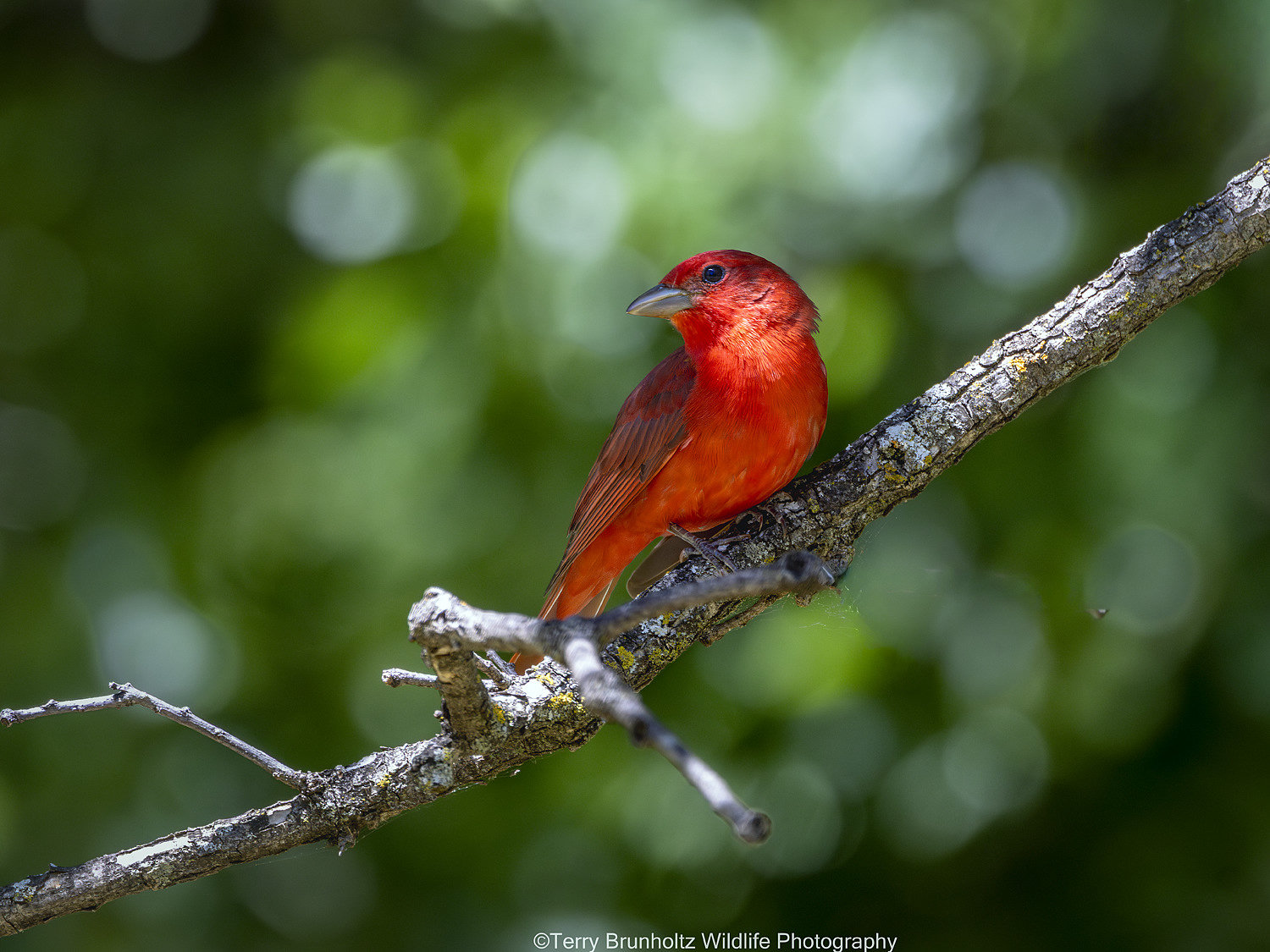
Photo Unknown photographer (opens in a new tab) / iNaturalist, CC0 1.0 (opens in a new tab)
At a glance
- Size
- About 17 to 19 cm long
- Weight
- About 25 to 40 g
- Habitat
- Open pine-oak woods, woodland edges and yards with tall trees
- Diet
- Bees, wasps and other insects; fruit
- In Georgia
- A common summer resident, April to October
- Voice
- A robin-like song; a "pik-i-tuk" call
- Rabies vector
- No
Identification
- Male
- Entirely rose-red
- Female
- Mustard-yellow
- Told apart from
- Northern cardinal, which has a crest and black face
- Told apart from
- Scarlet tanager, whose male has black wings
- Where to look
- Tall trees in open woods
Behaviour
Summer tanagers catch bees and wasps in flight, then beat them against branches to remove the sting before eating them.
Why they matter
Summer tanagers are specialists in eating bees and wasps. They are the only entirely red bird in North America.
Reproduction and lifecycle
Nest — A cup in a tree
Eggs — Usually three or four
Incubation — About 11 to 12 days
Chicks — Fed by both parents
Lifespan — Several years
Living around people
- Tall trees in yards and woods support them.
Misconceptions
- All red birds are cardinals. The summer tanager is red all over with no crest.
Related species
Seasonal activity
When this species is breeding, and when there are nests on the ground. Mowing during the shaded months is how most nests are found.
| Jan | Feb | Mar | Apr | May | Jun | Jul | Aug | Sep | Oct | Nov | Dec | |
|---|---|---|---|---|---|---|---|---|---|---|---|---|
| Breeding | Jan: no | Feb: no | Mar: no | Apr: no | May: no | Jun: no | Jul: no | Aug: no | Sep: no | Oct: no | Nov: no | Dec: no |
| Active nests | Jan: no | Feb: no | Mar: no | Apr: no | May: no | Jun: no | Jul: no | Aug: no | Sep: no | Oct: no | Nov: no | Dec: no |
| Notes | In South America | In South America | In South America | Arriving | Nesting | Nesting | Young fledging | Present | Leaving | Last birds | In South America | In South America |
Where it lives
Recorded in 61 states and provinces. Each one links to the other animals there, and to the rehabilitators licensed for them.
United States
- Alabamabreeding
- Arizonabreeding
- Arkansasbreeding
- California
- Delawarebreeding
- Florida
- Georgiabreeding
- Illinoisbreeding
- Indianabreeding
- Iowabreeding
- Kansasbreeding
- Kentuckybreeding
- Louisianabreeding
- Marylandbreeding
- Minnesotabreeding
- Mississippibreeding
- Missouribreeding
- Nebraskabreeding
- Nevadabreeding
- New Jerseybreeding
- New Mexicobreeding
- North Carolinabreeding
- Ohiobreeding
- Oklahomabreeding
- South Carolinabreeding
- Tennesseebreeding
- Texasbreeding
- Utahbreeding
- Virginiabreeding
- West Virginiabreeding
Mexico
- Aguascalientesin winter
- Baja Californiain winter
- Baja California Surin winter
- Campechein winter
- Chiapasin winter
- Chihuahuabreeding
- Coahuilabreeding
- Colimain winter
- Durango
- Guanajuatoin winter
- Guerreroin winter
- Hidalgoin winter
- Jaliscoin winter
- Mexico Cityin winter
- Michoacanin winter
- Morelosin winter
- Nayaritin winter
- Nuevo Leon
- Oaxacain winter
- Pueblain winter
- Queretaroin winter
- Quintana Rooin winter
- San Luis Potosiin winter
- Sinaloain winter
- Sonora
- State of Mexicoin winter
- Tabascoin winter
- Tamaulipasin winter
- Tlaxcalain winter
- Veracruzin winter
- Yucatanin winter
If you found one
Answer a few questions and you will get a specific answer for what you are looking at.
I found an animal