
Species
Scarlet tanager
Piranga olivacea
A brilliant red tanager with black wings, singing high in the canopy of mature forests.
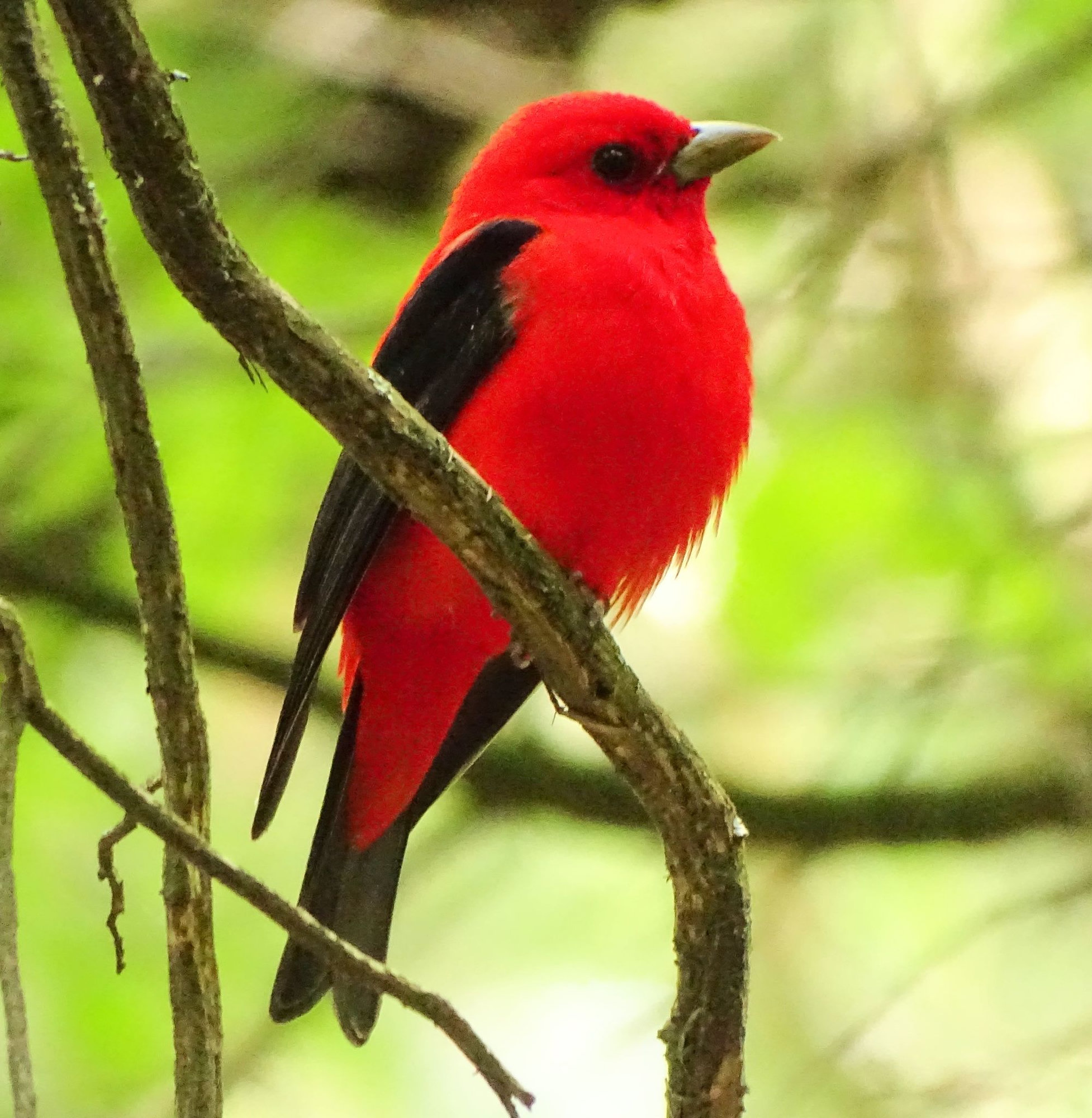
Photo Shirley Zundell (opens in a new tab) / iNaturalist, CC BY 4.0 (opens in a new tab)
At a glance
- Size
- About 16 to 17 cm long
- Weight
- About 23 to 38 g
- Habitat
- Mature deciduous forests
- Diet
- Insects and fruit
- In Georgia
- A summer resident in the north; a migrant elsewhere
- Voice
- A hoarse, robin-like song; a "chip-burr" call
- Rabies vector
- No
Identification
- Male
- Brilliant red with black wings and tail
- Female
- Olive-yellow with darker wings
- Told apart from
- Summer tanager, which is red all over
- Where to look
- The canopy of mature forests in north Georgia
Behaviour
Scarlet tanagers forage high in the canopy and are often hard to see despite their colour.
Why they matter
Scarlet tanagers need large forests to nest successfully. They are a sign of healthy, unbroken woodland.
Reproduction and lifecycle
Nest — A shallow cup high in a tree
Eggs — Usually four
Incubation — About 12 to 14 days
Chicks — Fed by both parents
Lifespan — Several years
Living around people
- Large forest blocks protect nesting tanagers.
Misconceptions
- Bright birds are easy to see. Scarlet tanagers are often hidden in the canopy.
Related species
Seasonal activity
When this species is breeding, and when there are nests on the ground. Mowing during the shaded months is how most nests are found.
| Jan | Feb | Mar | Apr | May | Jun | Jul | Aug | Sep | Oct | Nov | Dec | |
|---|---|---|---|---|---|---|---|---|---|---|---|---|
| Breeding | Jan: no | Feb: no | Mar: no | Apr: no | May: no | Jun: no | Jul: no | Aug: no | Sep: no | Oct: no | Nov: no | Dec: no |
| Active nests | Jan: no | Feb: no | Mar: no | Apr: no | May: no | Jun: no | Jul: no | Aug: no | Sep: no | Oct: no | Nov: no | Dec: no |
| Notes | In South America | In South America | In South America | Arriving | Nesting | Nesting | Young fledging | Present | Migrating | Last migrants | In South America | In South America |
Where it lives
Recorded in 46 states and provinces. Each one links to the other animals there, and to the rehabilitators licensed for them.
United States
- Alabamabreeding
- Arkansasbreeding
- Connecticutbreeding
- Delawarebreeding
- District of Columbiabreeding
- Floridapassing through
- Georgiabreeding
- Illinoisbreeding
- Indianabreeding
- Iowabreeding
- Kansasbreeding
- Kentuckybreeding
- Louisianapassing through
- Mainebreeding
- Marylandbreeding
- Massachusettsbreeding
- Michiganbreeding
- Minnesotabreeding
- Mississippibreeding
- Missouribreeding
- Nebraskabreeding
- New Hampshirebreeding
- New Jerseybreeding
- New Yorkbreeding
- North Carolinabreeding
- North Dakotabreeding
- Ohiobreeding
- Oklahomabreeding
- Pennsylvaniabreeding
- Rhode Islandbreeding
- South Carolinabreeding
- South Dakotabreeding
- Tennesseebreeding
- Texaspassing through
- Vermontbreeding
- Virginiabreeding
- West Virginiabreeding
- Wisconsinbreeding
If you found one
Answer a few questions and you will get a specific answer for what you are looking at.
I found an animal