
Species
Northern cardinal
Cardinalis cardinalis
The bright red, crested songbird of every Georgia yard, singing year-round and feeding its mate in courtship.
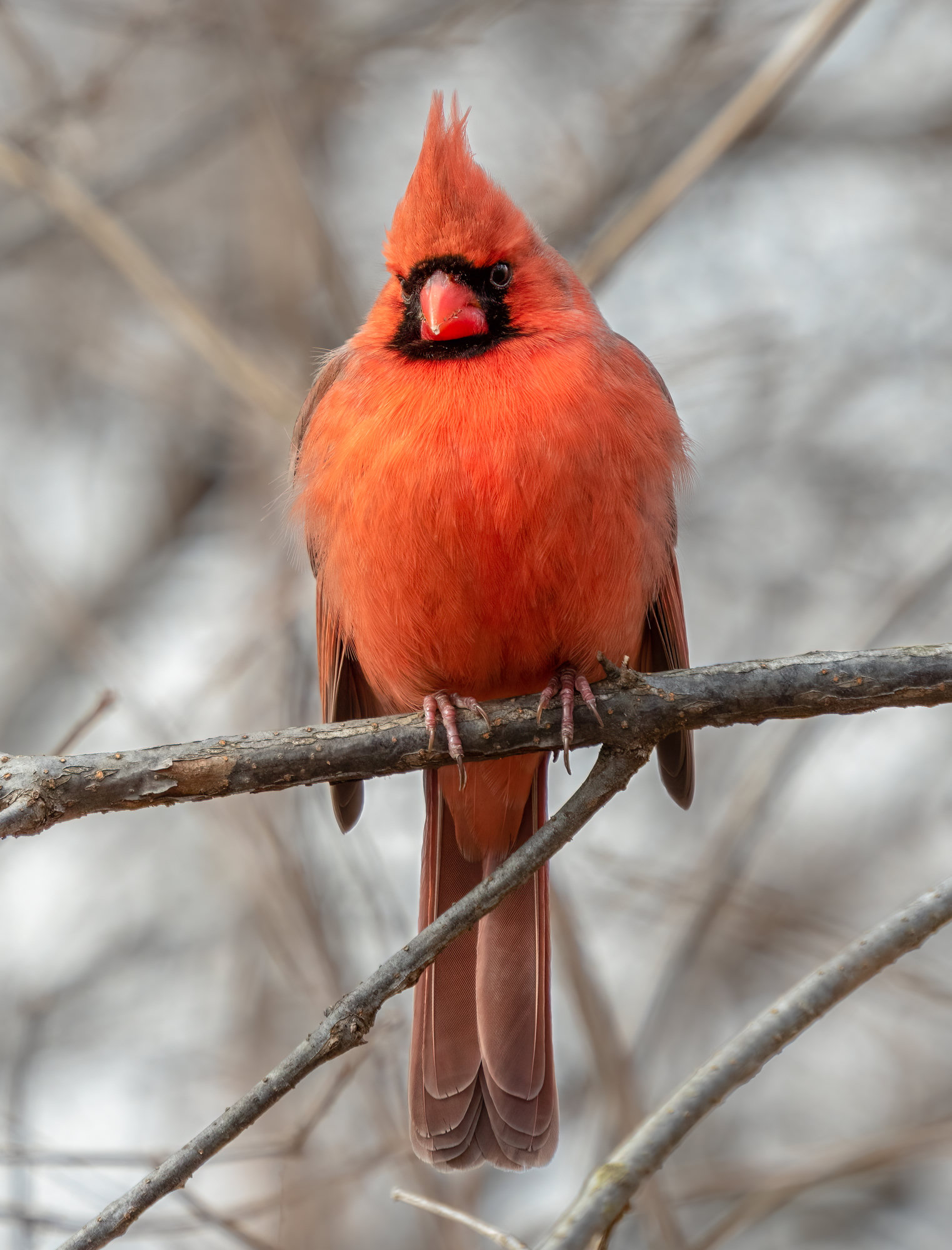
Photo Rhododendrites (opens in a new tab) / Wikimedia Commons, CC BY-SA 4.0 (opens in a new tab)
At a glance
- Size
- About 21 to 23 cm long
- Weight
- About 42 to 48 g
- Habitat
- Woodland edges, thickets, suburbs and gardens
- Diet
- Seeds, fruit and insects
- In Georgia
- Abundant resident statewide
- Voice
- Loud whistles "cheer-cheer-cheer" and "birdie-birdie-birdie"; a sharp "chip"
- Rabies vector
- No
Identification
- Male
- Bright red with a crest and black face
- Female
- Warm brown with red tinges and a red bill
- Told apart from
- Summer tanager, which has no crest or black face
- Where to look
- Almost any yard or thicket
Behaviour
Cardinals are territorial and males attack their reflections in windows and mirrors. In courtship, males feed seeds to females beak to beak. Both sexes sing.
Why they matter
The northern cardinal is the state bird of seven US states. Its spread north over the last century, helped by suburban shrubs and feeders, shows how birds respond to landscapes people create.
Reproduction and lifecycle
Nest — A cup in a dense shrub or tangle
Eggs — Usually three or four
Incubation — About 11 to 13 days
Chicks — Fed by both parents
Flight — At about 9 to 11 days
Lifespan — A few years; wild birds over fifteen years are recorded
Living around people
- A cardinal attacking a window is fighting its reflection; covering the outside of the window stops it.
- Dense shrubs in gardens give them nest sites.
Misconceptions
- A cardinal at the window is trying to get in or bringing a message. It is defending its territory against its reflection.
Related species
Seasonal activity
When this species is breeding, and when there are nests on the ground. Mowing during the shaded months is how most nests are found.
| Jan | Feb | Mar | Apr | May | Jun | Jul | Aug | Sep | Oct | Nov | Dec | |
|---|---|---|---|---|---|---|---|---|---|---|---|---|
| Breeding | Jan: no | Feb: no | Mar: no | Apr: no | May: no | Jun: no | Jul: no | Aug: no | Sep: no | Oct: no | Nov: no | Dec: no |
| Active nests | Jan: no | Feb: no | Mar: no | Apr: no | May: no | Jun: no | Jul: no | Aug: no | Sep: no | Oct: no | Nov: no | Dec: no |
| Notes | Pairs | Singing | Nesting | Nesting | Chicks | Second broods | Third broods | Young fledging | Present | Flocks forming | Flocks | Flocks |
Where it lives
Recorded in 69 states and provinces. Each one links to the other animals there, and to the rehabilitators licensed for them.
United States
- Alabama
- Arizona
- Arkansas
- Colorado
- Connecticut
- Delaware
- District of Columbia
- Florida
- Georgia
- Hawaiiintroduced
- Illinois
- Indiana
- Iowa
- Kansas
- Kentucky
- Louisiana
- Maine
- Maryland
- Massachusetts
- Michigan
- Minnesota
- Mississippi
- Missouri
- Nebraska
- New Hampshire
- New Jersey
- New Mexico
- New York
- North Carolina
- North Dakota
- Ohio
- Oklahoma
- Pennsylvania
- Rhode Island
- South Carolina
- South Dakota
- Tennessee
- Texas
- Vermont
- Virginia
- West Virginia
- Wisconsin
If you found one
Answer a few questions and you will get a specific answer for what you are looking at.
I found an animal