
Species
Sandhill crane
Antigone canadensis
A tall grey crane whose rattling, trumpeting calls announce the great flocks passing over Georgia each autumn and spring.
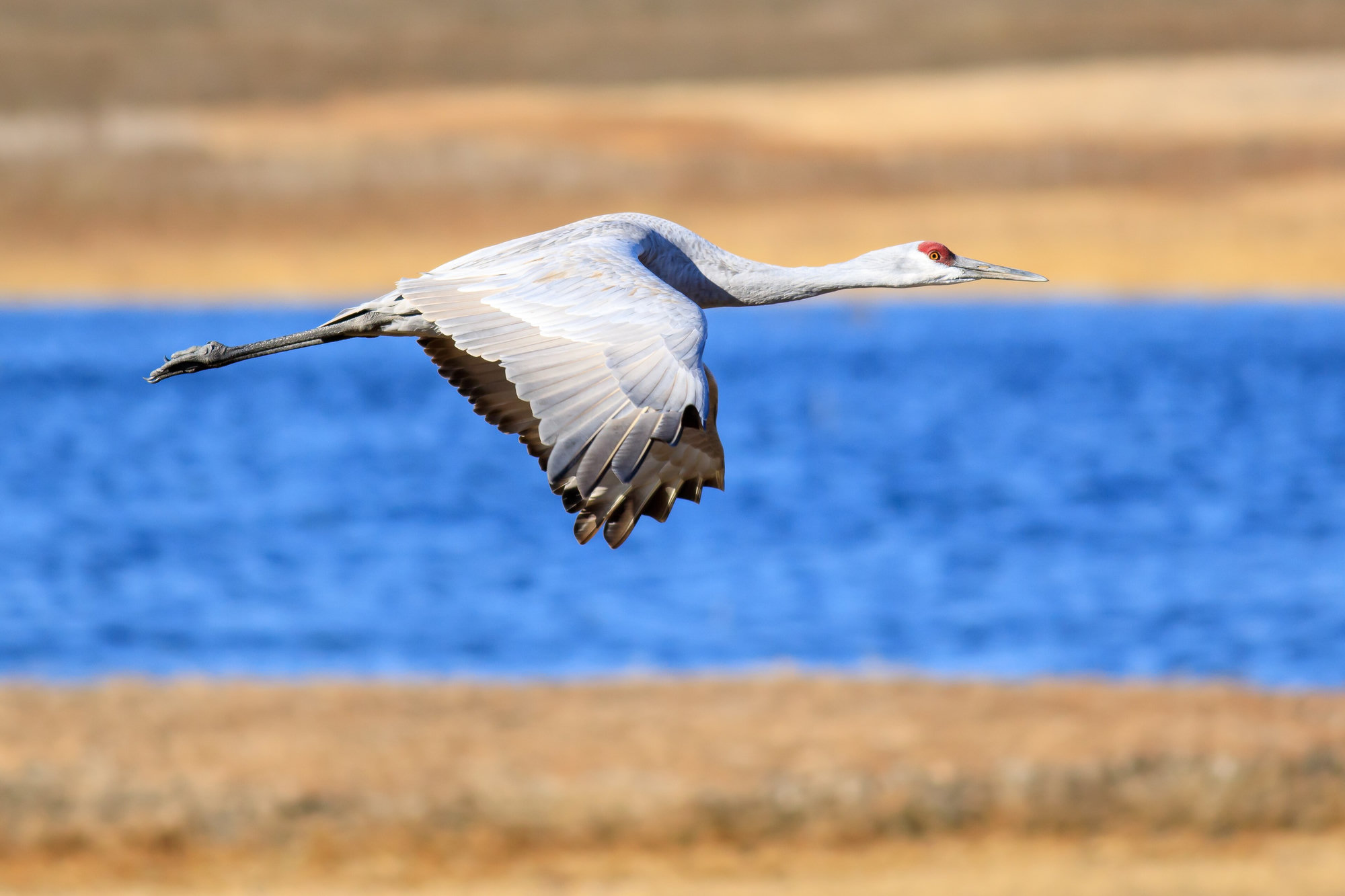
Photo Frank Schulenburg (opens in a new tab) / Wikimedia Commons, CC BY-SA 4.0 (opens in a new tab)
At a glance
- Size
- About 1 to 1.2 m tall; wingspan about 1.7 to 2.1 m
- Weight
- About 3 to 5 kg
- Habitat
- Wet prairies, fields, marshes and farmland
- Diet
- Grain, roots, tubers, insects, snails and small animals
- In Georgia
- A common migrant; winters in the south, especially in and around the Okefenokee
- Voice
- A loud, rolling, trumpeting "garoo-oo-oo", audible from far away
- Rabies vector
- No
Identification
- Key marks
- Tall, grey body; long neck and legs; bright red crown; white cheeks; bustle of feathers over the tail
- Told apart from
- Great blue heron, which flies with its neck folded and has no red crown
- Told apart from
- Whooping crane, a very rare visitor, which is white with black wingtips
- Where to look
- High, rattling flocks overhead in November and February; fields and wet prairies in the south
Behaviour
Sandhill cranes migrate in large flocks, riding thermals high overhead. Pairs stay together for years and perform leaping, wing-flapping dances.
A resident, non-migratory population, the Florida sandhill crane, nests in the Okefenokee Swamp.
Why they matter
The sandhill is one of the oldest bird species known from fossils; bones very like its own are more than two million years old. Their migration over Georgia is one of the great natural sights of the state, and the Okefenokee's resident cranes depend on the swamp's open prairies.
Reproduction and lifecycle
Nest — A mound of plants in shallow water or marsh
Eggs — Usually two
Incubation — About 29 to 32 days
Colts — Chicks leave the nest within a day and follow their parents
Flight — At about two to two-and-a-half months
Family — Young stay with parents for nearly a year
Lifespan — Often twenty years or more
Living around people
- Collisions with power lines kill many cranes during migration.
- Cranes in fields are feeding and resting; they need space and quiet.
Misconceptions
- Any big grey bird is a heron. Sandhill cranes fly with their necks outstretched, while herons fold theirs.
- They are whooping cranes. Whooping cranes are white and very rare.
Related species
Seasonal activity
When this species is breeding, and when there are nests on the ground. Mowing during the shaded months is how most nests are found.
| Jan | Feb | Mar | Apr | May | Jun | Jul | Aug | Sep | Oct | Nov | Dec | |
|---|---|---|---|---|---|---|---|---|---|---|---|---|
| Breeding | Jan: no | Feb: no | Mar: no | Apr: no | May: no | Jun: no | Jul: no | Aug: no | Sep: no | Oct: no | Nov: no | Dec: no |
| Active nests | Jan: no | Feb: no | Mar: no | Apr: no | May: no | Jun: no | Jul: no | Aug: no | Sep: no | Oct: no | Nov: no | Dec: no |
| Notes | Wintering in south Georgia | Migration north begins | Flocks passing north | Resident birds nesting in the Okefenokee | Chicks with parents | Chicks | Young growing | Young flying | Resident families | Migrants start arriving | Peak migration south | Wintering |
Where it lives
Recorded in 55 states and provinces. Each one links to the other animals there, and to the rehabilitators licensed for them.
United States
- Alabamain winter
- Alaskabreeding
- Arizonain winter
- California
- Colorado
- Connecticut
- Delaware
- Florida
- Georgia
- Idahobreeding
- Illinois
- Indianain winter
- Iowabreeding
- Kansasin winter
- Kentuckyin winter
- Louisianain winter
- Mainebreeding
- Massachusetts
- Michigan
- Minnesotabreeding
- Mississippi
- Missouri
- Montanabreeding
- Nebraskapassing through
- Nevadabreeding
- New Hampshire
- New Mexicoin winter
- New Yorkbreeding
- North Dakotapassing through
- Ohio
- Oklahomain winter
- Oregon
- Pennsylvania
- South Dakotapassing through
- Tennesseein winter
- Texasin winter
- Utahbreeding
- Washingtonin winter
- Wisconsinbreeding
- Wyomingbreeding
Canada
If you found one
Answer a few questions and you will get a specific answer for what you are looking at.
I found an animal