
Species
Rusty blackbird
Euphagus carolinus
A declining blackbird of wooded swamps whose feathers turn rusty in winter.
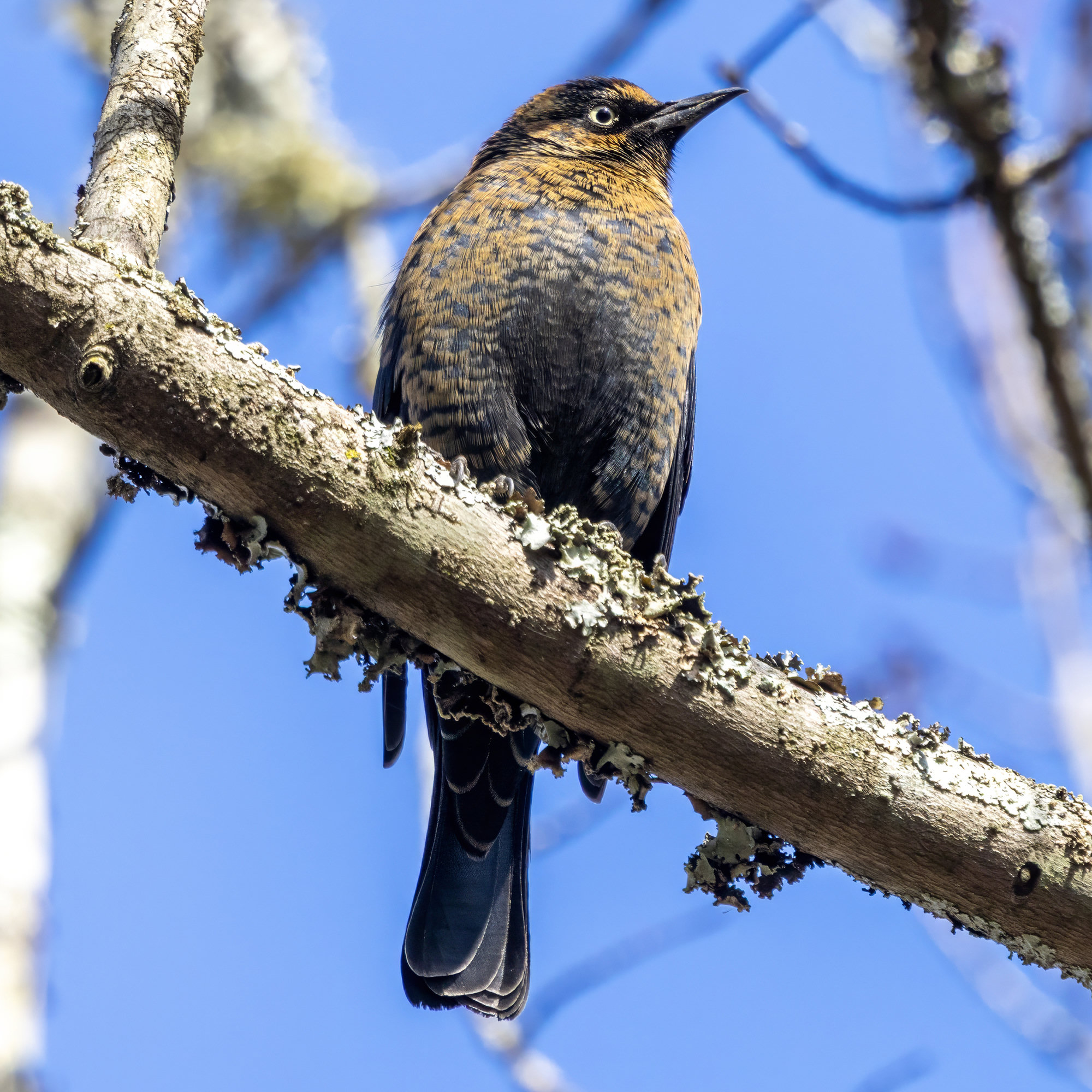
Photo Dan Vickers (opens in a new tab) / iNaturalist, CC BY 4.0 (opens in a new tab)
At a glance
- Size
- About 21 to 25 cm long
- Weight
- About 47 to 80 g
- Habitat
- Wooded swamps, flooded forests and wet fields in winter
- Diet
- Aquatic insects, snails, seeds and acorns
- In Georgia
- An uncommon winter visitor
- Voice
- A creaky, gate-hinge song
- Rabies vector
- No
Identification
- Key marks
- In winter, rusty-edged feathers on a black or grey body; pale yellow eye
- Told apart from
- Brewer's blackbird, which lacks rusty edges and has a dark eye in females
- Where to look
- Wooded swamps and wet woods in winter
Behaviour
Rusty blackbirds wade in shallow water in flooded forests, flipping leaves for insects.
Why they matter
The rusty blackbird has declined by about 90 per cent since the 1960s, one of the steepest declines of any North American songbird. The loss of wooded wetlands in both its breeding and wintering ranges is suspected.
Reproduction and lifecycle
Nest — A bulky cup in a conifer near water
Eggs — Usually four or five
Incubation — About 14 days
Chicks — Fed by both parents
Lifespan — Several years
Living around people
- Wooded swamps and bottomland forests are their winter habitat.
Misconceptions
- Blackbirds are always common. The rusty blackbird is one of the fastest-declining songbirds in North America.
Related species
Seasonal activity
When this species is breeding, and when there are nests on the ground. Mowing during the shaded months is how most nests are found.
| Jan | Feb | Mar | Apr | May | Jun | Jul | Aug | Sep | Oct | Nov | Dec | |
|---|---|---|---|---|---|---|---|---|---|---|---|---|
| Breeding | Jan: no | Feb: no | Mar: no | Apr: no | May: no | Jun: no | Jul: no | Aug: no | Sep: no | Oct: no | Nov: no | Dec: no |
| Active nests | Jan: no | Feb: no | Mar: no | Apr: no | May: no | Jun: no | Jul: no | Aug: no | Sep: no | Oct: no | Nov: no | Dec: no |
| Notes | Wintering | Wintering | Leaving | Migrating north | Nesting in boreal wetlands | Nesting | Young fledging | Present in the north | Migrating | Migrating | Arriving | Wintering |
Where it lives
Recorded in 55 states and provinces. Each one links to the other animals there, and to the rehabilitators licensed for them.
United States
- Alabamain winter
- Alaska
- Arkansasin winter
- Coloradoin winter
- Connecticutin winter
- Delawarein winter
- District of Columbiain winter
- Georgiain winter
- Illinoisin winter
- Indianain winter
- Iowain winter
- Kansasin winter
- Kentuckyin winter
- Louisianain winter
- Maine
- Marylandin winter
- Massachusettsin winter
- Michiganpassing through
- Minnesotain winter
- Mississippiin winter
- Missouriin winter
- Montanain winter
- Nebraskain winter
- New Hampshire
- New Jerseyin winter
- New Mexicoin winter
- New Yorkin winter
- North Carolinain winter
- North Dakotain winter
- Ohioin winter
- Oklahomain winter
- Pennsylvaniain winter
- Rhode Islandin winter
- South Carolinain winter
- South Dakotain winter
- Tennesseein winter
- Texasin winter
- Vermontin winter
- Virginiain winter
- West Virginiain winter
- Wisconsinpassing through
- Wyomingin winter
If you found one
Answer a few questions and you will get a specific answer for what you are looking at.
I found an animal