
Species
Red knot
Calidris canutus
A plump sandpiper that flies from the Arctic to South America and back each year, refuelling on Georgia's beaches.
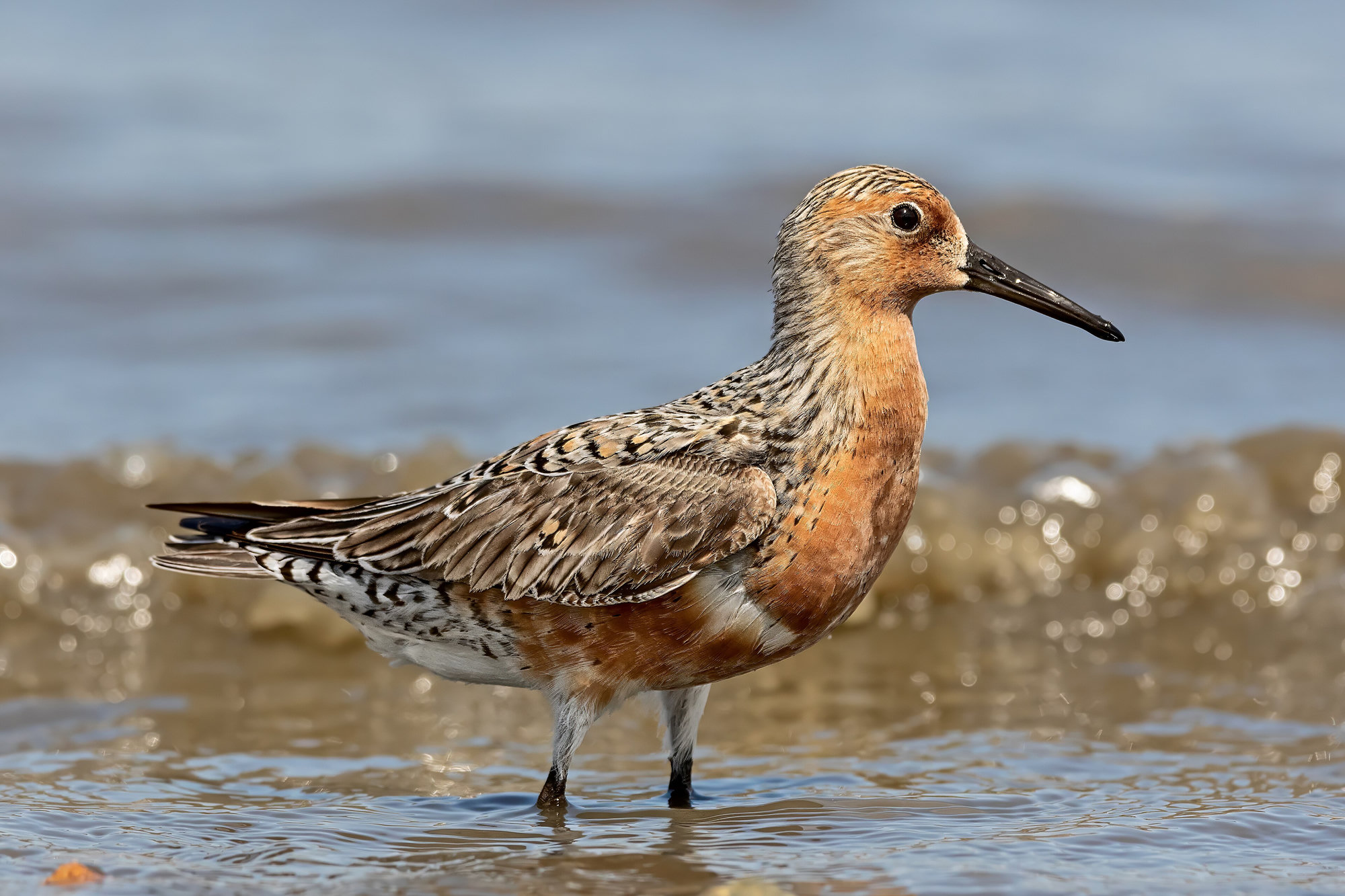
Photo Chuck Homler d/b/a Focus On Wildlife (opens in a new tab) / Wikimedia Commons, CC BY-SA 4.0 (opens in a new tab)
At a glance
- Size
- About 23 to 26 cm long
- Weight
- About 100 to 200 g
- Habitat
- Beaches, sandflats and mudflats
- Diet
- Small clams, mussels, crustaceans and horseshoe crab eggs
- In Georgia
- An uncommon to locally common migrant; some winter on the coast
- Voice
- A soft "knut"
- Rabies vector
- No
Identification
- Key marks
- Stocky; medium straight bill; in spring rich salmon-red face and breast; in winter plain grey with pale belly
- Told apart from
- Short-billed dowitcher, which has a much longer bill
- Told apart from
- Sanderling, which is smaller and whiter in winter
- Where to look
- Sandflats and beaches near inlets, April to May and August to October
Behaviour
Red knots feed by probing sand and mud and swallow small clams whole, crushing them in their muscular gizzards. Before long flights, their gizzards and flight muscles change size, remodelling their bodies for the journey.
Why they matter
The rufa red knot is federally listed as threatened after steep declines. Some birds fly more than 15,000 km each way between Tierra del Fuego and the Arctic, and Georgia's barrier islands are important stopovers, where they feed on clams and horseshoe crab eggs.
Reproduction and lifecycle
Nest — A scrape on Arctic tundra
Eggs — Usually four
Incubation — About 21 to 23 days
Chicks — Leave the nest within a day
Flight — At about 18 days
Lifespan — Wild birds over twenty years are recorded
Living around people
- Knots resting on beaches at high tide need every calorie for their journey; walking around flocks, and keeping dogs on lead, helps.
- Harvesting horseshoe crabs removes food knots depend on in spring.
Misconceptions
- Shorebirds can always find somewhere else to rest. Suitable high-tide roosts are few, and losing them costs knots dearly.
Related species
Seasonal activity
When this species is breeding, and when there are nests on the ground. Mowing during the shaded months is how most nests are found.
| Jan | Feb | Mar | Apr | May | Jun | Jul | Aug | Sep | Oct | Nov | Dec | |
|---|---|---|---|---|---|---|---|---|---|---|---|---|
| Breeding | Jan: no | Feb: no | Mar: no | Apr: no | May: no | Jun: no | Jul: no | Aug: no | Sep: no | Oct: no | Nov: no | Dec: no |
| Active nests | Jan: no | Feb: no | Mar: no | Apr: no | May: no | Jun: no | Jul: no | Aug: no | Sep: no | Oct: no | Nov: no | Dec: no |
| Notes | A few wintering | A few wintering | Wintering birds present | Migrants arriving | Peak migration; fattening on the beaches | Nesting in the Arctic | Adults leaving | Migrants arriving | Migrants | Migrants | A few wintering | A few wintering |
Where it lives
Recorded in 57 states and provinces. Each one links to the other animals there, and to the rehabilitators licensed for them.
United States
- Alabamain winter
- Alaskabreeding
- Californiain winter
- Connecticutpassing through
- Delawarepassing through
- Floridain winter
- Georgiain winter
- Illinoispassing through
- Indianapassing through
- Louisianain winter
- Mainepassing through
- Marylandin winter
- Massachusettspassing through
- Michiganpassing through
- Minnesotapassing through
- Mississippipassing through
- Nevadapassing through
- New Hampshirepassing through
- New Jerseyin winter
- New Yorkin winter
- North Carolinain winter
- North Dakotapassing through
- Ohiopassing through
- Oregonpassing through
- Rhode Islandpassing through
- South Carolinain winter
- Texasin winter
- Utahpassing through
- Vermontpassing through
- Virginiain winter
- Washingtonpassing through
- Wisconsinpassing through
Canada
- Albertapassing through
- British Columbia
- Manitobabreeding
- New Brunswickpassing through
- Newfoundland and Labradorpassing through
- Northwest Territoriesbreeding
- Nova Scotiain winter
- Nunavutbreeding
- Ontariopassing through
- Prince Edward Islandpassing through
- Quebecpassing through
- Saskatchewanpassing through
- Yukonpassing through
If you found one
Answer a few questions and you will get a specific answer for what you are looking at.
I found an animal