
Species
Ruddy turnstone
Arenaria interpres
A stocky, harlequin-patterned shorebird that flips stones and seaweed to find food on Georgia's jetties.
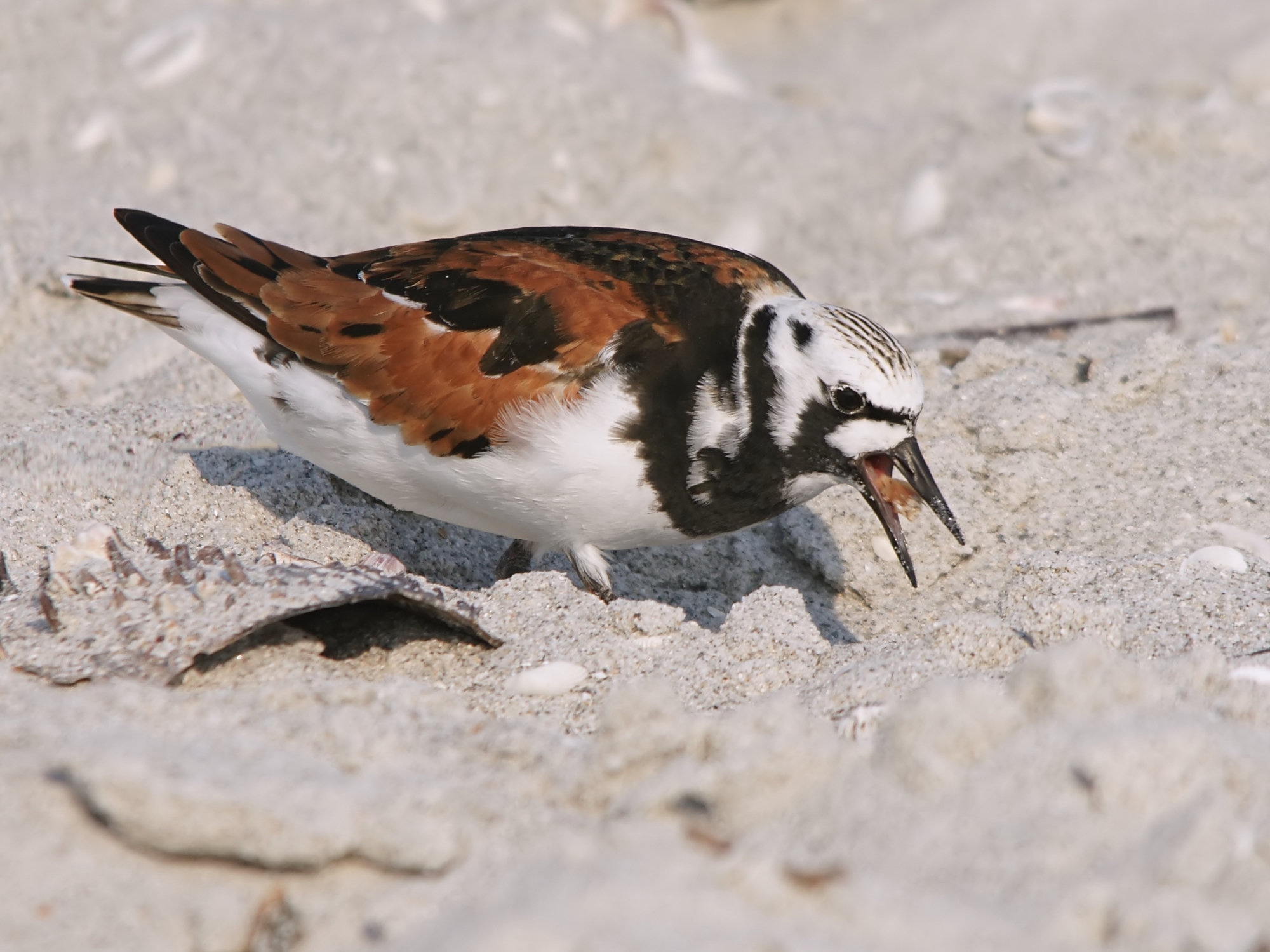
Photo ( Hans Hillewaert ) (opens in a new tab) / Wikimedia Commons, CC BY-SA 3.0 (opens in a new tab)
At a glance
- Size
- About 22 to 25 cm long
- Weight
- About 85 to 190 g
- Habitat
- Rocky jetties, beaches, mudflats and piers
- Diet
- Crabs, insects, barnacles, worms and eggs of horseshoe crabs
- In Georgia
- A common migrant and winter visitor on the coast
- Voice
- A low, rattling "kut-a-kut"
- Rabies vector
- No
Identification
- Key marks
- Short, slightly upturned bill; orange legs; bold black-and-white face and breast pattern; rusty back in summer
- Told apart from
- Sanderling, which is paler and runs along the surf
- Where to look
- Rock jetties, groins and piers
Behaviour
Turnstones flip over stones, shells and seaweed with their bills to find the animals underneath. They are bold and often feed near people on piers.
Why they matter
Ruddy turnstones breed in the high Arctic and winter on coasts worldwide. In spring, many rely on horseshoe crab eggs in Delaware Bay to fuel their journey north, linking their survival to the health of horseshoe crab populations.
Reproduction and lifecycle
Nest — A scrape on tundra
Eggs — Usually four
Incubation — About 22 to 24 days
Chicks — Leave the nest within a day
Flight — At about 19 to 21 days
Lifespan — Wild birds over nineteen years are recorded
Living around people
- Turnstones feed near anglers on piers and are sometimes tangled in discarded line or hooked on bait.
Misconceptions
- Shorebirds on piers are begging. Turnstones are foraging among the debris and barnacles.
Related species
Seasonal activity
When this species is breeding, and when there are nests on the ground. Mowing during the shaded months is how most nests are found.
| Jan | Feb | Mar | Apr | May | Jun | Jul | Aug | Sep | Oct | Nov | Dec | |
|---|---|---|---|---|---|---|---|---|---|---|---|---|
| Breeding | Jan: no | Feb: no | Mar: no | Apr: no | May: no | Jun: no | Jul: no | Aug: no | Sep: no | Oct: no | Nov: no | Dec: no |
| Active nests | Jan: no | Feb: no | Mar: no | Apr: no | May: no | Jun: no | Jul: no | Aug: no | Sep: no | Oct: no | Nov: no | Dec: no |
| Notes | Wintering | Wintering | Wintering | Moulting into breeding plumage | Migrating north | Nesting in the Arctic | Adults leaving | Migrants arriving | Migrants | Wintering birds settle | Wintering | Wintering |
Where it lives
Recorded in 56 states and provinces. Each one links to the other animals there, and to the rehabilitators licensed for them.
United States
- Alabamain winter
- Alaskabreeding
- Californiain winter
- Connecticutin winter
- Delawarein winter
- Floridain winter
- Georgiain winter
- Hawaiiin winter
- Illinoispassing through
- Indianapassing through
- Kansaspassing through
- Louisianain winter
- Mainepassing through
- Marylandin winter
- Massachusettsin winter
- Michiganpassing through
- Minnesotapassing through
- Mississippiin winter
- Nebraskapassing through
- New Hampshirepassing through
- New Jerseyin winter
- New Yorkin winter
- North Carolinain winter
- North Dakotapassing through
- Ohiopassing through
- Rhode Islandin winter
- South Carolinain winter
- South Dakotapassing through
- Texasin winter
- Virginiain winter
- Washingtonin winter
- Wisconsinin winter
Canada
If you found one
Answer a few questions and you will get a specific answer for what you are looking at.
I found an animal