
Species
Black-bellied plover
Pluvialis squatarola
The largest plover, grey in winter and black-bellied in spring, whose mournful whistle carries across Georgia's mudflats.
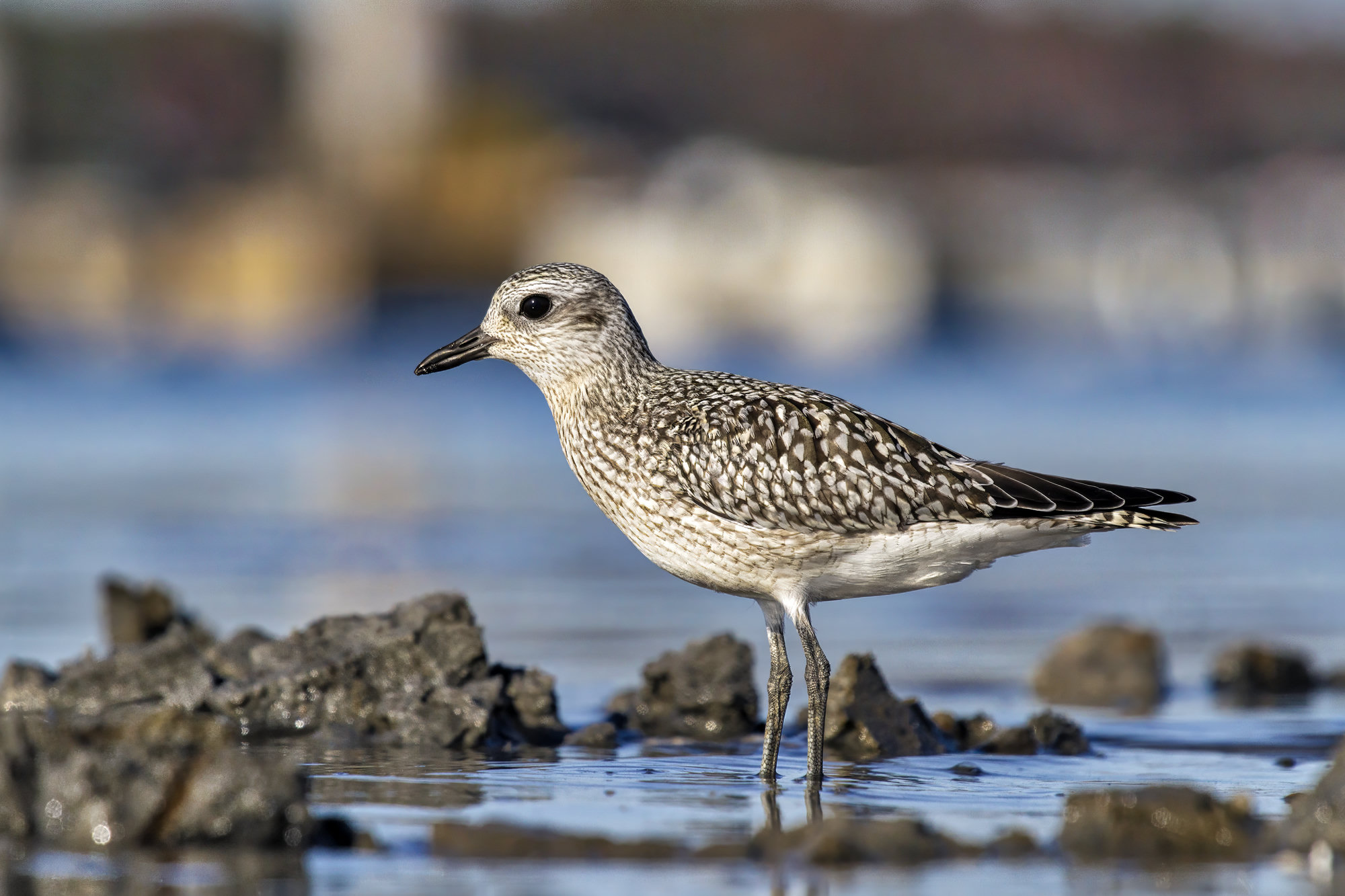
Photo Chuck Homler, Focus On Wildlife (opens in a new tab) / Wikimedia Commons, CC BY-SA 4.0 (opens in a new tab)
At a glance
- Size
- About 27 to 30 cm long
- Weight
- About 190 to 280 g
- Habitat
- Beaches, mudflats and coastal marshes; ploughed fields inland
- Diet
- Marine worms, clams, crabs and insects
- In Georgia
- A common migrant and winter visitor on the coast
- Voice
- A plaintive, three-note whistle "pee-oo-ee"
- Rabies vector
- No
Identification
- Key marks
- Large plover with a short, thick bill; in winter speckled grey above and whitish below; in spring black face and belly; black patches under the wing in flight
- Told apart from
- American golden-plover, which is browner, smaller-billed and lacks black under the wing
- Where to look
- Mudflats and beaches at low tide
Behaviour
Black-bellied plovers hunt by sight, running, stopping and then darting to seize worms from the mud. They are wary and often the first bird to call an alarm, sending whole flocks of shorebirds into the air.
Why they matter
These plovers breed on the high Arctic tundra and winter along coasts around the world. Their long journeys connect the Arctic with Georgia's beaches, and they rely on undisturbed mudflats to feed and rest.
Reproduction and lifecycle
Nest — A scrape on Arctic tundra
Eggs — Usually four
Incubation — About 26 to 27 days
Chicks — Leave the nest within a day and feed themselves
Flight — At about five to six weeks
Lifespan — Wild birds over twenty years are recorded
Living around people
- Shorebirds on the beach need to feed and rest; walking around flocks rather than through them saves them energy for migration.
Misconceptions
- Shorebirds on the beach have nowhere else to be. Many are resting in the middle of journeys of thousands of kilometres.
Related species
Seasonal activity
When this species is breeding, and when there are nests on the ground. Mowing during the shaded months is how most nests are found.
| Jan | Feb | Mar | Apr | May | Jun | Jul | Aug | Sep | Oct | Nov | Dec | |
|---|---|---|---|---|---|---|---|---|---|---|---|---|
| Breeding | Jan: no | Feb: no | Mar: no | Apr: no | May: no | Jun: no | Jul: no | Aug: no | Sep: no | Oct: no | Nov: no | Dec: no |
| Active nests | Jan: no | Feb: no | Mar: no | Apr: no | May: no | Jun: no | Jul: no | Aug: no | Sep: no | Oct: no | Nov: no | Dec: no |
| Notes | Wintering | Wintering | Migrants passing | Moulting into breeding plumage | Migrating north | Nesting in the Arctic | Adults returning south | Migrants arriving | Migrants | Wintering birds settle | Wintering | Wintering |
Where it lives
Recorded in 75 states and provinces. Each one links to the other animals there, and to the rehabilitators licensed for them.
United States
- Alabamain winter
- Alaskabreeding
- Arkansaspassing through
- Californiain winter
- Coloradopassing through
- Connecticutin winter
- Delawarein winter
- Floridain winter
- Georgiain winter
- Hawaiiin winter
- Idahopassing through
- Illinoispassing through
- Indianapassing through
- Iowapassing through
- Kansaspassing through
- Kentuckypassing through
- Louisianain winter
- Mainepassing through
- Marylandin winter
- Massachusettspassing through
- Michiganpassing through
- Minnesotapassing through
- Mississippiin winter
- Missouripassing through
- Montanapassing through
- Nebraskapassing through
- Nevadapassing through
- New Hampshirein winter
- New Jerseyin winter
- New Yorkin winter
- North Carolinain winter
- North Dakotapassing through
- Ohiopassing through
- Oklahomapassing through
- Oregonin winter
- Pennsylvaniapassing through
- Rhode Islandpassing through
- South Carolinain winter
- South Dakotapassing through
- Texasin winter
- Utahpassing through
- Vermontpassing through
- Virginiain winter
- Washingtonin winter
- Wisconsinpassing through
Canada
- Albertapassing through
- British Columbiain winter
- Manitobabreeding
- New Brunswickpassing through
- Newfoundland and Labradorin winter
- Northwest Territoriesbreeding
- Nova Scotiapassing through
- Nunavutbreeding
- Ontariopassing through
- Prince Edward Islandpassing through
- Quebecpassing through
- Saskatchewanpassing through
- Yukonbreeding
Mexico
- Baja Californiain winter
- Baja California Surin winter
- Campechein winter
- Chiapasin winter
- Colimain winter
- Guerreroin winter
- Jaliscoin winter
- Michoacanin winter
- Nayaritin winter
- Oaxacain winter
- Quintana Rooin winter
- Sinaloain winter
- Sonorain winter
- Tabascoin winter
- Tamaulipasin winter
- Veracruzin winter
- Yucatanin winter
If you found one
Answer a few questions and you will get a specific answer for what you are looking at.
I found an animal