
Species
Pond slider
Trachemys scripta
The turtle lined up on every sunny log in Georgia, whose native form is the yellow-bellied slider.
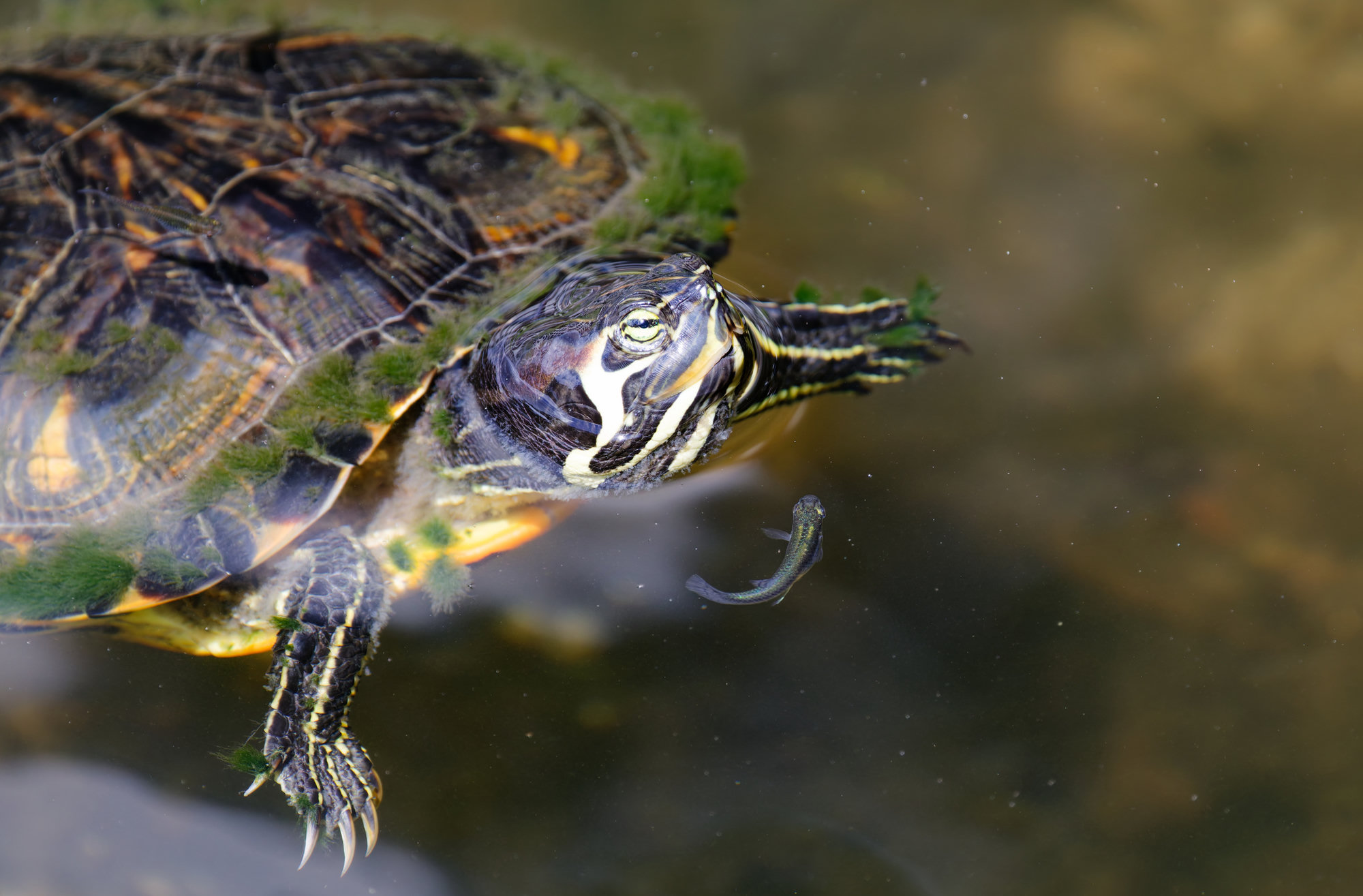
Photo Daughter Dad (opens in a new tab) / iNaturalist, CC BY 4.0 (opens in a new tab)
At a glance
- Size
- Shell usually 13 to 28 cm long; females larger than males
- Habitat
- Ponds, lakes, slow rivers, reservoirs and ditches with places to bask
- Diet
- Young eat insects and small animals; adults eat mostly plants
- In Georgia
- Common statewide; the native form is the yellow-bellied slider, and red-eared sliders from the pet trade also turn up
- Rabies vector
- No
Identification
- Key marks
- Olive to brown shell; the yellow-bellied form has a broad yellow blotch behind the eye, the red-eared form a red stripe
- Told apart from
- River and coastal plain cooters, which lack the blotch behind the eye and have a C-shaped mark on the side of the shell
- Told apart from
- Painted turtle, which has a smooth dark shell edged in red
- Where to look
- Basking in groups on logs and banks, sliding into the water at the first disturbance
Behaviour
Sliders spend warm days basking, often stacked on top of one another, and drop into the water when anything approaches. Males have long front claws, which they flutter in front of a female's face in courtship. Females leave the water in spring and summer and may walk a long way to find a sunny patch of soil to nest in.
Why they matter
Sliders graze water plants and scavenge dead fish, and their eggs and young feed raccoons, herons, snakes and fish. Because they are common and easy to see, they are often the first turtle a child learns to recognise.
Reproduction and lifecycle
Nest — Dug by the female in soil, often well away from water
Eggs — Usually 6 to 20, in one to several clutches a year
Incubation — About 60 to 90 days; temperature decides the sex of each hatchling
Hatchlings — Some emerge in autumn; others spend the winter in the nest and emerge in spring
Maturity — Males in 2 to 5 years, females in 5 to 8
Lifespan — Over 30 years in the wild
Living around people
- A turtle crossing a road can be helped across in the direction it was heading, held by the sides of the shell.
- A female digging in a lawn in spring is laying eggs; leaving her alone is all she needs.
- Never release a pet turtle. Released red-eared sliders compete with native turtles and can carry disease.
Misconceptions
- A turtle away from water is lost. Females travel overland to nest, sometimes hundreds of metres, and know where they are going.
- The red-eared slider is Georgia's native turtle. The native form here is the yellow-bellied slider; red-eared sliders were brought by the pet trade.
Related species
Seasonal activity
When this species is breeding, and when there are nests on the ground. Mowing during the shaded months is how most nests are found.
| Jan | Feb | Mar | Apr | May | Jun | Jul | Aug | Sep | Oct | Nov | Dec | |
|---|---|---|---|---|---|---|---|---|---|---|---|---|
| Breeding | Jan: no | Feb: no | Mar: no | Apr: no | May: no | Jun: no | Jul: no | Aug: no | Sep: no | Oct: no | Nov: no | Dec: no |
| Active nests | Jan: no | Feb: no | Mar: no | Apr: no | May: no | Jun: no | Jul: no | Aug: no | Sep: no | Oct: no | Nov: no | Dec: no |
| Notes | Inactive in cold water; basking on warm days | Basking on warm days | Active and basking | Courtship; feeding | Females nesting | Females nesting | Nesting ends; feeding | Hatching begins | Hatchlings emerge; some stay in the nest over winter | Basking and feeding | Slowing down | Mostly inactive |
Where it lives
Recorded in 76 states and provinces. Each one links to the other animals there, and to the rehabilitators licensed for them.
United States
- Alabama
- Arizonaintroduced
- Arkansas
- Californiaintroduced
- Coloradointroduced
- Connecticutintroduced
- Delawareintroduced
- District of Columbiaintroduced
- Florida
- Georgia
- Hawaiiintroduced
- Idahointroduced
- Illinois
- Indiana
- Iowa
- Kansas
- Kentucky
- Louisiana
- Maineintroduced
- Marylandintroduced
- Massachusettsintroduced
- Michiganintroduced
- Minnesotaintroduced
- Mississippi
- Missouri
- Nebraska
- Nevadaintroduced
- New Hampshireintroduced
- New Jerseyintroduced
- New Mexico
- New Yorkintroduced
- North Carolina
- Ohio
- Oklahoma
- Oregonintroduced
- Pennsylvaniaintroduced
- Rhode Islandintroduced
- South Carolina
- Tennessee
- Texas
- Utahintroduced
- Vermontintroduced
- Virginia
- Washingtonintroduced
- West Virginia
- Wisconsinintroduced
Mexico
- Aguascalientesintroduced
- Baja Californiaintroduced
- Baja California Surintroduced
- Chiapasintroduced
- Chihuahua
- Coahuila
- Colimaintroduced
- Guanajuatointroduced
- Guerrerointroduced
- Jaliscointroduced
- Mexico Cityintroduced
- Michoacanintroduced
- Morelosintroduced
- Nayaritintroduced
- Nuevo Leon
- Oaxacaintroduced
- Pueblaintroduced
- Queretarointroduced
- Quintana Roointroduced
- San Luis Potosiintroduced
- Sinaloaintroduced
- Sonoraintroduced
- State of Mexicointroduced
- Tamaulipas
- Veracruzintroduced
- Yucatanintroduced
If you found one
Answer a few questions and you will get a specific answer for what you are looking at.
I found an animal