
Species
Plain chachalaca
Ortalis vetula
A long-tailed, brown game bird of Mexican thickets whose loud dawn chorus has echoed on Sapelo Island for a century.
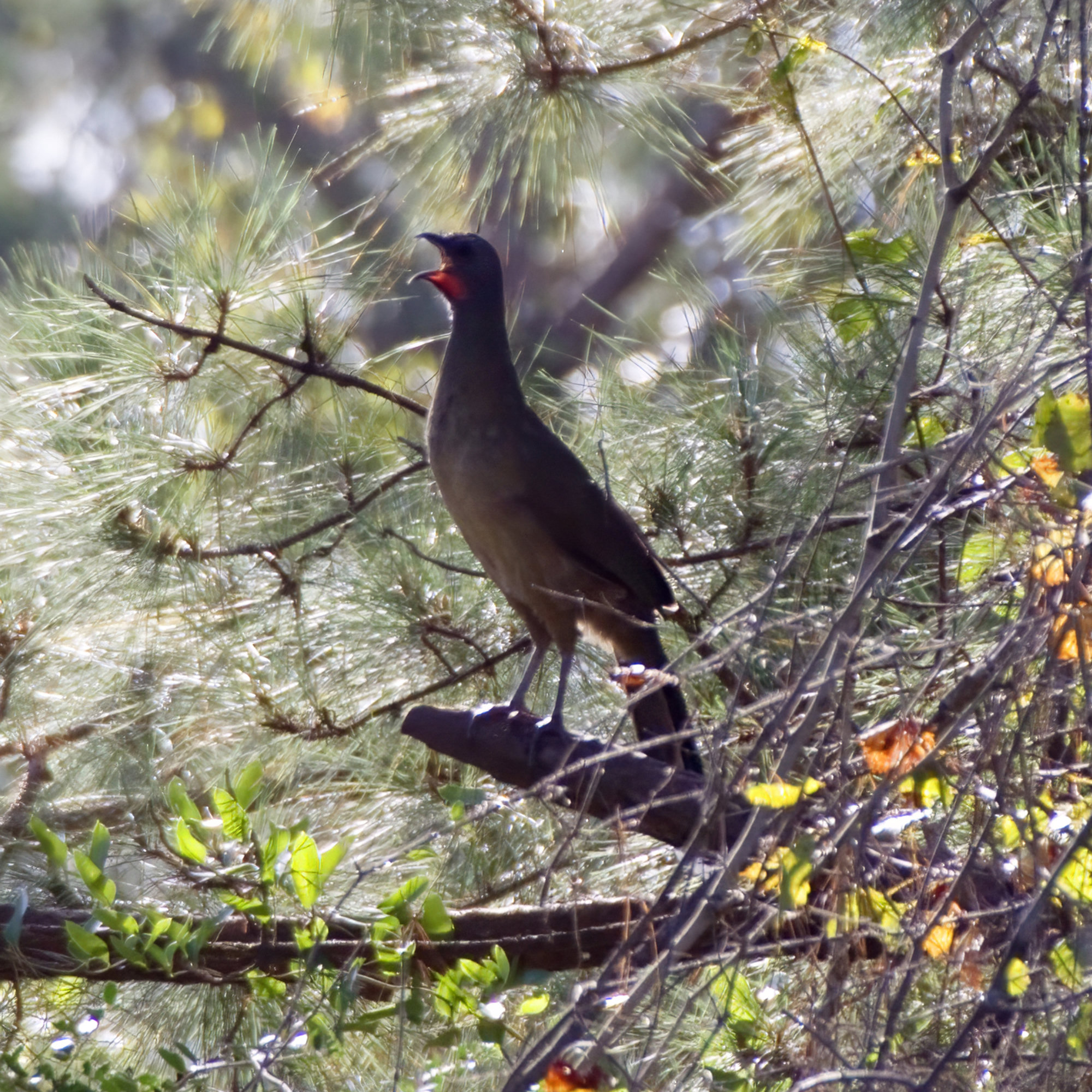
Photo Dan Vickers (opens in a new tab) / iNaturalist, CC BY 4.0 (opens in a new tab)
At a glance
- Size
- About 48 to 58 cm long, much of it tail
- Weight
- About 440 to 800 g
- Habitat
- Dense woodland and thickets
- Diet
- Leaves, buds, flowers, fruit and seeds, mostly taken in trees
- In Georgia
- Introduced; a small population lives on Sapelo Island and nearby islands
- Voice
- A loud, raucous "cha-cha-LAK", given in chorus at dawn
- Rabies vector
- No
Identification
- Key marks
- Slender, olive-brown body; long, rounded tail tipped pale; small head; bare red skin on the throat in breeding season
- Told apart from
- Wild turkey, which is far larger and bulkier
- Told apart from
- Brown thrasher and cuckoos, which are much smaller
- Where to look
- Maritime forest on Sapelo Island, usually heard before it is seen
Behaviour
Chachalacas live in noisy groups that move through the treetops, clambering along branches to eat leaves and fruit. At dawn, groups call back and forth in a deafening chorus that gives the bird its name.
Why they matter
The plain chachalaca's natural range runs from southern Texas through eastern Mexico. It was brought to Sapelo Island in the 1920s and has survived there ever since, making it one of the few introduced birds in Georgia that is not a city bird. It eats fruit and spreads seeds through the island's woods, as it does in its native thickets.
Reproduction and lifecycle
Nest — A flimsy platform of sticks in a shrub or tree
Eggs — Usually three
Incubation — About 25 days
Chicks — Leave the nest within hours and can climb and flutter within days
Lifespan — Several years
Living around people
- Chachalacas on Sapelo live mostly in woodland and keep out of sight; their calls are the usual sign of them.
- Free-roaming cats and dogs take ground-feeding birds and chicks.
Misconceptions
- They are escaped chickens or pheasants. They are wild chachalacas, descended from birds introduced a century ago.
Related species
Seasonal activity
When this species is breeding, and when there are nests on the ground. Mowing during the shaded months is how most nests are found.
| Jan | Feb | Mar | Apr | May | Jun | Jul | Aug | Sep | Oct | Nov | Dec | |
|---|---|---|---|---|---|---|---|---|---|---|---|---|
| Breeding | Jan: no | Feb: no | Mar: no | Apr: no | May: no | Jun: no | Jul: no | Aug: no | Sep: no | Oct: no | Nov: no | Dec: no |
| Active nests | Jan: no | Feb: no | Mar: no | Apr: no | May: no | Jun: no | Jul: no | Aug: no | Sep: no | Oct: no | Nov: no | Dec: no |
| Notes | Groups calling at dawn | Groups feeding on buds | Pairs forming | Nesting begins | Nesting | Chicks leaving the nest | Family groups | Family groups | Groups feeding on fruit | Groups | Groups | Groups calling at dawn |
Where it lives
Recorded in 15 states and provinces. Each one links to the other animals there, and to the rehabilitators licensed for them.
United States
If you found one
Answer a few questions and you will get a specific answer for what you are looking at.
I found an animal