
Species
Ovenbird
Seiurus aurocapilla
A ground-walking warbler that builds a domed nest like an old outdoor oven and shouts 'teacher-teacher-teacher'.
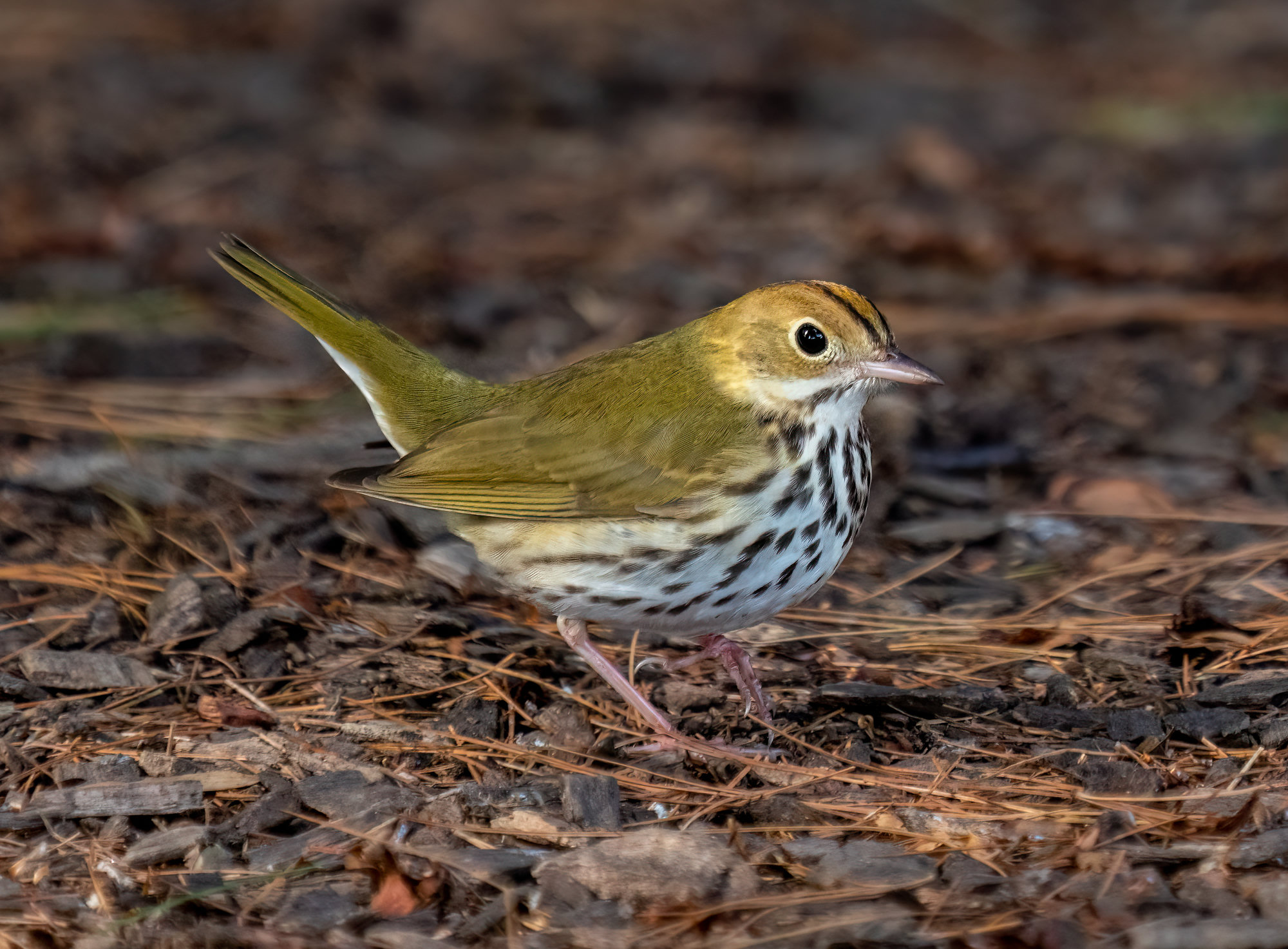
Photo Rhododendrites (opens in a new tab) / Wikimedia Commons, CC BY-SA 4.0 (opens in a new tab)
At a glance
- Size
- About 11 to 14 cm long
- Weight
- About 16 to 28 g
- Habitat
- Mature deciduous forests with open floors
- Diet
- Insects, spiders and snails from leaf litter
- In Georgia
- A summer resident in the north; a migrant statewide
- Voice
- A loud, rising "teacher-teacher-teacher"
- Rabies vector
- No
Identification
- Key marks
- Olive-brown above; white below with bold black spots; orange crown stripe edged in black; white eye-ring
- Told apart from
- Wood thrush, which is larger and rusty
- Told apart from
- Waterthrushes, which have eyebrows and bob their tails
- Where to look
- Walking on the forest floor in mature woods
Behaviour
Ovenbirds walk on the forest floor, flipping leaves for insects. Their domed nest, with a side entrance, looks like a small Dutch oven.
Why they matter
Ovenbirds need large, unbroken forests; in small woodlots, many nests are lost to predators. They are one of the best-studied examples of how forest fragmentation affects songbirds.
Reproduction and lifecycle
Nest — A domed cup of leaves on the forest floor with a side entrance
Eggs — Usually four or five
Incubation — About 11 to 14 days
Chicks — Fed by both parents
Lifespan — Several years
Living around people
- Ovenbirds often strike windows during migration.
Misconceptions
- Warblers live in treetops. Ovenbirds live on the forest floor.
Related species
Seasonal activity
When this species is breeding, and when there are nests on the ground. Mowing during the shaded months is how most nests are found.
| Jan | Feb | Mar | Apr | May | Jun | Jul | Aug | Sep | Oct | Nov | Dec | |
|---|---|---|---|---|---|---|---|---|---|---|---|---|
| Breeding | Jan: no | Feb: no | Mar: no | Apr: no | May: no | Jun: no | Jul: no | Aug: no | Sep: no | Oct: no | Nov: no | Dec: no |
| Active nests | Jan: no | Feb: no | Mar: no | Apr: no | May: no | Jun: no | Jul: no | Aug: no | Sep: no | Oct: no | Nov: no | Dec: no |
| Notes | In Central America and the Caribbean | In the tropics | In the tropics | Arriving | Nesting | Nesting | Young fledging | Present | Migrating | Last migrants | In the tropics | In the tropics |
Where it lives
Recorded in 69 states and provinces. Each one links to the other animals there, and to the rehabilitators licensed for them.
United States
- Alabamabreeding
- Arkansasbreeding
- Coloradobreeding
- Connecticutbreeding
- Delawarebreeding
- District of Columbiapassing through
- Floridain winter
- Georgiabreeding
- Illinoisbreeding
- Indianabreeding
- Iowabreeding
- Kansaspassing through
- Kentuckybreeding
- Louisianapassing through
- Mainebreeding
- Marylandbreeding
- Massachusettsbreeding
- Michiganbreeding
- Minnesotabreeding
- Mississippipassing through
- Missouribreeding
- Montanabreeding
- Nebraskabreeding
- New Hampshirebreeding
- New Jerseybreeding
- New Yorkbreeding
- North Carolinabreeding
- North Dakotabreeding
- Ohiobreeding
- Oklahomabreeding
- Pennsylvaniabreeding
- Rhode Islandbreeding
- South Carolinabreeding
- South Dakotabreeding
- Tennesseebreeding
- Texasin winter
- Vermontbreeding
- Virginiabreeding
- West Virginiabreeding
- Wisconsinbreeding
- Wyomingbreeding
Canada
If you found one
Answer a few questions and you will get a specific answer for what you are looking at.
I found an animal