
Species
Northern shoveler
Spatula clypeata
A duck with an oversized, spoon-shaped bill that sieves tiny food from the water like a whale.
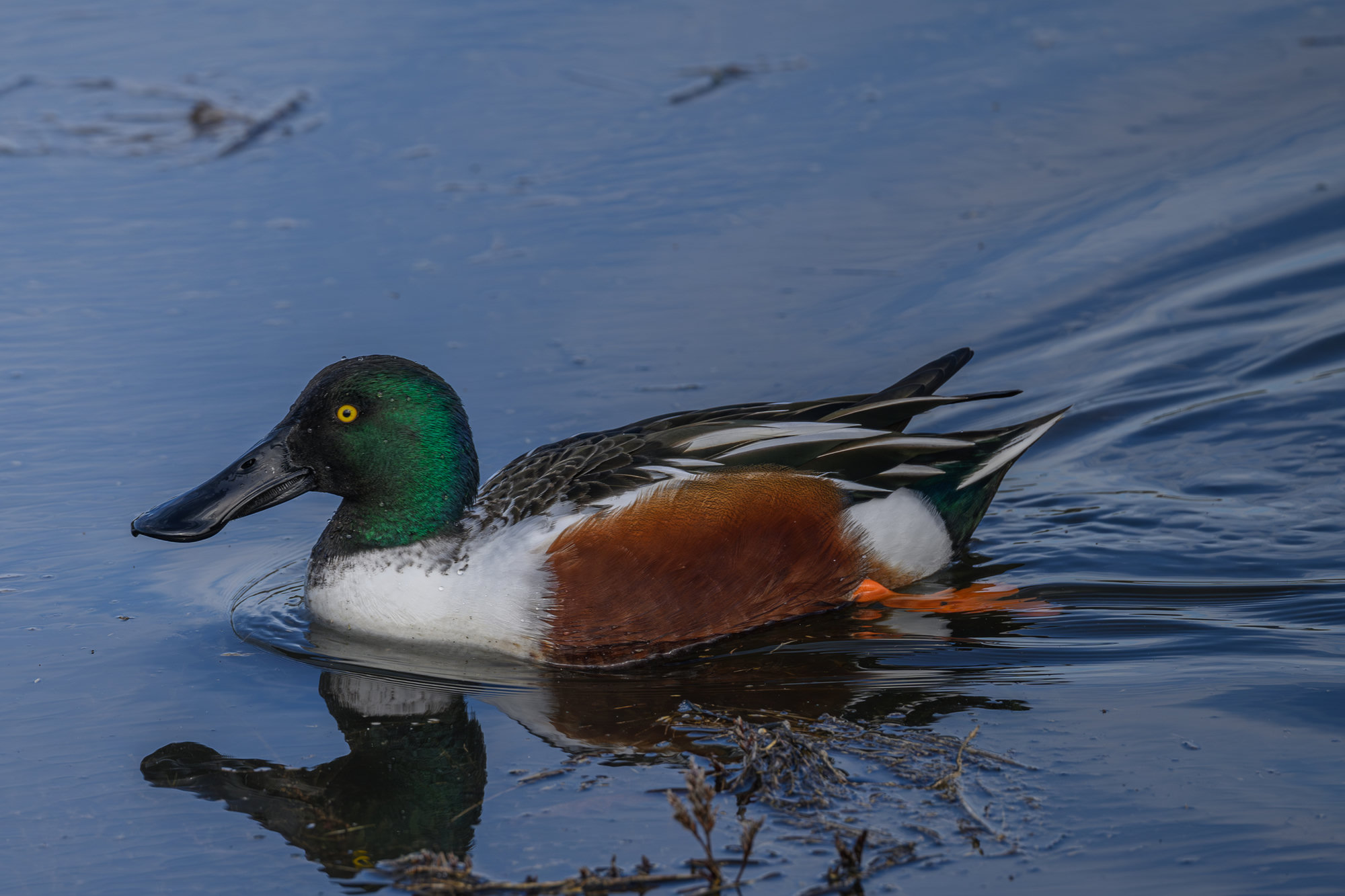
Photo Unknown photographer (opens in a new tab) / iNaturalist, CC0 1.0 (opens in a new tab)
At a glance
- Size
- About 44 to 51 cm long
- Weight
- About 400 to 800 g
- Habitat
- Shallow ponds, marshes, sewage lagoons and coastal impoundments
- Diet
- Tiny crustaceans, seeds, insects and plankton filtered from the water
- In Georgia
- A fairly common winter visitor, October to April
- Voice
- Males give a hollow "took-took"; females quack
- Rabies vector
- No
Identification
- Key marks
- A long, broad, spatula-shaped bill in both sexes
- Male
- Green head; white breast; chestnut sides; yellow eye
- Female
- Mottled brown with an orange-edged bill
- Told apart from
- Mallard, which has a normal-sized bill and no chestnut sides
- Told apart from
- Blue-winged teal, which shares the blue wing patch but is smaller with a small bill
- Where to look
- Groups swimming slowly with bills in the water, often in tight circles
Behaviour
Shovelers feed by sweeping their bills through the water, straining out tiny animals with comb-like edges along the bill. Groups often swim in tight circles together, stirring up food from below.
Why they matter
The shoveler's bill carries a fine fringe of plates called lamellae that sieves food much as a baleen whale does, letting it live on animals most ducks cannot use. Because it feeds on small invertebrates, it does well in wetlands rich in them — including managed impoundments and treatment ponds — and it helps keep those populations in check.
Reproduction and lifecycle
Nest — A grass-lined scrape in short grass near water
Eggs — Usually 8 to 12
Incubation — About 22 to 25 days
Ducklings — Leave the nest within a day; the female guards them
Flight — At about six to seven weeks
Lifespan — Usually a few years
Living around people
- Shovelers use sewage lagoons and stormwater ponds, where tiny invertebrates are plentiful.
- Their filter-feeding makes them vulnerable to pollutants concentrated in shallow water.
Misconceptions
- The big bill is a deformity. It is the shoveler's normal bill and the tool its whole way of feeding depends on.
Related species
Seasonal activity
When this species is breeding, and when there are nests on the ground. Mowing during the shaded months is how most nests are found.
| Jan | Feb | Mar | Apr | May | Jun | Jul | Aug | Sep | Oct | Nov | Dec | |
|---|---|---|---|---|---|---|---|---|---|---|---|---|
| Breeding | Jan: no | Feb: no | Mar: no | Apr: no | May: no | Jun: no | Jul: no | Aug: no | Sep: no | Oct: no | Nov: no | Dec: no |
| Active nests | Jan: no | Feb: no | Mar: no | Apr: no | May: no | Jun: no | Jul: no | Aug: no | Sep: no | Oct: no | Nov: no | Dec: no |
| Notes | Wintering | Wintering; pairs forming | Migrating north | Last birds leaving | Nesting on the northern prairies | Ducklings hatching | Adults moulting | Young flying | Migration begins | First arrivals in Georgia | Wintering flocks build | Wintering |
Where it lives
Recorded in 95 states and provinces. Each one links to the other animals there, and to the rehabilitators licensed for them.
United States
- Alabamain winter
- Alaskabreeding
- Arizonain winter
- Arkansasin winter
- Californiain winter
- Coloradoin winter
- Connecticutin winter
- Delawarein winter
- District of Columbiain winter
- Floridain winter
- Georgiain winter
- Hawaiiin winter
- Idaho
- Illinoisin winter
- Indianain winter
- Iowapassing through
- Kansasin winter
- Kentuckyin winter
- Louisianain winter
- Maine
- Marylandin winter
- Massachusettsin winter
- Michiganin winter
- Minnesota
- Mississippiin winter
- Missouriin winter
- Montanabreeding
- Nebraskain winter
- Nevadain winter
- New Hampshirein winter
- New Jerseyin winter
- New Mexicoin winter
- New Yorkin winter
- North Carolinain winter
- North Dakotabreeding
- Ohioin winter
- Oklahomain winter
- Oregonin winter
- Pennsylvaniain winter
- Rhode Islandin winter
- South Carolinain winter
- South Dakotabreeding
- Tennesseein winter
- Texasin winter
- Utahin winter
- Vermontpassing through
- Virginiain winter
- Washingtonin winter
- West Virginiain winter
- Wisconsinin winter
- Wyomingbreeding
Canada
Mexico
- Aguascalientesin winter
- Baja Californiain winter
- Baja California Surin winter
- Campechein winter
- Chiapasin winter
- Chihuahuain winter
- Coahuilain winter
- Colimain winter
- Durangoin winter
- Guanajuatoin winter
- Guerreroin winter
- Hidalgoin winter
- Jaliscoin winter
- Mexico Cityin winter
- Michoacanin winter
- Morelosin winter
- Nayaritin winter
- Nuevo Leonin winter
- Oaxacain winter
- Pueblain winter
- Queretaroin winter
- San Luis Potosiin winter
- Sinaloain winter
- Sonorain winter
- State of Mexicoin winter
- Tabascoin winter
- Tamaulipasin winter
- Tlaxcalain winter
- Veracruzin winter
- Yucatanin winter
- Zacatecasin winter
If you found one
Answer a few questions and you will get a specific answer for what you are looking at.
I found an animal