
Species
Blue-winged teal
Spatula discors
A small dabbling duck with a pale blue wing patch, among the first ducks to arrive in autumn and the last to leave in spring.
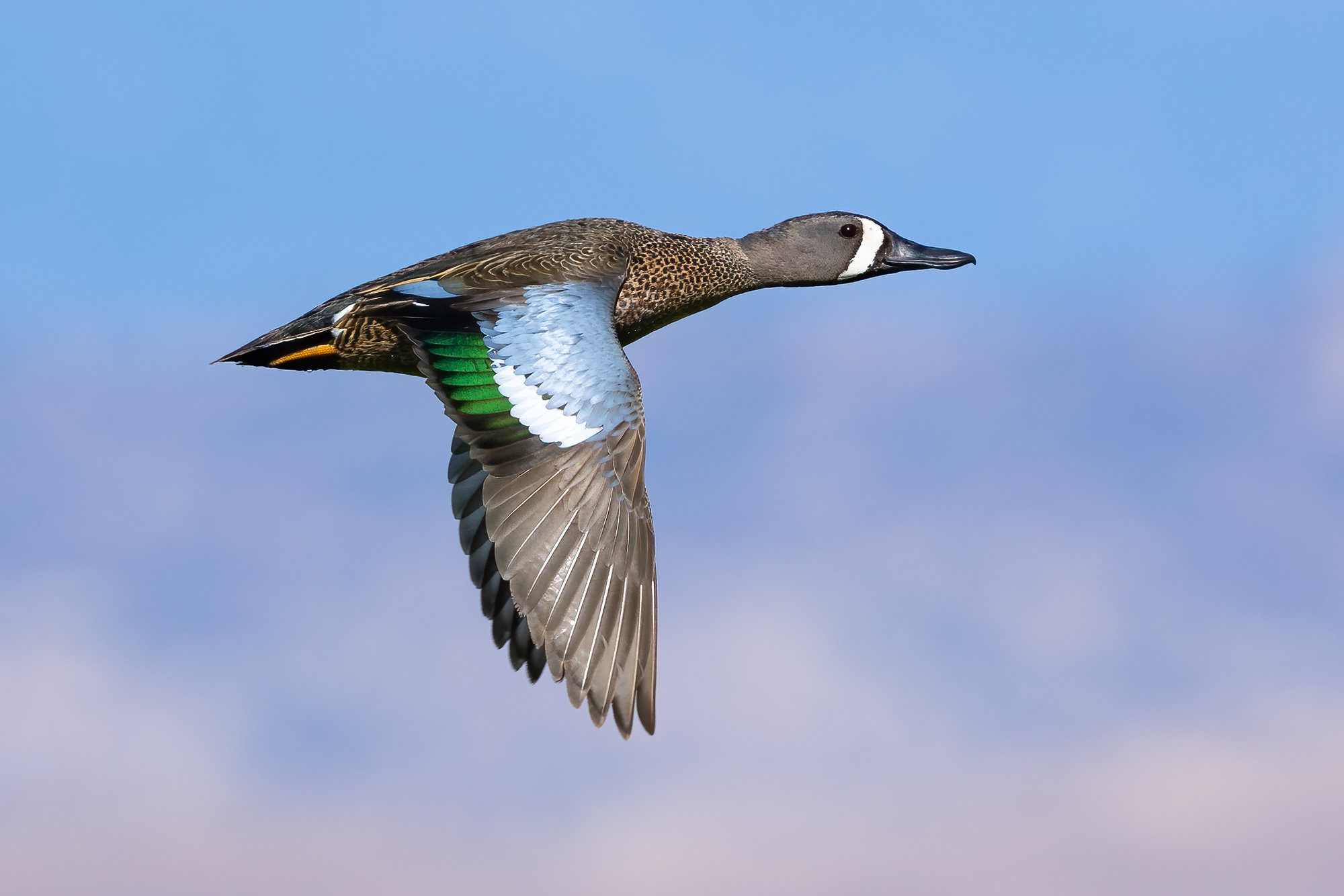
Photo Frank Schulenburg (opens in a new tab) / Wikimedia Commons, CC BY-SA 4.0 (opens in a new tab)
At a glance
- Size
- About 36 to 41 cm long
- Weight
- About 280 to 500 g
- Habitat
- Shallow marshes, ponds, flooded fields and coastal impoundments
- Diet
- Seeds, aquatic plants, snails and insects
- In Georgia
- A common migrant in spring and autumn; some winter on the coast
- Voice
- Males give a thin, whistled peep; females quack softly
- Rabies vector
- No
Identification
- Male
- Grey-blue head with a white crescent in front of the eye; speckled brown body; white patch near the tail
- Female
- Mottled brown with a dark eye-line and a pale spot at the base of the bill
- In flight
- A large powder-blue patch on the forewing
- Told apart from
- Green-winged teal, which is smaller with a green wing patch and no blue
- Told apart from
- Northern shoveler, which shares the blue wing patch but has a huge spatulate bill
- Where to look
- Shallow edges of marshes and flooded fields, especially in September and March
Behaviour
Blue-winged teal feed at the surface of shallow water, dabbling and sweeping their bills for seeds and small animals. They are fast, twisting fliers, and small flocks move in tight formation.
They migrate earlier in autumn and later in spring than most ducks, and many winter as far south as South America.
Why they matter
Blue-winged teal are among the most numerous ducks in North America, and they depend on the small prairie potholes and shallow wetlands that are easily drained. Their long migrations link the wetlands of the northern plains with those of the Gulf Coast and South America, and Georgia's marshes are one of the refuelling stops.
Reproduction and lifecycle
Nest — A grass-lined bowl hidden in tall grass near water, mostly on the northern prairies
Eggs — Usually 8 to 11
Incubation — About 23 to 24 days
Ducklings — Leave the nest within a day, feed themselves, guarded by the female
Flight — At about six to seven weeks
Lifespan — Usually a few years
Living around people
- Shallow flooded fields and impoundments give migrating teal food and rest.
- Lead shot and lost fishing tackle in wetlands poison dabbling ducks that sift the bottom.
Misconceptions
- All teal are the same. Blue-winged and green-winged teal are different species with different seasons and ranges.
Related species
Seasonal activity
When this species is breeding, and when there are nests on the ground. Mowing during the shaded months is how most nests are found.
| Jan | Feb | Mar | Apr | May | Jun | Jul | Aug | Sep | Oct | Nov | Dec | |
|---|---|---|---|---|---|---|---|---|---|---|---|---|
| Breeding | Jan: no | Feb: no | Mar: no | Apr: no | May: no | Jun: no | Jul: no | Aug: no | Sep: no | Oct: no | Nov: no | Dec: no |
| Active nests | Jan: no | Feb: no | Mar: no | Apr: no | May: no | Jun: no | Jul: no | Aug: no | Sep: no | Oct: no | Nov: no | Dec: no |
| Notes | A few winter in coastal marshes | Migrants begin returning | Peak spring migration | Migrants passing north | Last birds leave for northern breeding grounds | Nesting in the northern prairies | Adults moult | First autumn migrants arrive | Peak autumn migration | Migration continues | Most have passed through | A few remain on the coast |
Where it lives
Recorded in 83 states and provinces. Each one links to the other animals there, and to the rehabilitators licensed for them.
United States
- Alabamain winter
- Arizona
- Arkansaspassing through
- Californiain winter
- Coloradobreeding
- Delawarein winter
- Floridain winter
- Georgiain winter
- Idahobreeding
- Illinoisbreeding
- Indianapassing through
- Iowapassing through
- Kansasbreeding
- Kentuckypassing through
- Louisianain winter
- Michiganbreeding
- Minnesotabreeding
- Mississippiin winter
- Missouripassing through
- Montanabreeding
- Nebraskabreeding
- Nevadabreeding
- New Jerseypassing through
- New Mexicobreeding
- New Yorkbreeding
- North Carolinain winter
- North Dakotabreeding
- Ohiobreeding
- Oklahomapassing through
- Oregonbreeding
- Pennsylvaniapassing through
- South Carolinain winter
- South Dakotabreeding
- Tennesseepassing through
- Texasin winter
- Utahbreeding
- Washingtonbreeding
- West Virginiapassing through
- Wisconsinbreeding
- Wyomingbreeding
Canada
Mexico
- Aguascalientesin winter
- Baja Californiain winter
- Baja California Surin winter
- Campechein winter
- Chiapasin winter
- Chihuahuain winter
- Coahuilain winter
- Colimain winter
- Durangoin winter
- Guanajuatoin winter
- Guerreroin winter
- Hidalgoin winter
- Jaliscoin winter
- Mexico Cityin winter
- Michoacanin winter
- Morelosin winter
- Nayaritin winter
- Nuevo Leonin winter
- Oaxacain winter
- Pueblain winter
- Queretaroin winter
- Quintana Rooin winter
- San Luis Potosiin winter
- Sinaloain winter
- Sonorain winter
- State of Mexicoin winter
- Tabascoin winter
- Tamaulipasin winter
- Tlaxcalain winter
- Veracruzin winter
- Yucatanin winter
- Zacatecaspassing through
If you found one
Answer a few questions and you will get a specific answer for what you are looking at.
I found an animal