
Species
Northern mockingbird
Mimus polyglottos
The grey master mimic of Georgia's yards, singing borrowed songs day and night and defending its nest fearlessly.
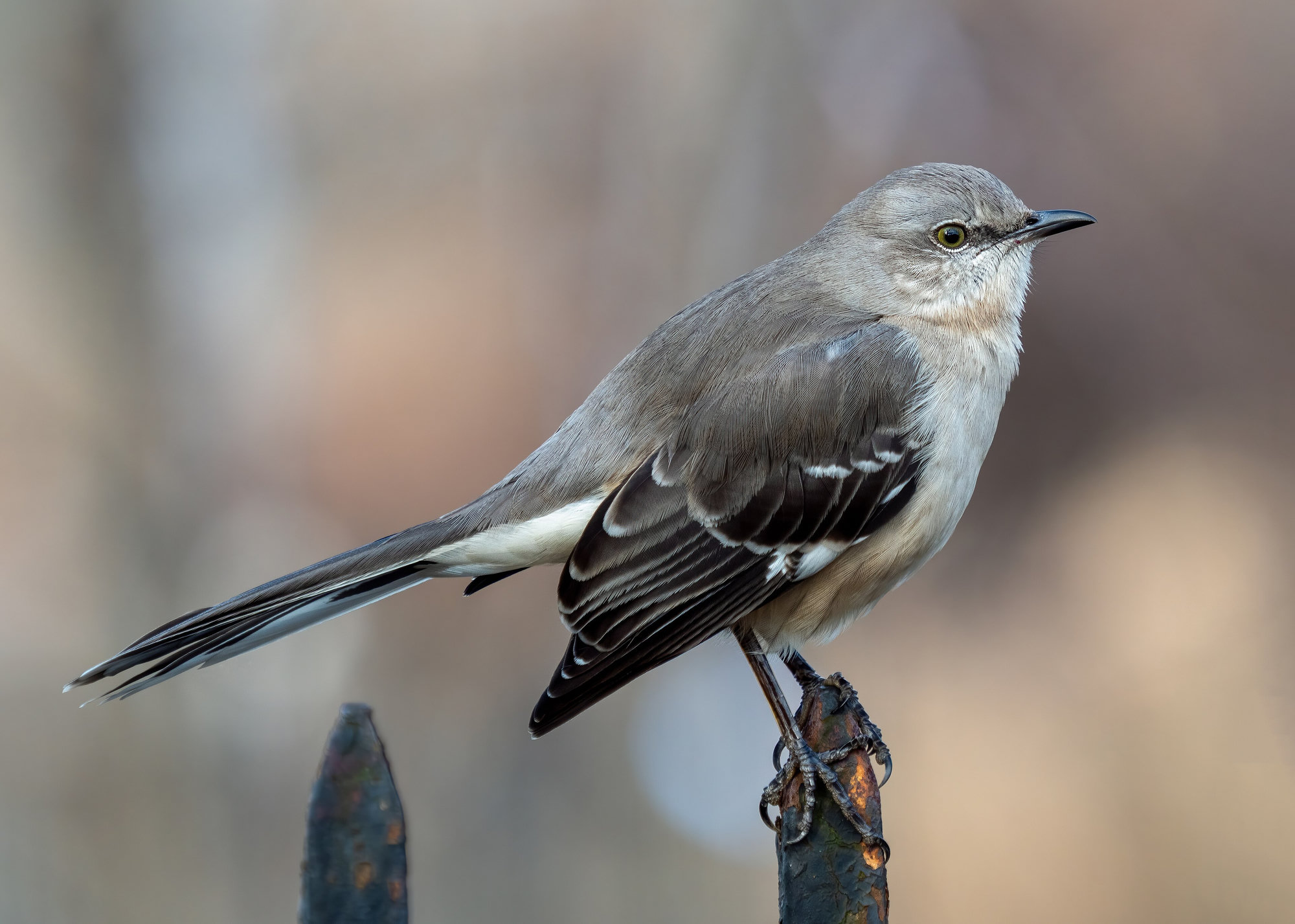
Photo Rhododendrites (opens in a new tab) / Wikimedia Commons, CC BY-SA 4.0 (opens in a new tab)
At a glance
- Size
- About 21 to 26 cm long
- Weight
- About 45 to 58 g
- Habitat
- Towns, yards, parks and open areas with shrubs
- Diet
- Insects and berries
- In Georgia
- Common resident statewide
- Voice
- Long songs of repeated phrases, many copied from other birds and sounds
- Rabies vector
- No
Identification
- Key marks
- Grey above, paler below; long tail; white wing patches flashed in flight
- Told apart from
- Loggerhead shrike, which has a black mask and hooked bill
- Told apart from
- Gray catbird, which is darker and lacks white wing patches
- Where to look
- Rooftops, fence posts and shrubs
Behaviour
Mockingbirds imitate other birds, car alarms and even frogs, and males may learn over 200 songs. They flash their white wing patches while feeding and aggressively defend nests.
Why they matter
The mockingbird is the state bird of five southern states. It eats many insects and spreads the seeds of berry-bearing shrubs, and its songs record the sounds of the neighbourhood.
Reproduction and lifecycle
Nest — A cup of twigs in a shrub or tree
Eggs — Usually three to five
Incubation — About 12 to 13 days
Chicks — Fed by both parents
Flight — At about 12 days
Lifespan — Several years
Living around people
- Mockingbirds defending nests will dive at people and pets for a couple of weeks; avoiding the area ends it.
- A singing mockingbird at night is often an unmated male.
Misconceptions
- Mockingbirds mock other birds out of spite. Mimicry helps them attract mates and defend territories.
Related species
Seasonal activity
When this species is breeding, and when there are nests on the ground. Mowing during the shaded months is how most nests are found.
| Jan | Feb | Mar | Apr | May | Jun | Jul | Aug | Sep | Oct | Nov | Dec | |
|---|---|---|---|---|---|---|---|---|---|---|---|---|
| Breeding | Jan: no | Feb: no | Mar: no | Apr: no | May: no | Jun: no | Jul: no | Aug: no | Sep: no | Oct: no | Nov: no | Dec: no |
| Active nests | Jan: no | Feb: no | Mar: no | Apr: no | May: no | Jun: no | Jul: no | Aug: no | Sep: no | Oct: no | Nov: no | Dec: no |
| Notes | Defending feeding territories | Singing | Nesting | Nesting | Chicks | Second broods | Third broods | Young fledging | Present | Defending berry trees | Present | Present |
Where it lives
Recorded in 72 states and provinces. Each one links to the other animals there, and to the rehabilitators licensed for them.
United States
- Alabama
- Arizona
- Arkansas
- California
- Coloradobreeding
- Connecticut
- Delaware
- District of Columbia
- Florida
- Georgia
- Hawaiiintroduced
- Illinois
- Indiana
- Iowabreeding
- Kansas
- Kentucky
- Louisiana
- Maine
- Maryland
- Massachusetts
- Michigan
- Mississippi
- Missouri
- Nebraskabreeding
- Nevada
- New Hampshire
- New Jersey
- New Mexicobreeding
- New York
- North Carolina
- Ohio
- Oklahoma
- Pennsylvania
- Rhode Island
- South Carolina
- Tennessee
- Texas
- Utah
- Vermont
- Virginia
- West Virginia
Mexico
If you found one
Answer a few questions and you will get a specific answer for what you are looking at.
I found an animal