
Species
Marsh wren
Cistothorus palustris
A small, feisty wren of tall marsh grass that builds many dummy nests and sings through the night.
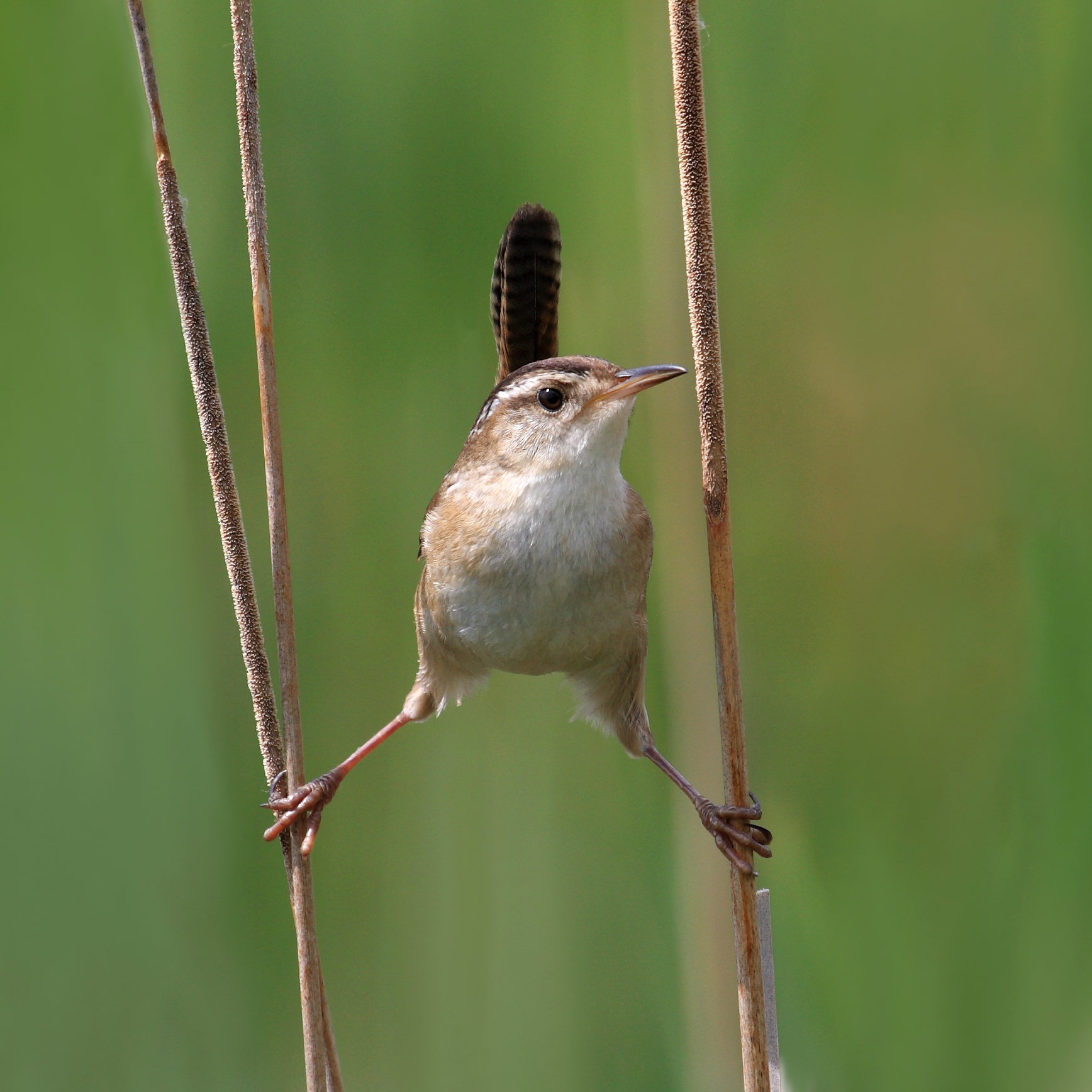
Photo Cephas (opens in a new tab) / Wikimedia Commons, CC BY-SA 3.0 (opens in a new tab)
At a glance
- Size
- About 10 to 14 cm long
- Weight
- About 9 to 14 g
- Habitat
- Tall marsh grass, cattails and cordgrass
- Diet
- Insects and spiders
- In Georgia
- A common resident of coastal marshes; more in winter
- Voice
- A rattling, gurgling song
- Rabies vector
- No
Identification
- Key marks
- Rusty brown; bold white eyebrow; black-and-white streaked back; cocked tail
- Told apart from
- Sedge wren, which has a streaked crown and faint eyebrow
- Told apart from
- Carolina wren, which lives in woods and yards
- Where to look
- Salt and freshwater marshes
Behaviour
Male marsh wrens build many dome-shaped nests, some never used, and females choose one. They sing day and night in the breeding season.
Why they matter
Marsh wrens are among the most numerous songbirds in Georgia's salt marshes. Their dummy nests may confuse predators and help attract mates.
Reproduction and lifecycle
Nest — A dome of woven grass attached to marsh stems
Eggs — Usually four or five
Incubation — About 12 to 16 days
Chicks — Fed mostly by the female
Flight — At about 12 to 16 days
Lifespan — A few years
Living around people
- Marsh development and draining remove their habitat.
Misconceptions
- Empty nests in a marsh are abandoned. Many are dummy nests built by male wrens.
Related species
Seasonal activity
When this species is breeding, and when there are nests on the ground. Mowing during the shaded months is how most nests are found.
| Jan | Feb | Mar | Apr | May | Jun | Jul | Aug | Sep | Oct | Nov | Dec | |
|---|---|---|---|---|---|---|---|---|---|---|---|---|
| Breeding | Jan: no | Feb: no | Mar: no | Apr: no | May: no | Jun: no | Jul: no | Aug: no | Sep: no | Oct: no | Nov: no | Dec: no |
| Active nests | Jan: no | Feb: no | Mar: no | Apr: no | May: no | Jun: no | Jul: no | Aug: no | Sep: no | Oct: no | Nov: no | Dec: no |
| Notes | Present; northern birds wintering | Present | Singing | Nesting | Nesting | Chicks | Second broods | Present | Present | Migrants arriving | Present | Present |
Where it lives
Recorded in 78 states and provinces. Each one links to the other animals there, and to the rehabilitators licensed for them.
United States
- Alabamain winter
- Arizonain winter
- Arkansasin winter
- California
- Colorado
- Connecticutbreeding
- Delawarebreeding
- District of Columbiabreeding
- Floridain winter
- Georgia
- Idaho
- Illinoisbreeding
- Indianabreeding
- Iowabreeding
- Kansasin winter
- Kentuckyin winter
- Louisianain winter
- Mainebreeding
- Marylandbreeding
- Massachusettsbreeding
- Michiganbreeding
- Minnesotabreeding
- Mississippiin winter
- Missouripassing through
- Montanabreeding
- Nebraskabreeding
- Nevada
- New Hampshirebreeding
- New Jerseybreeding
- New Mexicoin winter
- New Yorkbreeding
- North Carolinain winter
- North Dakotabreeding
- Ohiobreeding
- Oklahomain winter
- Oregon
- Pennsylvaniabreeding
- Rhode Island
- South Carolina
- South Dakotabreeding
- Tennesseein winter
- Texasin winter
- Utah
- Vermontbreeding
- Virginia
- Washington
- Wisconsinbreeding
- Wyomingbreeding
Canada
Mexico
- Aguascalientesin winter
- Baja California
- Baja California Surin winter
- Chihuahuain winter
- Coahuilain winter
- Durangoin winter
- Guanajuatoin winter
- Hidalgoin winter
- Jaliscoin winter
- Mexico Cityin winter
- Michoacanin winter
- Nayaritin winter
- Nuevo Leonin winter
- Pueblain winter
- Queretaroin winter
- San Luis Potosiin winter
- Sinaloain winter
- Sonora
- State of Mexico
- Tamaulipasin winter
- Tlaxcalain winter
If you found one
Answer a few questions and you will get a specific answer for what you are looking at.
I found an animal