
Species
Carolina wren
Thryothorus ludovicianus
A small, rusty wren with a huge voice, singing 'teakettle-teakettle' year-round in Georgia's yards.
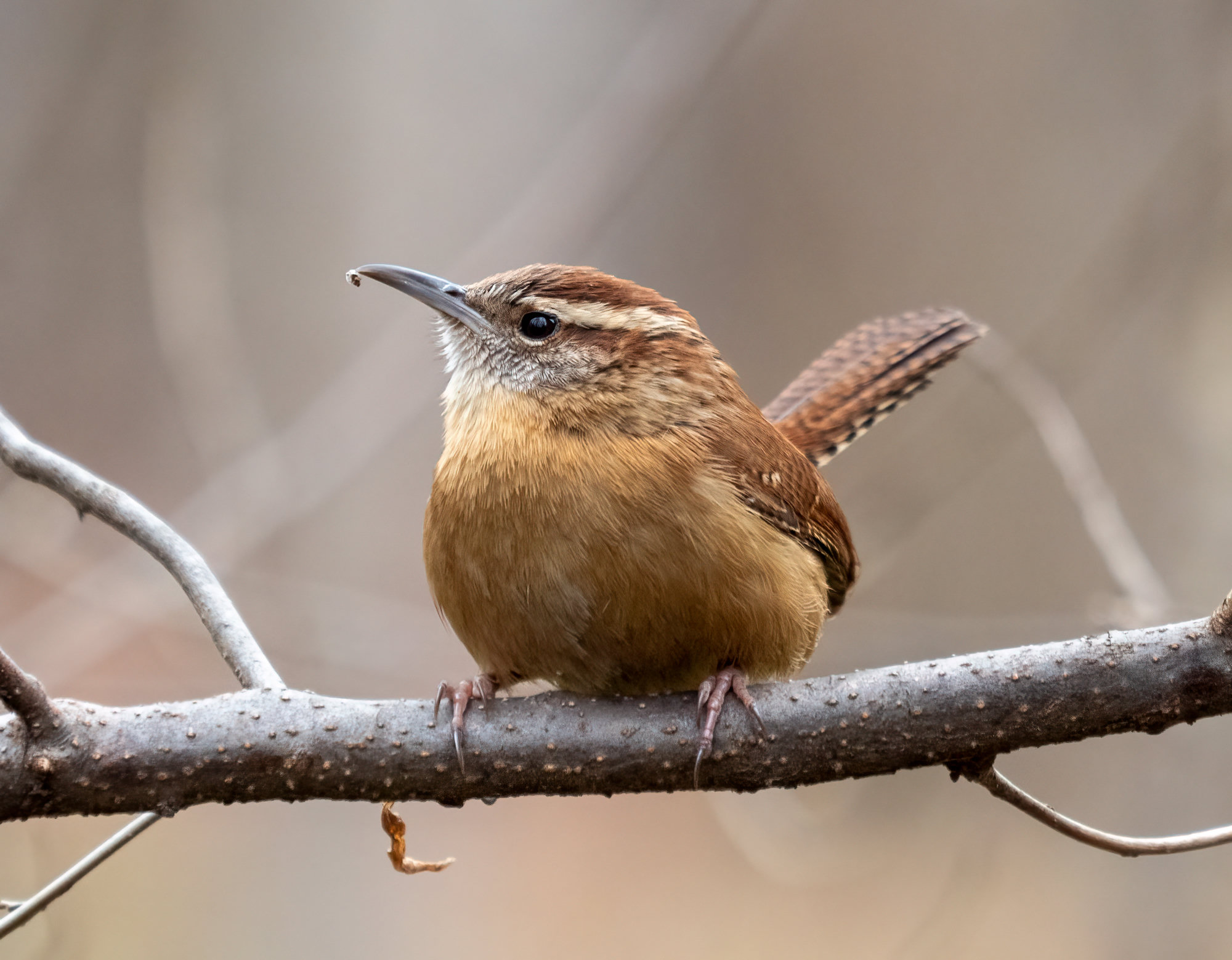
Photo Rhododendrites (opens in a new tab) / Wikimedia Commons, CC BY-SA 4.0 (opens in a new tab)
At a glance
- Size
- About 12 to 14 cm long
- Weight
- About 18 to 22 g
- Habitat
- Woods, thickets, yards and gardens
- Diet
- Insects and spiders; some seeds
- In Georgia
- Common resident statewide
- Voice
- A loud, rolling "teakettle-teakettle-teakettle"
- Rabies vector
- No
Identification
- Key marks
- Rusty brown above; buff below; bold white eyebrow; cocked tail
- Told apart from
- House wren, which is greyer with no bold eyebrow
- Told apart from
- Marsh wren, which has a streaked back and lives in marshes
- Where to look
- Brush piles, porches and shrubs
Behaviour
Carolina wrens nest in odd places — hanging baskets, mailboxes, garages and boots. Pairs stay together year-round and sing duets.
Why they matter
Carolina wrens eat many insects and spiders around homes. Their loud song is one of the most familiar sounds in Georgia yards, all year.
Reproduction and lifecycle
Nest — A dome of leaves and grass in a cavity or sheltered nook
Eggs — Usually four to six
Incubation — About 12 to 16 days
Chicks — Fed by both parents
Flight — At about 12 to 14 days
Lifespan — A few years
Living around people
- A wren nesting in a porch planter or garage needs only a few weeks of peace.
- Brush piles give them shelter in winter.
Misconceptions
- Such a loud song must come from a big bird. It comes from this small wren.
Related species
Seasonal activity
When this species is breeding, and when there are nests on the ground. Mowing during the shaded months is how most nests are found.
| Jan | Feb | Mar | Apr | May | Jun | Jul | Aug | Sep | Oct | Nov | Dec | |
|---|---|---|---|---|---|---|---|---|---|---|---|---|
| Breeding | Jan: no | Feb: no | Mar: no | Apr: no | May: no | Jun: no | Jul: no | Aug: no | Sep: no | Oct: no | Nov: no | Dec: no |
| Active nests | Jan: no | Feb: no | Mar: no | Apr: no | May: no | Jun: no | Jul: no | Aug: no | Sep: no | Oct: no | Nov: no | Dec: no |
| Notes | Pairs singing | Pairs | Nesting | Nesting | Chicks | Second broods | Third broods | Young fledging | Present | Present | Present | Present |
Where it lives
Recorded in 41 states and provinces. Each one links to the other animals there, and to the rehabilitators licensed for them.
United States
- Alabama
- Arkansas
- Connecticut
- Delaware
- District of Columbia
- Florida
- Georgia
- Illinois
- Indiana
- Iowa
- Kansas
- Kentucky
- Louisiana
- Maine
- Maryland
- Massachusetts
- Michigan
- Mississippi
- Missouri
- Nebraska
- New Hampshire
- New Jersey
- New York
- North Carolina
- Ohio
- Oklahoma
- Pennsylvania
- Rhode Island
- South Carolina
- Tennessee
- Texas
- Vermont
- Virginia
- West Virginia
- Wisconsin
Canada
If you found one
Answer a few questions and you will get a specific answer for what you are looking at.
I found an animal