
Species
King rail
Rallus elegans
The largest North American rail, a rusty, chicken-sized bird of freshwater and brackish marshes.
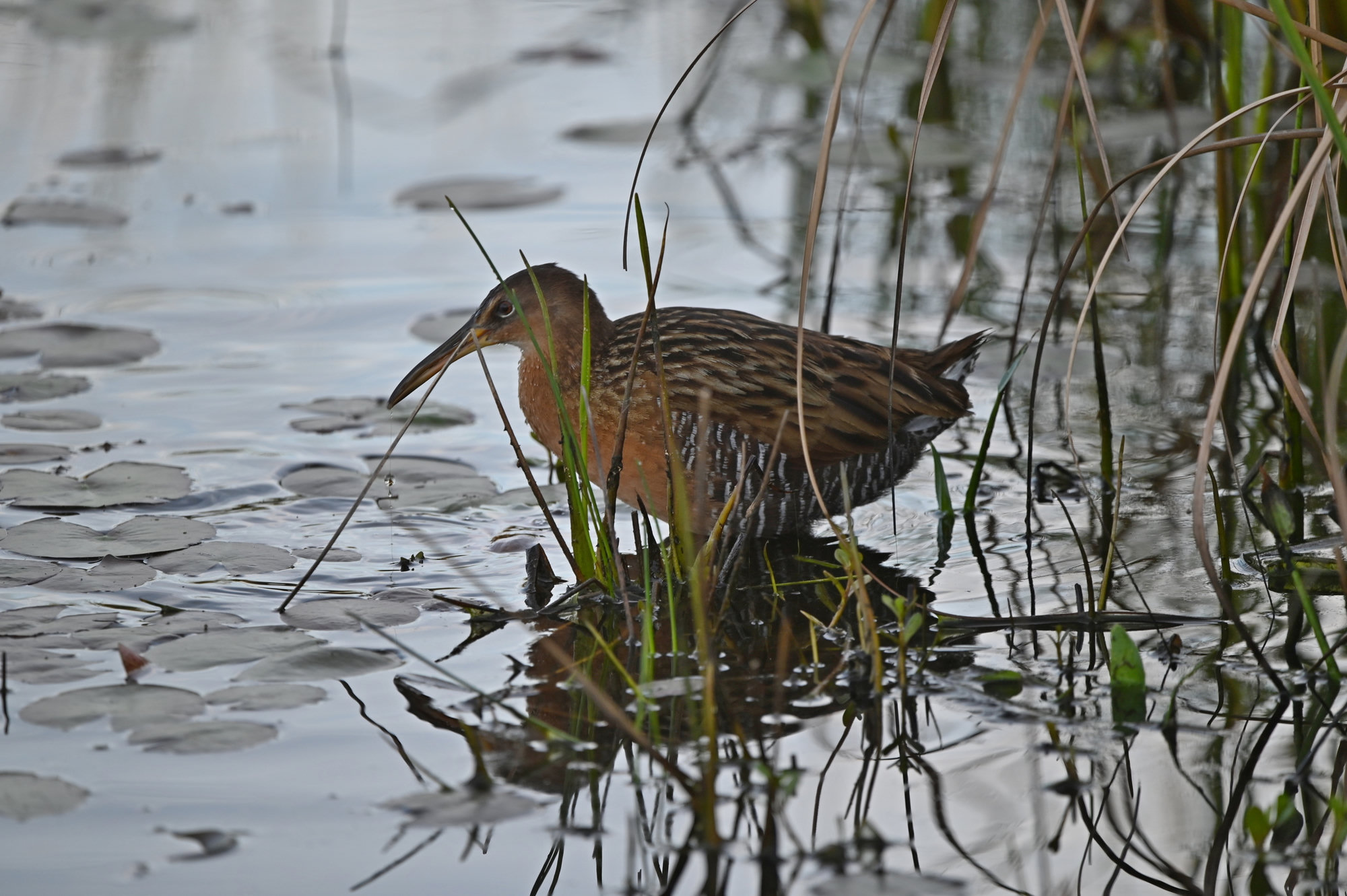
Photo Jody Shugart (opens in a new tab) / iNaturalist, CC BY 4.0 (opens in a new tab)
At a glance
- Size
- About 38 to 48 cm long
- Weight
- About 250 to 450 g
- Habitat
- Freshwater and brackish marshes, rice fields and wet meadows
- Diet
- Crayfish, crabs, insects, snails, small fish and seeds
- In Georgia
- An uncommon resident, mostly on the coastal plain and coast
- Voice
- A deep, grunting "kek-kek-kek"
- Rabies vector
- No
Identification
- Key marks
- Large rail with warm cinnamon breast; long bill; bold black and white barring on the flanks
- Told apart from
- Clapper rail, which is greyer and lives in salt marsh
- Told apart from
- Virginia rail, which is much smaller with a grey face
- Where to look
- Edges of freshwater marshes and impoundments, especially at dawn and dusk
Behaviour
King rails move secretively through dense marsh plants and wade in shallow water to catch crayfish and other prey. Pairs defend territories with loud calls.
Why they matter
King rails have declined across much of their range as freshwater marshes were drained. They are a sign of healthy, well-managed wetlands, and coastal impoundments in Georgia are important to them.
Reproduction and lifecycle
Nest — A basket of plants above water, often with a canopy
Eggs — Usually 10 to 12
Incubation — About 21 to 23 days
Chicks — Downy and black; leave the nest soon after hatching
Flight — At about nine weeks
Lifespan — A few years
Living around people
- Draining or filling small freshwater marshes removes their habitat for good.
Misconceptions
- King and clapper rails are the same bird. They are separate species, though they sometimes interbreed where fresh and salt marsh meet.
Related species
Seasonal activity
When this species is breeding, and when there are nests on the ground. Mowing during the shaded months is how most nests are found.
| Jan | Feb | Mar | Apr | May | Jun | Jul | Aug | Sep | Oct | Nov | Dec | |
|---|---|---|---|---|---|---|---|---|---|---|---|---|
| Breeding | Jan: no | Feb: no | Mar: no | Apr: no | May: no | Jun: no | Jul: no | Aug: no | Sep: no | Oct: no | Nov: no | Dec: no |
| Active nests | Jan: no | Feb: no | Mar: no | Apr: no | May: no | Jun: no | Jul: no | Aug: no | Sep: no | Oct: no | Nov: no | Dec: no |
| Notes | Resident | Calling | Pairs forming | Nesting | Nesting | Chicks | Chicks | Young independent | Present | Present | Present | Present |
Where it lives
Recorded in 24 states and provinces. Each one links to the other animals there, and to the rehabilitators licensed for them.
United States
- Alabama
- Arkansasbreeding
- Connecticutbreeding
- Delawarebreeding
- Florida
- Georgia
- Illinoisbreeding
- Indianabreeding
- Kansasbreeding
- Louisiana
- Mainebreeding
- Maryland
- Massachusettsbreeding
- Michiganbreeding
- Minnesotabreeding
- Mississippi
- New Jerseybreeding
- North Carolina
- Ohiobreeding
- Oklahoma
- Rhode Islandbreeding
- South Carolina
- Texas
- Virginia
If you found one
Answer a few questions and you will get a specific answer for what you are looking at.
I found an animal