
Species
House finch
Haemorhous mexicanus
A red-headed finch of feeders and porch ledges, once a western bird, now common across the East.
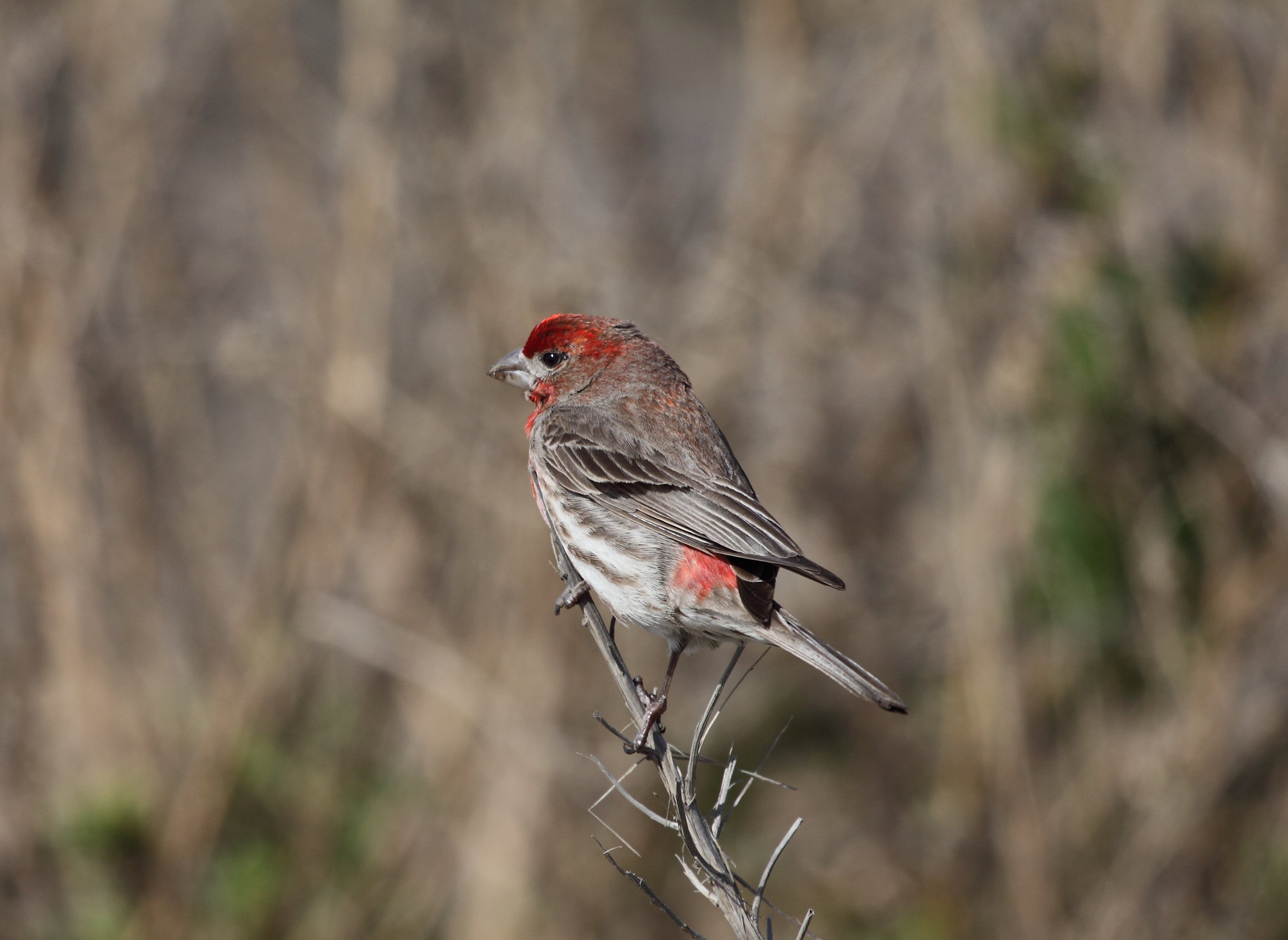
Photo Basar (opens in a new tab) / Wikimedia Commons, CC BY-SA 3.0 (opens in a new tab)
At a glance
- Size
- About 13 to 14 cm long
- Weight
- About 16 to 27 g
- Habitat
- Towns, suburbs, farms and parks
- Diet
- Seeds, buds and fruit
- In Georgia
- Common resident
- Voice
- A long, warbling song ending in a burry note
- Rabies vector
- No
Identification
- Male
- Red head, breast and rump; brown-streaked belly and sides
- Female
- Plain brown with blurry streaks
- Told apart from
- Purple finch, which is raspberry-coloured with unstreaked sides
- Where to look
- Feeders, porch lights and hanging baskets
Behaviour
House finches nest on buildings, in wreaths and in hanging plants. Males' red colour comes from pigments in their food, and females prefer the reddest males.
Why they matter
House finches were released on Long Island in the 1940s after being sold illegally as cage birds, and spread across the East. An eye disease, mycoplasmal conjunctivitis, has swept through their populations, and scientists study it as a model of how diseases spread in wildlife.
Reproduction and lifecycle
Nest — A cup of grass on a ledge, wreath or hanging plant
Eggs — Usually four or five
Incubation — About 13 to 14 days
Chicks — Fed by both parents
Flight — At about 12 to 19 days
Lifespan — Several years
Living around people
- Finches with crusty, swollen eyes have conjunctivitis; feeders should be cleaned with a dilute bleach solution and dried to slow its spread.
- A nest in a porch wreath lasts about a month.
Misconceptions
- Red finches are cardinals. House finches are much smaller with no crest.
Related species
Seasonal activity
When this species is breeding, and when there are nests on the ground. Mowing during the shaded months is how most nests are found.
| Jan | Feb | Mar | Apr | May | Jun | Jul | Aug | Sep | Oct | Nov | Dec | |
|---|---|---|---|---|---|---|---|---|---|---|---|---|
| Breeding | Jan: no | Feb: no | Mar: no | Apr: no | May: no | Jun: no | Jul: no | Aug: no | Sep: no | Oct: no | Nov: no | Dec: no |
| Active nests | Jan: no | Feb: no | Mar: no | Apr: no | May: no | Jun: no | Jul: no | Aug: no | Sep: no | Oct: no | Nov: no | Dec: no |
| Notes | Flocks | Pairs forming | Nesting | Nesting | Chicks | Second broods | Young fledging | Flocks | Flocks | Flocks | Flocks | Flocks |
Where it lives
Recorded in 86 states and provinces. Each one links to the other animals there, and to the rehabilitators licensed for them.
United States
- Alabama
- Arizona
- Arkansas
- California
- Colorado
- Connecticut
- Delaware
- District of Columbia
- Florida
- Georgia
- Hawaiiintroduced
- Idaho
- Illinois
- Indiana
- Iowa
- Kansas
- Kentucky
- Louisiana
- Maine
- Maryland
- Massachusetts
- Michigan
- Minnesota
- Mississippi
- Missouri
- Montana
- Nebraska
- Nevada
- New Hampshire
- New Jersey
- New Mexico
- New York
- North Carolina
- North Dakota
- Ohio
- Oklahoma
- Oregon
- Pennsylvania
- Rhode Island
- South Carolina
- South Dakota
- Tennessee
- Texas
- Utah
- Vermont
- Virginia
- Washington
- West Virginia
- Wisconsin
- Wyoming
If you found one
Answer a few questions and you will get a specific answer for what you are looking at.
I found an animal