
Species
Herring gull
Larus smithsonianus
The big, pink-legged gull of winter beaches, which drops shellfish on rocks and roads to break them open.
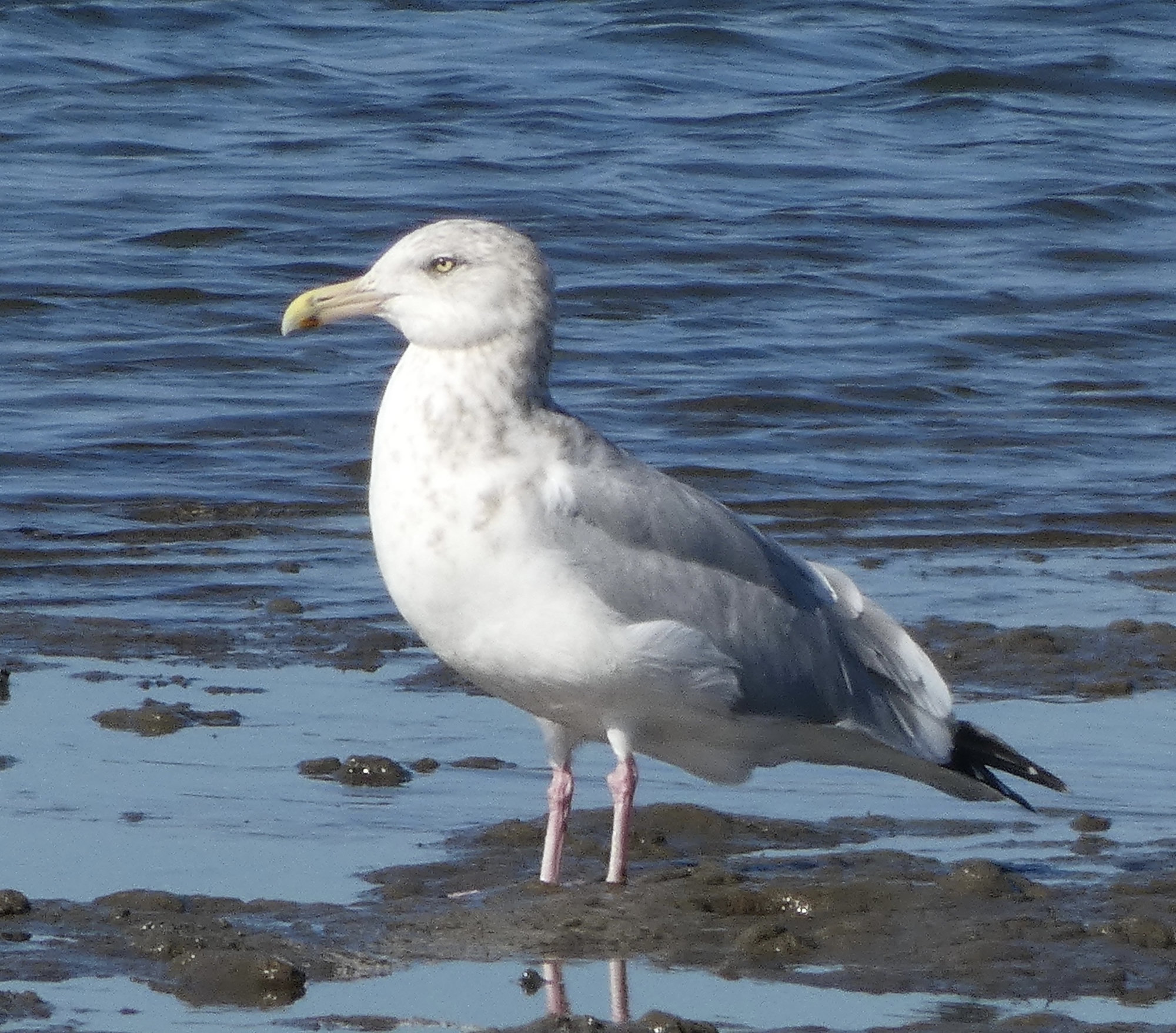
Photo Laura Liedtke (opens in a new tab) / iNaturalist, CC BY 4.0 (opens in a new tab)
At a glance
- Size
- About 56 to 66 cm long; wingspan about 1.4 m
- Weight
- About 800 to 1,500 g
- Habitat
- Beaches, harbours, landfills, lakes and reservoirs
- Diet
- Fish, crabs, clams, eggs, carrion and food scraps
- In Georgia
- A common winter visitor on the coast; fewer inland
- Voice
- A loud, laughing "kyow-kyow-kyow"
- Rabies vector
- No
Identification
- Key marks
- Large; pale grey back; black wingtips; pink legs; yellow bill with a red spot; young birds mottled brown for up to four years
- Told apart from
- Ring-billed gull, which is smaller with yellow legs and a ringed bill
- Told apart from
- Lesser black-backed gull, which has a darker back and yellow legs
- Where to look
- Beaches and harbours, November to March
Behaviour
Herring gulls drop clams and crabs from the air onto hard surfaces to break them. Chicks peck the red spot on the parent's bill to prompt it to bring up food, one of the classic studies of animal behaviour.
Why they matter
Herring gulls are scavengers that clean up beaches and harbours, and their behaviour has taught scientists a great deal about how instinct and learning work together in birds.
Reproduction and lifecycle
Nest — A scrape lined with grass on islands, beaches or rooftops
Eggs — Usually three
Incubation — About 28 to 30 days
Chicks — Fed by both parents
Flight — At about six to seven weeks
Maturity — Adult plumage at about four years
Lifespan — Wild birds over thirty years are recorded
Living around people
- Fed gulls lose their fear of people and can become a nuisance; not feeding them keeps them wild.
- Gulls tangled in fishing line or hooked need a rehabilitator; cutting the line and releasing them rarely helps.
Misconceptions
- A brown gull is a different species. Young herring gulls are brown for several years before turning grey and white.
Related species
Seasonal activity
When this species is breeding, and when there are nests on the ground. Mowing during the shaded months is how most nests are found.
| Jan | Feb | Mar | Apr | May | Jun | Jul | Aug | Sep | Oct | Nov | Dec | |
|---|---|---|---|---|---|---|---|---|---|---|---|---|
| Breeding | Jan: no | Feb: no | Mar: no | Apr: no | May: no | Jun: no | Jul: no | Aug: no | Sep: no | Oct: no | Nov: no | Dec: no |
| Active nests | Jan: no | Feb: no | Mar: no | Apr: no | May: no | Jun: no | Jul: no | Aug: no | Sep: no | Oct: no | Nov: no | Dec: no |
| Notes | Wintering | Wintering | Adults leaving | Young birds remain | Nesting farther north | Nesting | Chicks | Young flying | Moving south | Arriving | Wintering | Wintering |
Where it lives
Recorded in 61 states and provinces. Each one links to the other animals there, and to the rehabilitators licensed for them.
United States
- Alabamain winter
- Alaska
- Californiain winter
- Coloradoin winter
- Connecticut
- Delaware
- District of Columbiain winter
- Floridain winter
- Georgiain winter
- Idahoin winter
- Illinoisin winter
- Indianain winter
- Iowain winter
- Kansasin winter
- Kentuckyin winter
- Louisianain winter
- Maine
- Marylandin winter
- Massachusetts
- Michigan
- Minnesota
- Mississippiin winter
- Missouriin winter
- Nebraskain winter
- Nevadain winter
- New Hampshire
- New Jersey
- New Yorkin winter
- North Carolina
- North Dakotain winter
- Ohioin winter
- Oklahomain winter
- Oregonin winter
- Pennsylvaniain winter
- Rhode Island
- South Carolinain winter
- South Dakotain winter
- Texasin winter
- Utahin winter
- Vermontin winter
- Virginiain winter
- Washingtonin winter
- Wisconsin
Canada
If you found one
Answer a few questions and you will get a specific answer for what you are looking at.
I found an animal