
Species
Great crested flycatcher
Myiarchus crinitus
A loud, lemon-bellied flycatcher of the treetops that often weaves a shed snakeskin into its nest.
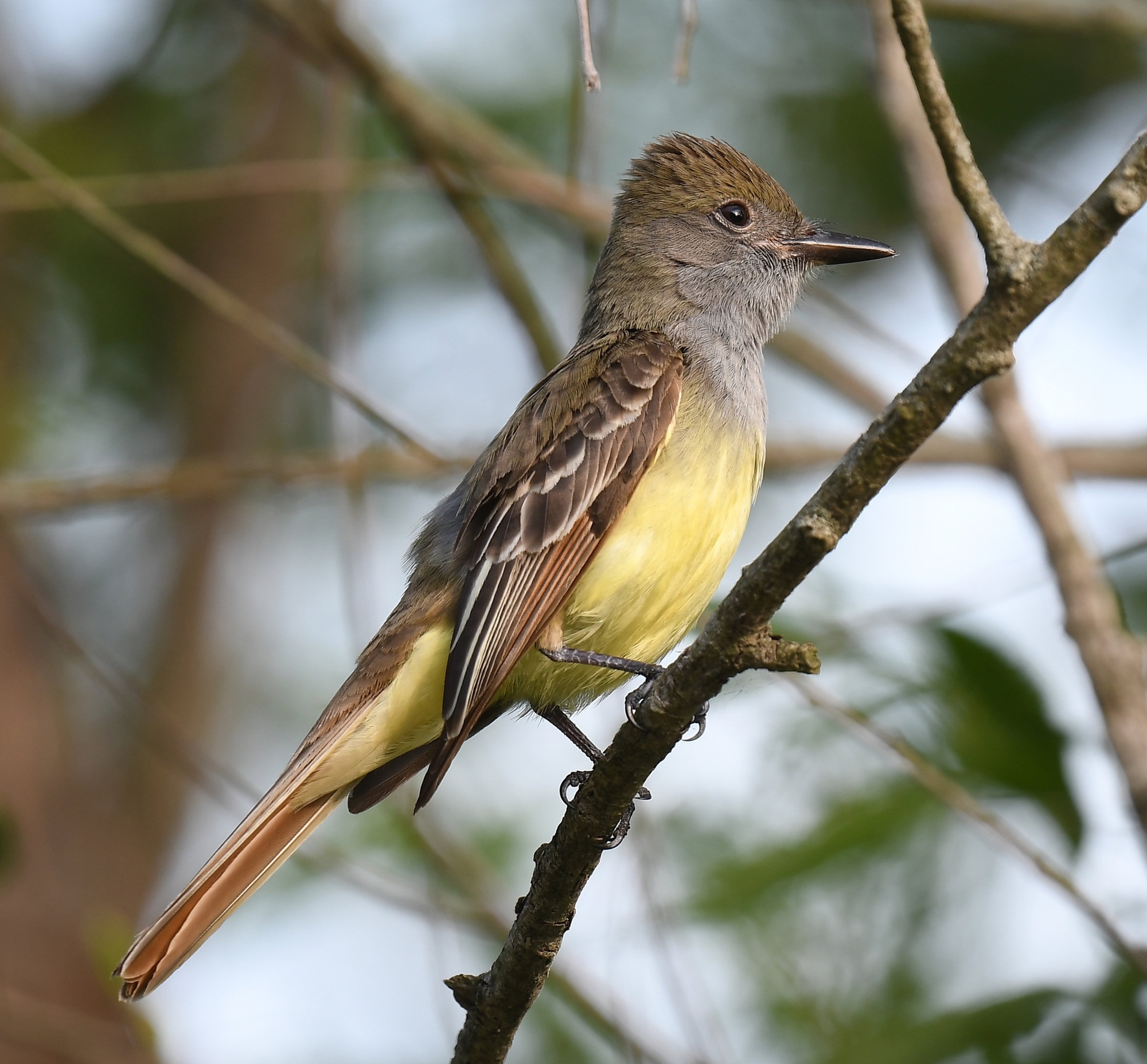
Photo Unknown photographer (opens in a new tab) / iNaturalist, CC0 1.0 (opens in a new tab)
At a glance
- Size
- About 17 to 21 cm long
- Weight
- About 27 to 40 g
- Habitat
- Open woods, forest edges, parks and wooded suburbs
- Diet
- Large insects, including beetles, moths and katydids; some berries
- In Georgia
- A common summer resident, April to September
- Voice
- A loud, rising "wheep!"
- Rabies vector
- No
Identification
- Key marks
- Grey throat and breast; bright lemon-yellow belly; rufous in the wings and tail; slight crest
- Told apart from
- Eastern kingbird, which is black and white
- Told apart from
- Western kingbird, which has a pale grey head and a black tail
- Where to look
- High in leafy trees; listen for the loud "wheep"
Behaviour
Great crested flycatchers catch insects in flight or snatch them from leaves. They nest in tree cavities and nest boxes, often adding a piece of shed snakeskin or plastic to the nest.
Why they matter
This is the only eastern flycatcher that nests in cavities, so it depends on old woodpecker holes and dead trees. It eats many large insects in the tree canopy.
Reproduction and lifecycle
Nest — A cavity or nest box filled with grass, feathers and often a snakeskin
Eggs — Usually four to six
Incubation — About 13 to 15 days
Chicks — Fed by both parents
Flight — At about 13 to 15 days
Lifespan — Several years
Living around people
- Nest boxes with a 5 cm entrance hole are sometimes used.
- Dead trees with woodpecker holes provide nest sites.
Misconceptions
- The snakeskin in the nest is to scare predators. Nobody is sure why they use it; it may simply be a favoured material.
Related species
Seasonal activity
When this species is breeding, and when there are nests on the ground. Mowing during the shaded months is how most nests are found.
| Jan | Feb | Mar | Apr | May | Jun | Jul | Aug | Sep | Oct | Nov | Dec | |
|---|---|---|---|---|---|---|---|---|---|---|---|---|
| Breeding | Jan: no | Feb: no | Mar: no | Apr: no | May: no | Jun: no | Jul: no | Aug: no | Sep: no | Oct: no | Nov: no | Dec: no |
| Active nests | Jan: no | Feb: no | Mar: no | Apr: no | May: no | Jun: no | Jul: no | Aug: no | Sep: no | Oct: no | Nov: no | Dec: no |
| Notes | In Central America | In Central America | In Central America | Arriving | Nesting | Nesting | Young fledging | Present | Leaving | Last birds | In Central America | In Central America |
Where it lives
Recorded in 56 states and provinces. Each one links to the other animals there, and to the rehabilitators licensed for them.
United States
- Alabamabreeding
- Arkansasbreeding
- Connecticutbreeding
- Delawarebreeding
- District of Columbiabreeding
- Florida
- Georgiabreeding
- Illinoisbreeding
- Indianabreeding
- Iowabreeding
- Kansasbreeding
- Kentuckybreeding
- Louisianabreeding
- Mainebreeding
- Marylandbreeding
- Massachusettsbreeding
- Michiganbreeding
- Minnesotabreeding
- Mississippibreeding
- Missouribreeding
- Nebraskabreeding
- New Hampshirebreeding
- New Jerseybreeding
- New Yorkbreeding
- North Carolinabreeding
- North Dakotabreeding
- Ohiobreeding
- Oklahomabreeding
- Pennsylvaniabreeding
- Rhode Islandbreeding
- South Carolinabreeding
- South Dakotabreeding
- Tennesseebreeding
- Texasbreeding
- Vermontbreeding
- Virginiabreeding
- West Virginiabreeding
- Wisconsinbreeding
Canada
If you found one
Answer a few questions and you will get a specific answer for what you are looking at.
I found an animal