
Species
Eastern newt
Notophthalmus viridescens
A newt with three lives: an aquatic larva, a bright orange land-dwelling eft, and an olive pond adult.
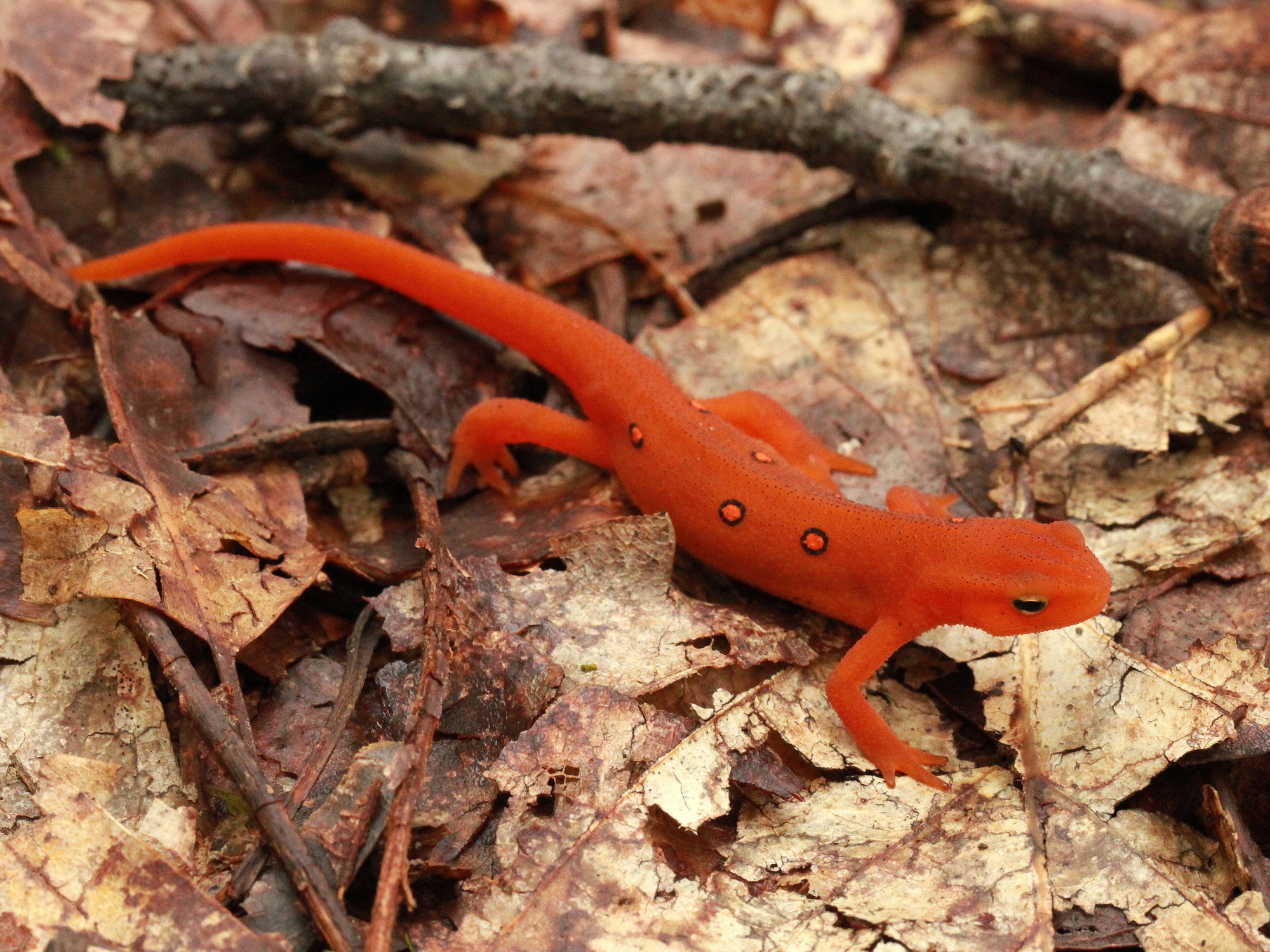
Photo Jason Quinn (opens in a new tab) / Wikimedia Commons, CC BY-SA 3.0 (opens in a new tab)
At a glance
- Size
- Usually 6 to 12 cm long
- Habitat
- Ponds and lakes with plants, and the moist forests around them
- Diet
- Insects, snails, worms, small crustaceans and amphibian eggs
- In Georgia
- Statewide
- Rabies vector
- No
Identification
- Key marks
- Adults olive-green with a flat, finned tail and small red spots ringed in black; efts bright orange-red and rough-skinned
- Told apart from
- Striped newt, which has red stripes rather than spots
- Where to look
- Efts walk openly on the forest floor after rain; adults in weedy ponds
Behaviour
Eastern newts have a life of three stages. Larvae hatch in ponds, many then leave as bright orange efts and wander the forest for several years, then return to water as adults. Efts walk in daylight because their skin is toxic, and their colour warns predators.
Why they matter
They are long-lived predators of pond insects and mosquito larvae. The eft's bright colour is one of the clearest examples of warning coloration in North America.
Reproduction and lifecycle
Eggs — Laid singly on water plants, a few hundred a season
Hatching — In three to five weeks
Larvae — Gilled; change after a few months
Eft stage — Two to seven years on land, where it occurs
Maturity — On return to water
Lifespan — Over 10 years
Living around people
- Wash hands after touching an eft; its skin secretions are toxic if swallowed.
- An eft on a path can be left alone; it is safe from most predators.
Misconceptions
- Red efts and green newts are different animals. They are the same animal at different stages.
Related species
Seasonal activity
When this species is breeding, and when there are nests on the ground. Mowing during the shaded months is how most nests are found.
| Jan | Feb | Mar | Apr | May | Jun | Jul | Aug | Sep | Oct | Nov | Dec | |
|---|---|---|---|---|---|---|---|---|---|---|---|---|
| Breeding | Jan: no | Feb: no | Mar: no | Apr: no | May: no | Jun: no | Jul: no | Aug: no | Sep: no | Oct: no | Nov: no | Dec: no |
| Active nests | Jan: no | Feb: no | Mar: no | Apr: no | May: no | Jun: no | Jul: no | Aug: no | Sep: no | Oct: no | Nov: no | Dec: no |
| Notes | Adults active in ponds | Breeding | Breeding | Breeding | Larvae | Efts leaving ponds | Efts on land after rain | Efts on land | Efts on land | Adults in ponds | Adults active | Adults active |
Where it lives
Recorded in 38 states and provinces. Each one links to the other animals there, and to the rehabilitators licensed for them.
United States
If you found one
Answer a few questions and you will get a specific answer for what you are looking at.
I found an animal