
Species
Double-crested cormorant
Nannopterum auritum
A black diving bird with a hooked bill and turquoise eyes, often seen standing with wings spread on posts and docks.
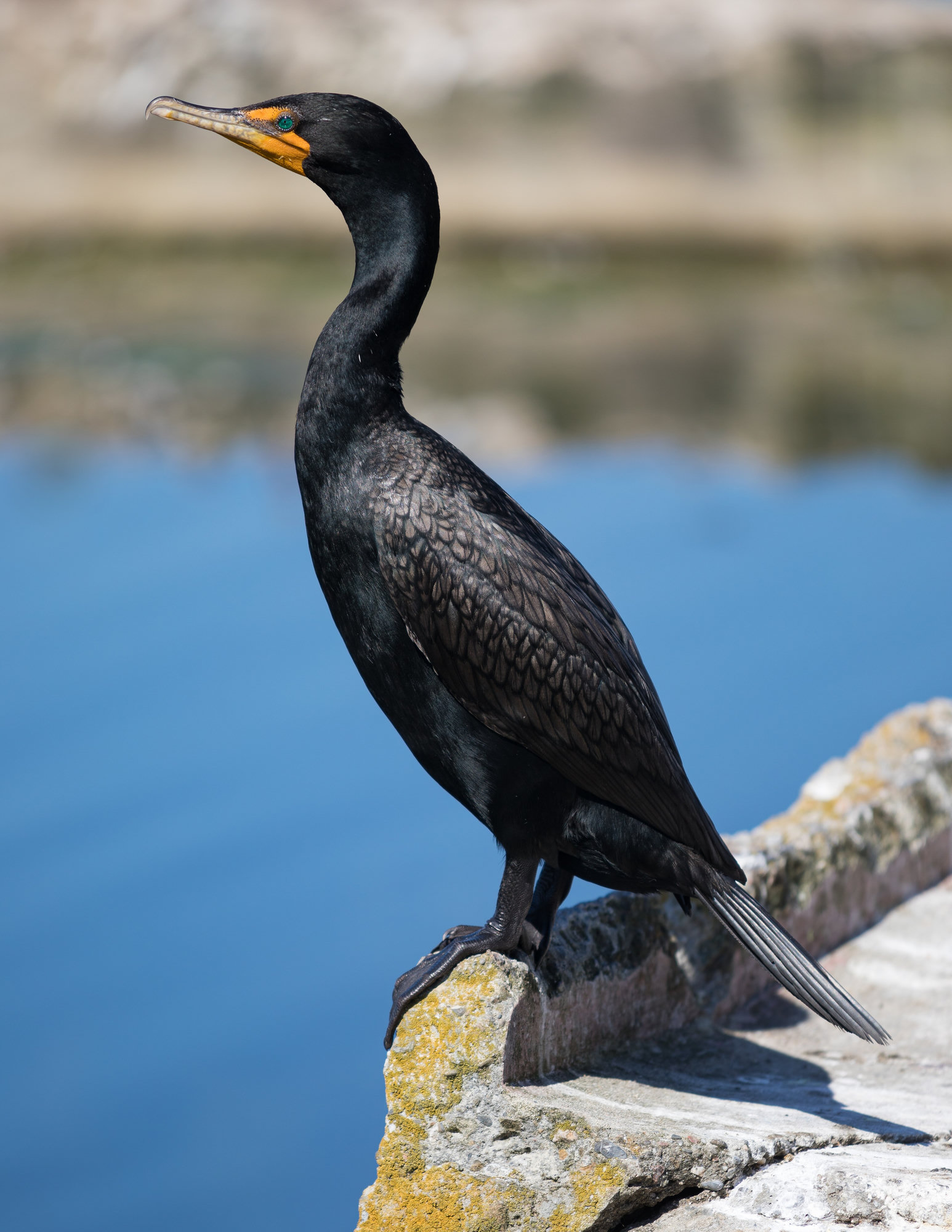
Photo Frank Schulenburg (opens in a new tab) / Wikimedia Commons, CC BY-SA 4.0 (opens in a new tab)
At a glance
- Size
- About 70 to 90 cm long; wingspan about 1.1 to 1.2 m
- Weight
- About 1.2 to 2.5 kg
- Habitat
- Lakes, rivers, reservoirs, coasts and harbours
- Diet
- Fish
- In Georgia
- Common all year; more numerous in winter
- Voice
- Grunts at colonies; silent elsewhere
- Rabies vector
- No
Identification
- Key marks
- Black with an orange-yellow throat patch; hooked bill; turquoise-green eyes; small tufts of feathers on the head in breeding season
- Told apart from
- Anhinga, which has a straight, pointed bill and long tail
- Told apart from
- Neotropic cormorant, which is smaller with a longer tail and a white edge to the throat patch
- Where to look
- Perched on posts, buoys and dead trees near water
Behaviour
Cormorants dive from the surface and chase fish underwater with their feet. Their feathers are partly wettable, reducing buoyancy, and they spread their wings to dry after fishing.
Why they matter
Double-crested cormorants were nearly wiped out in the mid-1900s by the pesticide DDT, which thinned their eggshells. Their recovery since DDT was banned is one of the clearest signs of how much cleaner many waters have become.
Reproduction and lifecycle
Nest — A platform of sticks in trees or on the ground, in colonies
Eggs — Usually three or four
Incubation — About 25 to 28 days
Chicks — Hatched naked; fed by both parents
Flight — At about six to seven weeks
Lifespan — Wild birds over twenty years are recorded
Living around people
- Fishing line is a common cause of injury; a hooked or tangled cormorant needs a rehabilitator.
- A cormorant with wings spread is drying off, not hurt.
Misconceptions
- Cormorants empty lakes of fish. Most of what they eat is small fish of little interest to anglers. Effects on fisheries are real in a few places, but far smaller than their reputation.
- Wet feathers mean a sick bird. Cormorants' feathers are designed to get wet.
Related species
Seasonal activity
When this species is breeding, and when there are nests on the ground. Mowing during the shaded months is how most nests are found.
| Jan | Feb | Mar | Apr | May | Jun | Jul | Aug | Sep | Oct | Nov | Dec | |
|---|---|---|---|---|---|---|---|---|---|---|---|---|
| Breeding | Jan: no | Feb: no | Mar: no | Apr: no | May: no | Jun: no | Jul: no | Aug: no | Sep: no | Oct: no | Nov: no | Dec: no |
| Active nests | Jan: no | Feb: no | Mar: no | Apr: no | May: no | Jun: no | Jul: no | Aug: no | Sep: no | Oct: no | Nov: no | Dec: no |
| Notes | Large wintering flocks | Wintering | Migrants leaving | Nesting in colonies | Nesting | Chicks | Young flying | Families | Migrants arriving | Flocks building | Wintering flocks | Wintering |
Where it lives
Recorded in 76 states and provinces. Each one links to the other animals there, and to the rehabilitators licensed for them.
United States
- Alabamain winter
- Alaska
- Arizona
- Arkansasin winter
- California
- Coloradobreeding
- Connecticutbreeding
- Delaware
- District of Columbia
- Florida
- Georgia
- Idaho
- Illinoisbreeding
- Indiana
- Iowabreeding
- Kansas
- Kentucky
- Louisianain winter
- Mainebreeding
- Maryland
- Massachusettsbreeding
- Michiganbreeding
- Minnesotabreeding
- Mississippiin winter
- Missouri
- Montanabreeding
- Nebraskabreeding
- Nevada
- New Hampshirebreeding
- New Jersey
- New Mexico
- New York
- North Carolinain winter
- North Dakotabreeding
- Ohio
- Oklahomain winter
- Oregon
- Pennsylvania
- Rhode Islandbreeding
- South Carolinain winter
- South Dakotabreeding
- Tennessee
- Texasin winter
- Utahbreeding
- Vermontbreeding
- Virginia
- Washingtonin winter
- West Virginiain winter
- Wisconsinbreeding
- Wyomingbreeding
Canada
If you found one
Answer a few questions and you will get a specific answer for what you are looking at.
I found an animal