
Species
Anhinga
Anhinga anhinga
A long-necked swamp bird that spears fish underwater, then hangs its wings out to dry.
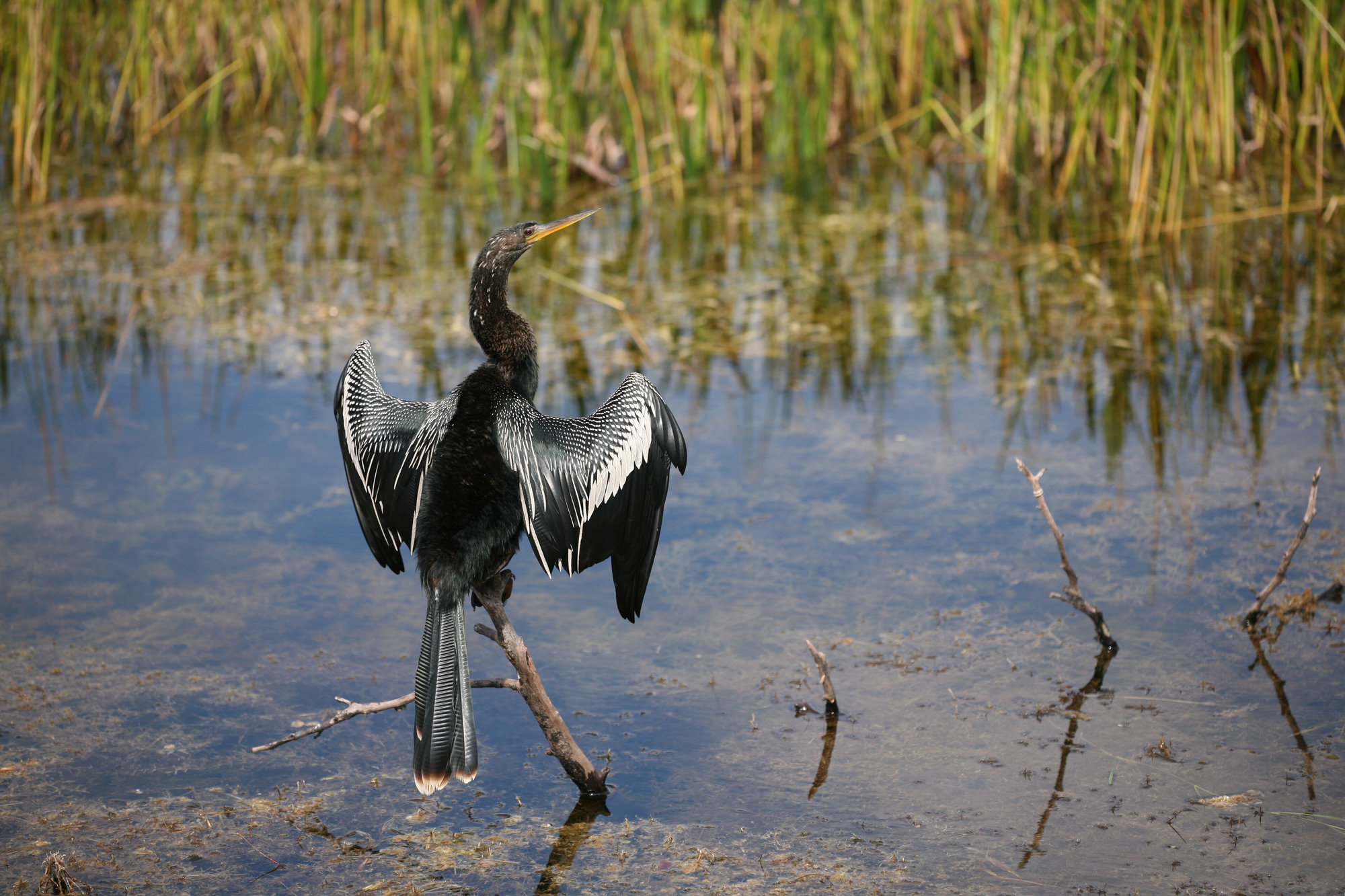
Photo Daniel Schwen (opens in a new tab) / Wikimedia Commons, CC BY-SA 4.0 (opens in a new tab)
At a glance
- Size
- About 75 to 95 cm long; wingspan about 1.1 m
- Weight
- About 1 to 1.35 kg
- Habitat
- Swamps, slow rivers, ponds and lakes with trees
- Diet
- Fish, speared with a dagger-like bill
- In Georgia
- Common in the south in summer and along the coast; fewer in winter
- Voice
- Mostly silent; clicks and grunts at the nest
- Rabies vector
- No
Identification
- Key marks
- Long, snake-like neck; sharp, pointed bill; long fan-shaped tail; silvery-white streaks on the wings; males black, females with a buff neck
- Told apart from
- Double-crested cormorant, which has a hooked bill and a shorter tail
- Where to look
- Perched over water with wings spread; swimming with only the neck showing
Behaviour
Anhingas swim with their bodies underwater and only the head and neck showing, looking like a snake. They spear fish with their bill, flip them in the air and swallow them head first.
Their feathers soak up water, which helps them dive, so afterwards they perch with wings spread to dry and warm in the sun.
Why they matter
The anhinga is one of the defining birds of southern swamps. It hunts slow-moving fish in still water, and it often nests alongside herons and egrets in mixed colonies, where alligators beneath the nests keep raccoons and other egg thieves away.
Reproduction and lifecycle
Nest — A platform of sticks in a tree over water, often in colonies
Eggs — Usually three to five
Incubation — About 25 to 29 days
Chicks — Fed by both parents
Leaving the nest — At about three weeks, clambering in branches
Flight — At about six weeks
Lifespan — Wild birds over twelve years are recorded
Living around people
- Fishing line and hooks tangle anhingas; a hooked bird needs a rehabilitator.
- A bird with wings spread is drying off, not injured.
Misconceptions
- A bird holding its wings out is hurt. Anhingas and cormorants dry their wings this way.
- It is a snake in the water. It is an anhinga swimming low.
Related species
Seasonal activity
When this species is breeding, and when there are nests on the ground. Mowing during the shaded months is how most nests are found.
| Jan | Feb | Mar | Apr | May | Jun | Jul | Aug | Sep | Oct | Nov | Dec | |
|---|---|---|---|---|---|---|---|---|---|---|---|---|
| Breeding | Jan: no | Feb: no | Mar: no | Apr: no | May: no | Jun: no | Jul: no | Aug: no | Sep: no | Oct: no | Nov: no | Dec: no |
| Active nests | Jan: no | Feb: no | Mar: no | Apr: no | May: no | Jun: no | Jul: no | Aug: no | Sep: no | Oct: no | Nov: no | Dec: no |
| Notes | Fewer present; mostly in the far south and on the coast | Returning birds | Pairs forming | Nesting in colonies | Nesting | Chicks | Young leaving nests | Young flying | Present | Many move south | Fewer present | Fewer present |
Where it lives
Recorded in 26 states and provinces. Each one links to the other animals there, and to the rehabilitators licensed for them.
United States
If you found one
Answer a few questions and you will get a specific answer for what you are looking at.
I found an animal