
Species
Common snapping turtle
Chelydra serpentina
A big, prehistoric-looking turtle of every Georgia pond and river, shy in the water and defensive on land.
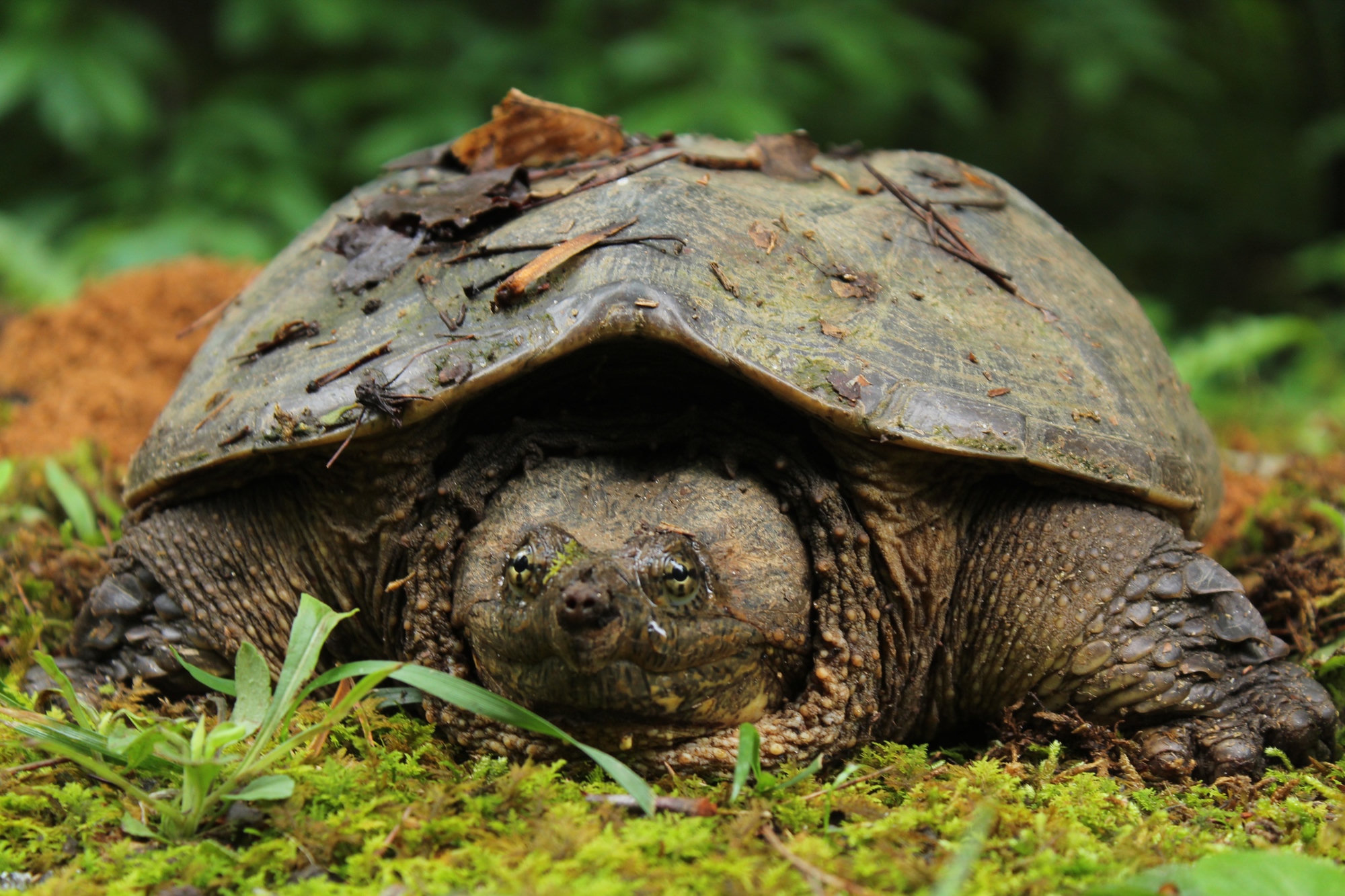
Photo Abbie King (opens in a new tab) / iNaturalist, CC BY 4.0 (opens in a new tab)
At a glance
- Size
- Shell usually 20 to 36 cm long, with a long, saw-toothed tail
- Weight
- Usually 4.5 to 16 kg; exceptional adults over 30 kg
- Habitat
- Almost any fresh water with a soft bottom, from farm ponds to rivers and marshes
- Diet
- Fish, frogs, crayfish, insects, carrion and water plants
- In Georgia
- Common statewide
- Rabies vector
- No
Identification
- Key marks
- Large head, hooked jaw, rough dark shell with three low ridges, small cross-shaped underside and a long tail with a crest of points
- Told apart from
- Alligator snapping turtle, which has three tall ridges on the shell, eyes on the sides of the head and lives only in some southern Georgia rivers
- Where to look
- Rarely seen in the water; most often met crossing roads in spring and early summer
Behaviour
In the water a snapping turtle spends most of its time buried in mud with only its eyes and nostrils showing, and it avoids people. On land it cannot pull itself into its small shell, so it defends itself by lunging and biting. Females travel from the water in late spring to dig nests in sunny soil, often in yards and road verges.
Why they matter
Snapping turtles are among the most important scavengers in fresh water, clearing dead fish and animals, and they keep populations of fish, crayfish and snails in check. They can live for decades, and a pond with a big snapper in it is usually a healthy one.
Reproduction and lifecycle
Nest — Dug by the female in open, sunny soil
Eggs — Usually 20 to 40, round like table-tennis balls
Incubation — About 80 to 90 days; temperature decides each hatchling's sex
Hatchlings — About 3 cm long; some stay in the nest over winter
Maturity — At about 8 to 15 years
Lifespan — Wild snapping turtles over 40 years old are recorded
Living around people
- To help one across a road, push it gently from behind with a car mat, or lift it by the back edge of the shell, and set it down on the side it was heading for; never lift it by the tail, which can injure its spine, and never move it somewhere else.
- Keep hands well away from the front of the shell. The neck reaches farther back than it looks.
- A snapping turtle nesting in a yard is harmless if left alone, and the young leave for water on their own.
Misconceptions
- Snapping turtles attack swimmers. In the water they avoid people; they snap on land only because they cannot hide inside their shell.
- A snapping turtle can be carried safely by its tail. Lifting one by the tail can dislocate the vertebrae.
Related species
Seasonal activity
When this species is breeding, and when there are nests on the ground. Mowing during the shaded months is how most nests are found.
| Jan | Feb | Mar | Apr | May | Jun | Jul | Aug | Sep | Oct | Nov | Dec | |
|---|---|---|---|---|---|---|---|---|---|---|---|---|
| Breeding | Jan: no | Feb: no | Mar: no | Apr: no | May: no | Jun: no | Jul: no | Aug: no | Sep: no | Oct: no | Nov: no | Dec: no |
| Active nests | Jan: no | Feb: no | Mar: no | Apr: no | May: no | Jun: no | Jul: no | Aug: no | Sep: no | Oct: no | Nov: no | Dec: no |
| Notes | Inactive under water; can move beneath ice | Inactive | Becoming active | Feeding; courtship | Females nesting | Females nesting; the peak of road crossings | Nesting ends | Hatching begins | Hatchlings emerge and head for water | Feeding | Slowing down | Inactive under water |
Where it lives
Recorded in 54 states and provinces. Each one links to the other animals there, and to the rehabilitators licensed for them.
United States
- Alabama
- Arizonaintroduced
- Arkansas
- Californiaintroduced
- Colorado
- Connecticut
- Delaware
- District of Columbia
- Florida
- Georgia
- Idahointroduced
- Illinois
- Indiana
- Iowa
- Kansas
- Kentucky
- Louisiana
- Maine
- Maryland
- Massachusetts
- Michigan
- Minnesota
- Mississippi
- Missouri
- Montana
- Nebraska
- New Hampshire
- New Jersey
- New Mexico
- New York
- North Carolina
- North Dakota
- Ohio
- Oklahoma
- Oregonintroduced
- Pennsylvania
- Rhode Island
- South Carolina
- South Dakota
- Tennessee
- Texas
- Vermont
- Virginia
- Washingtonintroduced
- West Virginia
- Wisconsin
- Wyoming
If you found one
Answer a few questions and you will get a specific answer for what you are looking at.
I found an animal