
Species
Suwannee alligator snapping turtle
Macrochelys suwanniensis
A giant snapping turtle found only in the Suwannee river system, including its headwaters in south Georgia.
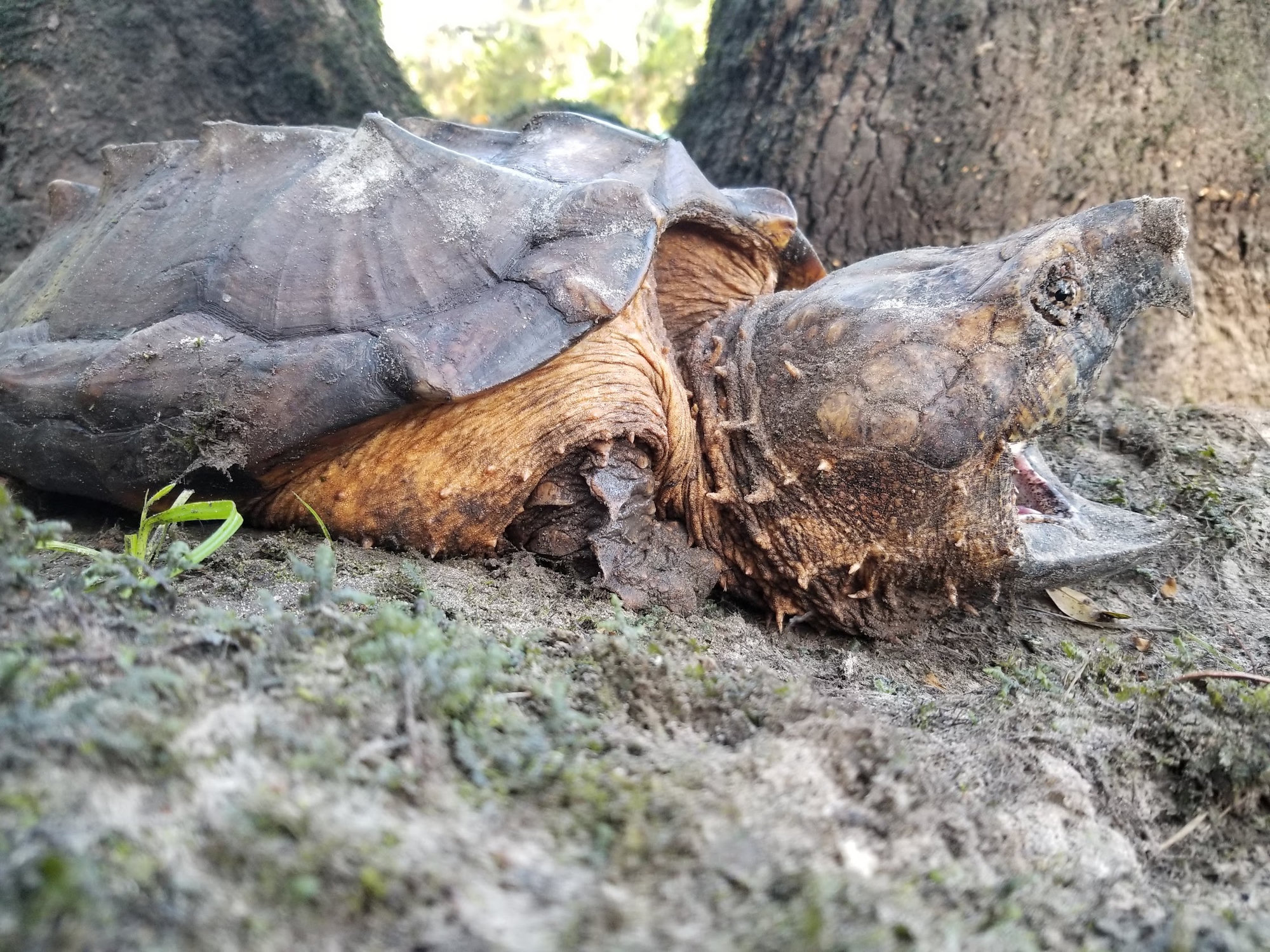
Photo Chris Coppola (opens in a new tab) / Wikimedia Commons, Public domain (opens in a new tab)
At a glance
- Size
- Shell up to about 75 cm long in large males
- Weight
- Adults commonly 20 to 70 kg
- Habitat
- Blackwater rivers, creeks and swamps
- Diet
- Fish, turtles, snails, crayfish, carrion and fallen fruit
- In Georgia
- The Suwannee, Alapaha and Withlacoochee river systems of south Georgia
- Rabies vector
- No
Identification
- Key marks
- Massive head, hooked beak, three tall ridges on the shell and eyes on the sides of the head
- Told apart from
- Alligator snapping turtle, which looks almost identical but lives in different river systems
- Told apart from
- Common snapping turtle, which has a smoother shell and eyes facing upward
- Where to look
- Rarely seen; sometimes caught by anglers
Behaviour
It lures fish with a worm-like flap on its tongue while lying still on the river bottom, and spends nearly its whole life in the water. It was recognised as a separate species in 2014.
Why they matter
With a range confined to one river system, it depends entirely on the Suwannee basin's health, including the rivers that rise in south Georgia.
Reproduction and lifecycle
Nest — Dug by the female near the river
Eggs — Usually 15 to 40
Incubation — About 100 to 140 days
Hatchlings — Small, rough-shelled
Maturity — At over ten years
Lifespan — Many decades
Living around people
- Never try to pick one up. A turtle caught on a line is best released by cutting the line close to the mouth.
Misconceptions
- It is just a local alligator snapper. Genetic study shows it is a species of its own.
Related species
Seasonal activity
When this species is breeding, and when there are nests on the ground. Mowing during the shaded months is how most nests are found.
| Jan | Feb | Mar | Apr | May | Jun | Jul | Aug | Sep | Oct | Nov | Dec | |
|---|---|---|---|---|---|---|---|---|---|---|---|---|
| Breeding | Jan: no | Feb: no | Mar: no | Apr: no | May: no | Jun: no | Jul: no | Aug: no | Sep: no | Oct: no | Nov: no | Dec: no |
| Active nests | Jan: no | Feb: no | Mar: no | Apr: no | May: no | Jun: no | Jul: no | Aug: no | Sep: no | Oct: no | Nov: no | Dec: no |
| Notes | Inactive in deep water | Inactive | Becoming active | Courtship | Nesting | Nesting | Feeding | Hatching | Hatchlings emerge | Feeding | Slowing down | Inactive |
Where it lives
Recorded in 2 states and provinces. Each one links to the other animals there, and to the rehabilitators licensed for them.
If you found one
Answer a few questions and you will get a specific answer for what you are looking at.
I found an animal