
Species
Common gallinule
Gallinula galeata
A dark, chicken-like marsh bird with a red face shield, walking on lily pads with its long toes.
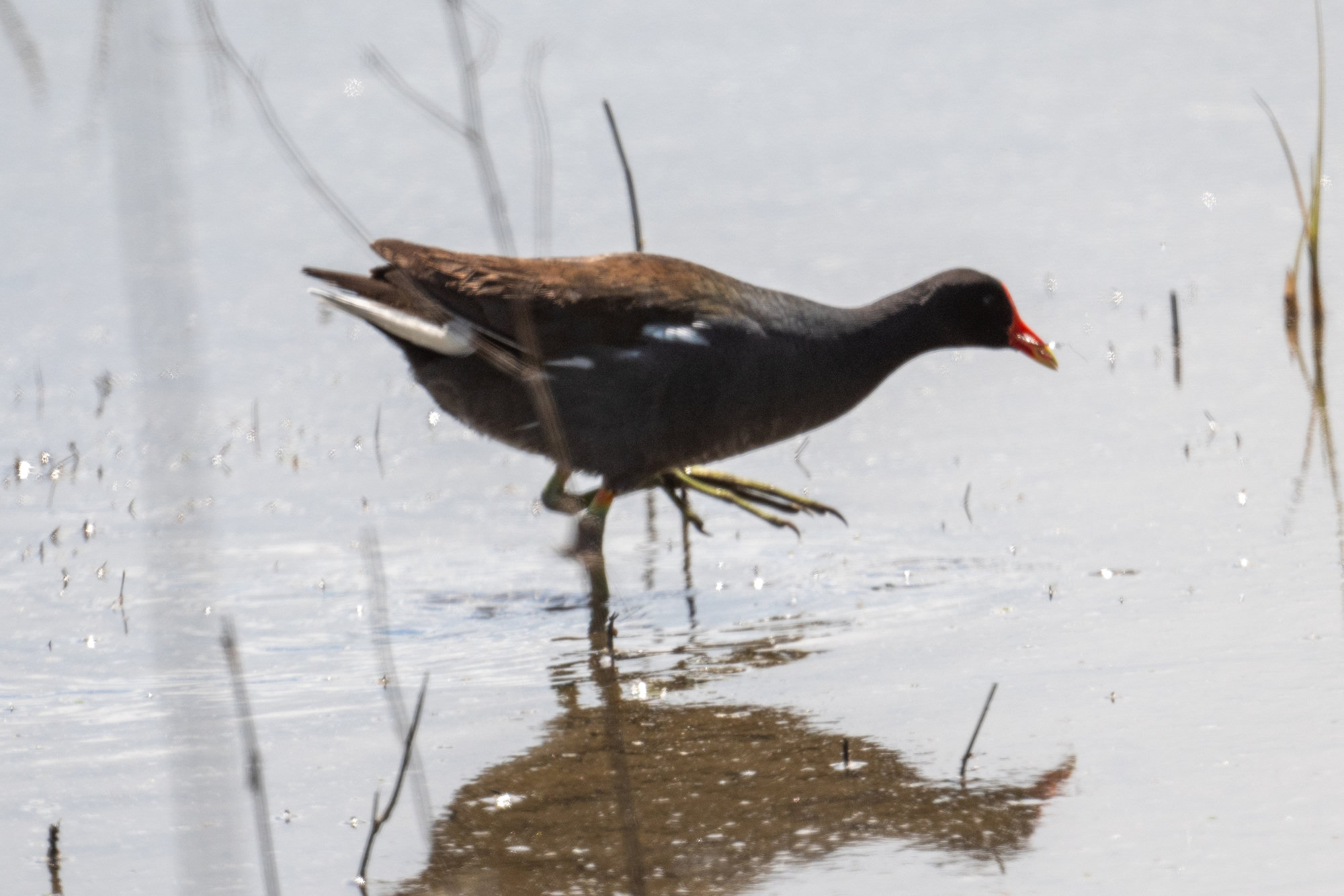
Photo Jonathan Eisen (opens in a new tab) / iNaturalist, CC BY 4.0 (opens in a new tab)
At a glance
- Size
- About 32 to 37 cm long
- Weight
- About 250 to 500 g
- Habitat
- Freshwater marshes, ponds and lakes with plenty of plants
- Diet
- Plants, seeds, snails and insects
- In Georgia
- A fairly common resident in the south and on the coast; scarcer inland in winter
- Voice
- A variety of clucks, cackles and chattering calls
- Rabies vector
- No
Identification
- Key marks
- Dark grey-black with a red forehead shield and a yellow-tipped red bill; a white stripe along the side; white under the tail; long yellowish legs
- Told apart from
- American coot, which has a white bill and shield
- Told apart from
- Purple gallinule, which is purple-blue and green
- Where to look
- Edges of marshes and ponds, swimming with a bobbing head
Behaviour
Common gallinules swim with a jerky, head-bobbing motion and walk on floating plants with their long toes. They flick their tails to show the white patch beneath.
Young from earlier broods sometimes help feed later broods.
Why they matter
Gallinules are part of the marsh food web, eating plants and small animals and being eaten by alligators, hawks and snakes. The helpers at their nests, older siblings feeding younger ones, show a family life more complex than it first appears.
Reproduction and lifecycle
Nest — A platform of plants, often with a ramp, in marsh vegetation
Eggs — Usually 5 to 9
Incubation — About 19 to 22 days
Chicks — Black and downy with a red-and-yellow bill; leave the nest within a day
Flight — At about six to seven weeks
Lifespan — A few years
Living around people
- Fishing line tangled in marsh plants catches gallinules and their chicks.
Misconceptions
- Gallinules are ducks. They are rails, with long toes rather than webbed feet.
Related species
Seasonal activity
When this species is breeding, and when there are nests on the ground. Mowing during the shaded months is how most nests are found.
| Jan | Feb | Mar | Apr | May | Jun | Jul | Aug | Sep | Oct | Nov | Dec | |
|---|---|---|---|---|---|---|---|---|---|---|---|---|
| Breeding | Jan: no | Feb: no | Mar: no | Apr: no | May: no | Jun: no | Jul: no | Aug: no | Sep: no | Oct: no | Nov: no | Dec: no |
| Active nests | Jan: no | Feb: no | Mar: no | Apr: no | May: no | Jun: no | Jul: no | Aug: no | Sep: no | Oct: no | Nov: no | Dec: no |
| Notes | Resident in the south | Present | Pairs forming | Nesting | Nesting | Chicks | Second broods | Chicks | Young independent | Present | Present | Present |
Where it lives
Recorded in 63 states and provinces. Each one links to the other animals there, and to the rehabilitators licensed for them.
United States
- Alabama
- Arizona
- Arkansasbreeding
- California
- Delawarebreeding
- Florida
- Georgia
- Hawaii
- Illinoisbreeding
- Indianabreeding
- Iowabreeding
- Kansasbreeding
- Louisiana
- Mainebreeding
- Maryland
- Michiganbreeding
- Minnesotabreeding
- Mississippi
- Missouribreeding
- Nevada
- New Jerseybreeding
- New Mexico
- New Yorkbreeding
- Ohiobreeding
- Oklahomabreeding
- South Carolina
- Tennessee
- Texas
- Wisconsinbreeding
Mexico
- Aguascalientesin winter
- Baja California
- Baja California Sur
- Campechein winter
- Chiapasin winter
- Chihuahua
- Coahuila
- Colima
- Durango
- Guanajuato
- Guerreroin winter
- Hidalgoin winter
- Jalisco
- Mexico City
- Michoacan
- Morelos
- Nayarit
- Nuevo Leon
- Oaxaca
- Puebla
- Queretaro
- Quintana Roo
- San Luis Potosiin winter
- Sinaloa
- Sonora
- State of Mexico
- Tabascobreeding
- Tamaulipas
- Tlaxcalain winter
- Veracruz
- Yucatan
If you found one
Answer a few questions and you will get a specific answer for what you are looking at.
I found an animal