
Species
American coot
Fulica americana
A slate-grey, white-billed water bird with lobed toes, often mistaken for a duck on winter ponds.
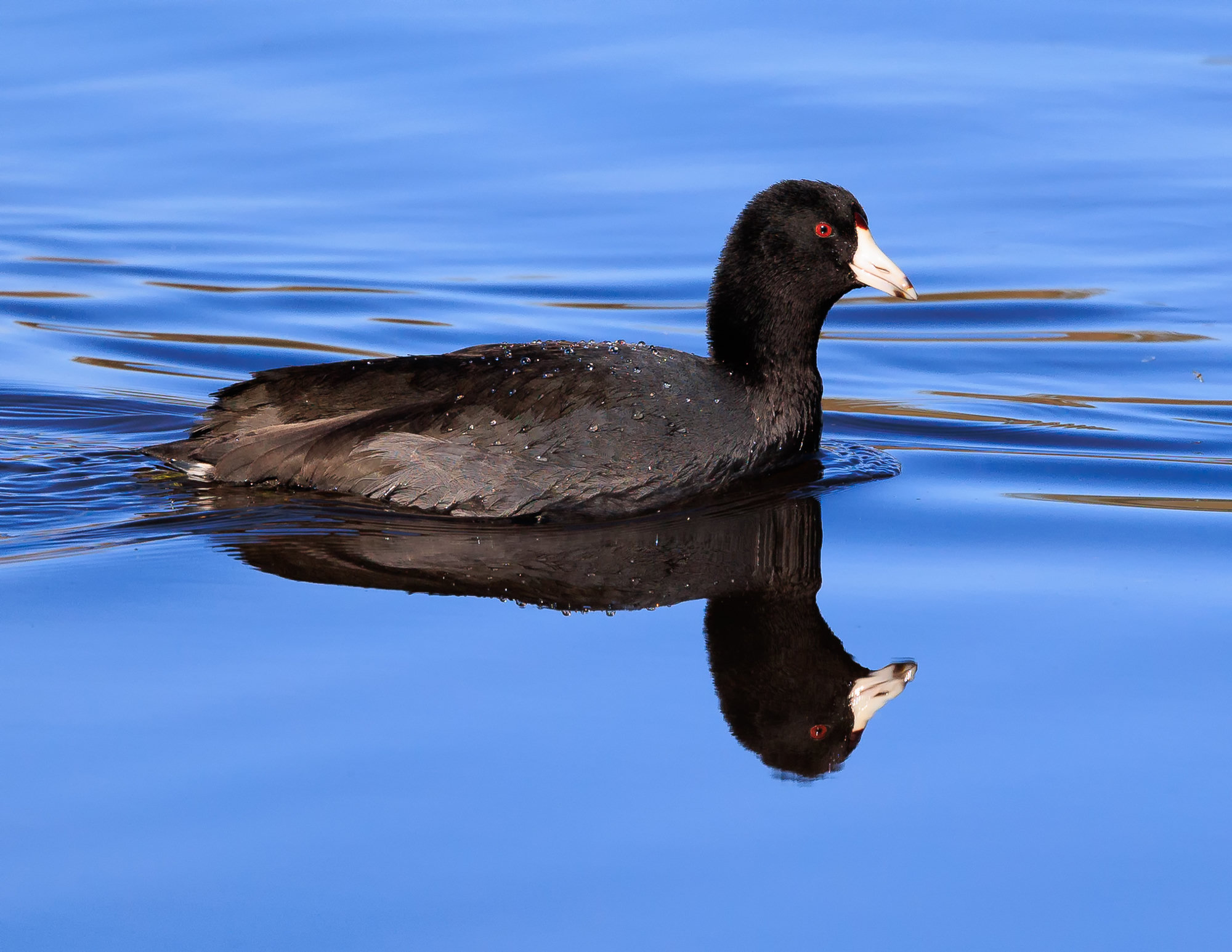
Photo Frank Schulenburg (opens in a new tab) / Wikimedia Commons, CC BY-SA 4.0 (opens in a new tab)
At a glance
- Size
- About 34 to 43 cm long
- Weight
- About 430 to 850 g
- Habitat
- Ponds, lakes, marshes, golf-course ponds and stormwater ponds
- Diet
- Aquatic plants, algae, insects and snails
- In Georgia
- A common winter visitor; a few breed
- Voice
- Grunts, clucks and cackles
- Rabies vector
- No
Identification
- Key marks
- Dark grey with a black head; white bill with a small red-brown shield; red eye; green legs with lobed toes
- Told apart from
- Common gallinule, which has a red shield and yellow-tipped bill
- Told apart from
- Ducks, which have flat bills and webbed feet
- Where to look
- Large flocks on ponds and lakes, and grazing on lawns by water
Behaviour
Coots dive, dabble and graze on land. They run across the water to take off, and in flocks they splash and squabble constantly. Their toes have broad lobes rather than webs, which help them swim and walk on mud.
Why they matter
American coots are a major winter food for bald eagles on Georgia's reservoirs; eagles often hunt them by making repeated passes until a coot tires. Coots eat large amounts of aquatic plants and are a basic part of the wetland food web.
Reproduction and lifecycle
Nest — A floating platform of plants
Eggs — Usually 8 to 12
Incubation — About 21 to 25 days
Chicks — Black with bright orange-red heads; leave the nest within a day
Flight — At about seven to eight weeks
Lifespan — Several years
Living around people
- Coots graze lawns by ponds in winter and move on in spring.
- Bread fills coots without nourishing them.
- A coot on a road or car park cannot take off from land and needs help.
Misconceptions
- Coots are ducks. They are rails, with lobed toes and a chicken-like bill.
- A coot that runs across the water is fleeing danger. Running is how coots take off.
Related species
Seasonal activity
When this species is breeding, and when there are nests on the ground. Mowing during the shaded months is how most nests are found.
| Jan | Feb | Mar | Apr | May | Jun | Jul | Aug | Sep | Oct | Nov | Dec | |
|---|---|---|---|---|---|---|---|---|---|---|---|---|
| Breeding | Jan: no | Feb: no | Mar: no | Apr: no | May: no | Jun: no | Jul: no | Aug: no | Sep: no | Oct: no | Nov: no | Dec: no |
| Active nests | Jan: no | Feb: no | Mar: no | Apr: no | May: no | Jun: no | Jul: no | Aug: no | Sep: no | Oct: no | Nov: no | Dec: no |
| Notes | Wintering flocks | Wintering | Migrating north | Last birds leave | Nesting farther north; a few in Georgia | Nesting | Chicks | Young independent | Migration begins | Arriving in Georgia | Wintering flocks | Wintering flocks |
Where it lives
Recorded in 89 states and provinces. Each one links to the other animals there, and to the rehabilitators licensed for them.
United States
- Alabamain winter
- Arizonain winter
- Arkansasin winter
- Californiain winter
- Coloradoin winter
- Connecticutin winter
- Delawarein winter
- District of Columbiain winter
- Floridain winter
- Georgiain winter
- Idaho
- Illinoisin winter
- Indianain winter
- Iowain winter
- Kansasin winter
- Kentuckyin winter
- Louisianain winter
- Marylandin winter
- Massachusettsin winter
- Michigan
- Minnesota
- Mississippiin winter
- Missouriin winter
- Montana
- Nebraska
- Nevada
- New Jerseyin winter
- New Mexicoin winter
- New Yorkin winter
- North Carolinain winter
- North Dakotabreeding
- Ohioin winter
- Oklahomain winter
- Oregonin winter
- Pennsylvaniain winter
- Rhode Islandin winter
- South Carolinain winter
- South Dakota
- Tennesseein winter
- Texasin winter
- Utahin winter
- Virginiain winter
- Washingtonin winter
- West Virginiain winter
- Wisconsin
- Wyoming
Canada
Mexico
- Aguascalientesin winter
- Baja California
- Baja California Sur
- Campechein winter
- Chiapas
- Chihuahua
- Coahuilain winter
- Colimain winter
- Durango
- Guanajuato
- Guerreroin winter
- Hidalgo
- Jalisco
- Mexico City
- Michoacan
- Morelosin winter
- Nayarit
- Nuevo Leonin winter
- Oaxacain winter
- Puebla
- Queretaro
- Quintana Rooin winter
- San Luis Potosi
- Sinaloain winter
- Sonorain winter
- State of Mexico
- Tabascoin winter
- Tamaulipasin winter
- Tlaxcala
- Veracruzin winter
- Yucatanin winter
- Zacatecasin winter
If you found one
Answer a few questions and you will get a specific answer for what you are looking at.
I found an animal