
Species
Bufflehead
Bucephala albeola
A tiny, buoyant diving duck with a big white head patch, nesting in old flicker holes far to the north.
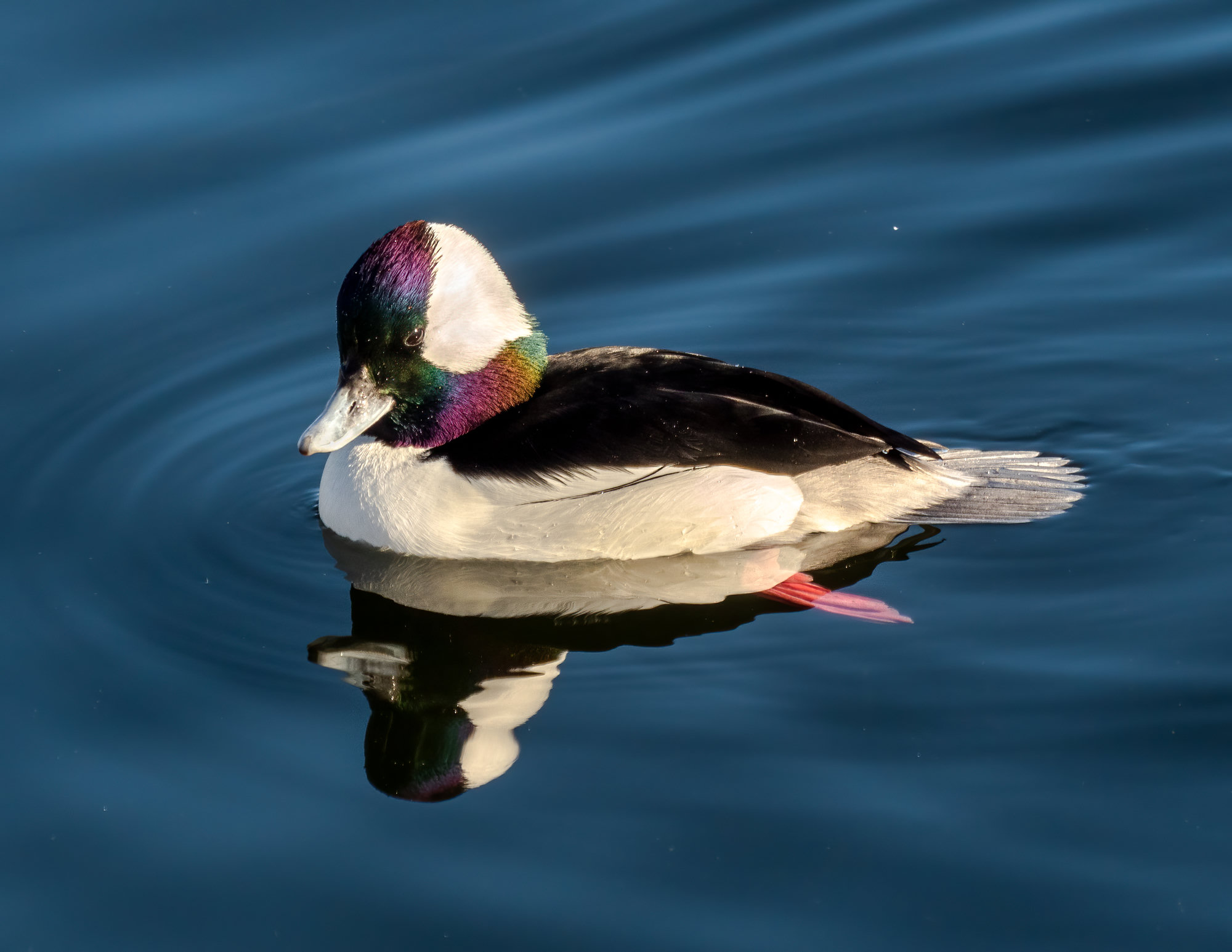
Photo Rhododendrites (opens in a new tab) / Wikimedia Commons, CC BY-SA 4.0 (opens in a new tab)
At a glance
- Size
- About 32 to 40 cm long
- Weight
- About 270 to 550 g
- Habitat
- Lakes, reservoirs, ponds, tidal creeks and bays
- Diet
- Insect larvae, snails, small crustaceans and seeds
- In Georgia
- A fairly common winter visitor, November to March
- Voice
- Mostly quiet
- Rabies vector
- No
Identification
- Male
- Mostly white body; black back; large, puffy head, glossy green and purple, with a big white patch behind the eye
- Female
- Grey-brown with a white oval patch on the cheek
- Told apart from
- Hooded merganser, whose male has a fan-shaped white crest edged in black and chestnut sides
- Told apart from
- Common goldeneye, which is larger with a round white spot in front of the eye
- Where to look
- Small groups diving on lakes and coastal creeks
Behaviour
Buffleheads dive constantly, popping back to the surface like corks. Small groups often dive together, with one bird staying up as a lookout.
Why they matter
Buffleheads nest almost only in old holes made by northern flickers in boreal forest trees, so a woodpecker's work thousands of kilometres away decides where these ducks can breed. They are one of the smallest ducks in North America and a good example of how closely forest and water are linked.
Reproduction and lifecycle
Nest — An old woodpecker hole, usually a flicker's, in a tree near water
Eggs — Usually 6 to 11
Incubation — About 29 to 31 days
Leaving the nest — Ducklings jump from the hole a day or two after hatching
Flight — At about seven to eight weeks
Lifespan — Wild birds over fifteen years are recorded
Living around people
- Small reservoirs and stormwater ponds are enough for wintering buffleheads if they are left undisturbed.
Misconceptions
- A duck this small must be a duckling. Buffleheads are fully grown adults.
Related species
Seasonal activity
When this species is breeding, and when there are nests on the ground. Mowing during the shaded months is how most nests are found.
| Jan | Feb | Mar | Apr | May | Jun | Jul | Aug | Sep | Oct | Nov | Dec | |
|---|---|---|---|---|---|---|---|---|---|---|---|---|
| Breeding | Jan: no | Feb: no | Mar: no | Apr: no | May: no | Jun: no | Jul: no | Aug: no | Sep: no | Oct: no | Nov: no | Dec: no |
| Active nests | Jan: no | Feb: no | Mar: no | Apr: no | May: no | Jun: no | Jul: no | Aug: no | Sep: no | Oct: no | Nov: no | Dec: no |
| Notes | Wintering | Wintering; courtship displays | Migrating north | Last birds leaving | Nesting in tree holes in the boreal forest | Ducklings hatching | Ducklings growing | Young flying | Adults moulting | Migration begins | Arriving in Georgia | Wintering |
Where it lives
Recorded in 74 states and provinces. Each one links to the other animals there, and to the rehabilitators licensed for them.
United States
- Alabamain winter
- Alaska
- Arizonain winter
- Arkansasin winter
- Californiain winter
- Coloradoin winter
- Connecticutin winter
- Delawarein winter
- District of Columbiain winter
- Floridain winter
- Georgiain winter
- Idahoin winter
- Illinoisin winter
- Indianain winter
- Iowain winter
- Kansasin winter
- Kentuckyin winter
- Louisianain winter
- Mainein winter
- Marylandin winter
- Massachusettsin winter
- Michiganin winter
- Minnesotain winter
- Mississippiin winter
- Missouriin winter
- Montana
- Nebraskain winter
- Nevadain winter
- New Hampshirein winter
- New Jerseyin winter
- New Mexicoin winter
- New Yorkin winter
- North Carolinain winter
- North Dakotain winter
- Ohioin winter
- Oklahomain winter
- Oregonin winter
- Pennsylvaniain winter
- Rhode Islandin winter
- South Carolinain winter
- South Dakotain winter
- Tennesseein winter
- Texasin winter
- Utahin winter
- Vermontin winter
- Virginiain winter
- Washingtonin winter
- West Virginiain winter
- Wisconsinin winter
- Wyoming
Canada
If you found one
Answer a few questions and you will get a specific answer for what you are looking at.
I found an animal