
Species
Brazilian free-tailed bat
Tadarida brasiliensis
A fast, narrow-winged bat that lives in colonies of thousands, in the South often in buildings.
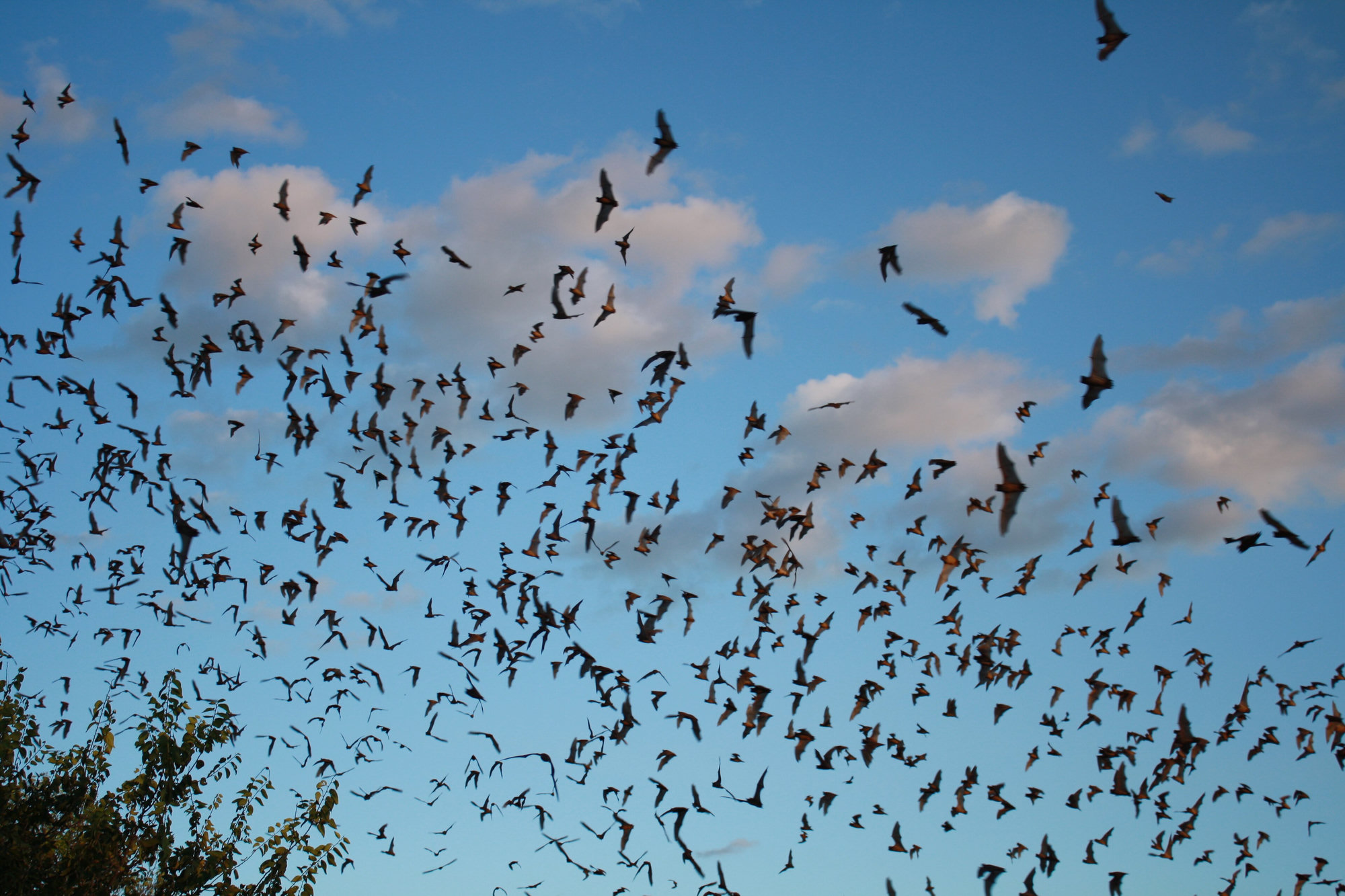
Photo U.S. Fish and Wildlife Service Headquarters (opens in a new tab) / Wikimedia Commons, Public domain (opens in a new tab)
At a glance
- Size
- Body about 9 to 11 cm; wingspan about 30 to 35 cm
- Weight
- About 10 to 15 g
- Habitat
- Towns, farmland and open country across the southern and western United States and Mexico
- Diet
- Moths, beetles, flying ants, leafhoppers and other insects, often caught high above the ground
- Active
- Night, from dusk
- Roost
- Buildings, bridges and stadiums in the Southeast; caves in the Southwest and Mexico
- Young
- One pup a year
- Rabies vector
- Yes
Identification
- Key marks
- The tail extends well beyond the edge of the tail membrane; deeply wrinkled upper lip; broad ears that point forward; long, narrow wings
- Colour
- Dark brown to greyish brown
- Told apart from
- Big brown bat and evening bat, whose tails are enclosed in the membrane
- Signs
- A strong musky smell and droppings below the roost
- Where to look
- Streaming out of attics, roof tiles, stadiums and bridges at dusk
Behaviour
Brazilian free-tailed bats live in large colonies. In the Southwest and Mexico some caves hold millions, and their evening emergence can be seen on weather radar. In the Southeast, including Georgia, colonies are smaller and live mostly in buildings — attics, walls, spaces under roof tiles, stadiums and bridges — where they stay all year.
They are built for speed and distance, with long, narrow wings, and are among the fastest-flying animals ever measured. They hunt high over farmland and towns, often hundreds of metres up, catching insects that migrate on the wind.
Why they matter
Free-tailed bats eat great numbers of moths whose caterpillars damage crops, including corn earworms and cotton bollworms, and studies in Texas have estimated that this saves farmers substantial pesticide costs each year.
They also show how the same species can live very different lives. A free-tailed bat in Georgia may spend its whole life in one church attic, while one in Texas may migrate a thousand kilometres to Mexico each autumn.
Reproduction and lifecycle
Mating — late winter and early spring
Gestation — about 11 to 12 weeks
Birth — June, a single pup
Nursing — in large colonies, pups cluster together and mothers find their own by voice and smell
Flight — at about five weeks old
Independence — by late summer
Lifespan — up to about 8 years or more
Living around people
- A colony in a building should never be sealed in or out between May and August; pups left inside cannot survive.
- Humane exclusion, timed for autumn or early spring, lets the colony leave safely; a bat house nearby can give it somewhere to go.
- Never handle a grounded bat with bare hands; bats are rabies vector species.
- Their droppings (guano) should be cleaned with care and good ventilation.
Misconceptions
- Bats in the attic will chew through the house. Bats cannot gnaw; they use gaps that already exist.
- Poisons or mothballs are a solution. They are cruel, often illegal for bats, and do not work; a dying bat is more likely to end up inside the house.
- Free-tailed bats only live in Texas caves. In the Southeast they live in buildings, often in towns, all year.
Related species
Seasonal activity
When this species is breeding, and when there are nests on the ground. Mowing during the shaded months is how most nests are found.
| Jan | Feb | Mar | Apr | May | Jun | Jul | Aug | Sep | Oct | Nov | Dec | |
|---|---|---|---|---|---|---|---|---|---|---|---|---|
| Breeding | Jan: no | Feb: no | Mar: no | Apr: no | May: no | Jun: no | Jul: no | Aug: no | Sep: no | Oct: no | Nov: no | Dec: no |
| Active nests | Jan: no | Feb: no | Mar: no | Apr: no | May: no | Jun: no | Jul: no | Aug: no | Sep: no | Oct: no | Nov: no | Dec: no |
| Notes | Southeastern colonies stay in their building roosts, active on mild nights | Activity increases; mating takes place | Females begin gathering in maternity roosts | Maternity colonies grow | Colonies are at their largest before births | Pups are born, one per female | Young begin to fly at about five weeks old | Young are independent; colonies at their busiest | Western populations begin migrating to Mexico | Southeastern colonies continue feeding on autumn insects | Activity eases with cooler weather | Colonies remain in their roosts in the Southeast |
Where it lives
Recorded in 47 states and provinces. Each one links to the other animals there, and to the rehabilitators licensed for them.
Treated as a rabies-vector species in Alabama, Arizona, Arkansas, California, Colorado, Florida, Georgia, Kansas, Louisiana, Mississippi, Nebraska, Nevada, New Mexico, North Carolina, Oklahoma, Oregon, South Carolina, Texas, Utah, Aguascalientes, Baja California, Baja California Sur, Chiapas, Chihuahua, Coahuila, Colima, Durango, Guanajuato, Guerrero, Hidalgo, Jalisco, Mexico City, Michoacan, Morelos, Nayarit, Nuevo Leon, Oaxaca, Puebla, Queretaro, San Luis Potosi, Sinaloa, Sonora, State of Mexico, Tamaulipas, Tlaxcala, Veracruz and Zacatecas. There, only a certified rehabilitator may take one.
United States
If you found one
Answer a few questions and you will get a specific answer for what you are looking at.
I found an animal