
Species
Bottlenose dolphin
Tursiops erebennus
The dolphin of Georgia's tidal creeks and beaches, a clever hunter that knows other dolphins by name.
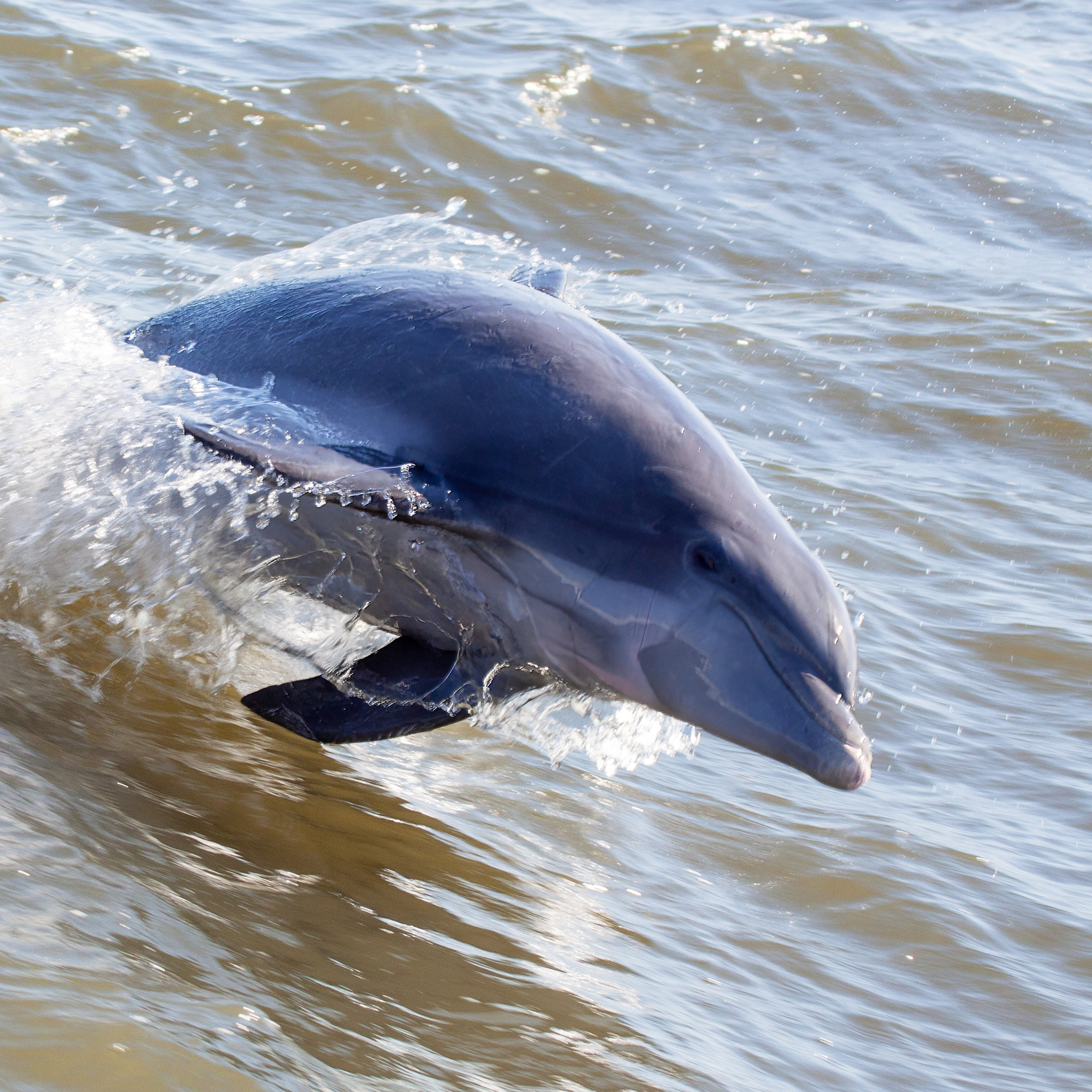
Photo Dan Vickers (opens in a new tab) / iNaturalist, CC BY 4.0 (opens in a new tab)
At a glance
- Size
- Adults about 2.2 to 3 m long
- Weight
- About 150 to 300 kg
- Habitat
- Tidal creeks, sounds, estuaries, inlets and near-shore ocean waters
- Diet
- Fish such as mullet, croaker and menhaden, plus shrimp and squid
- Active
- Day and night
- Social life
- Groups called pods, whose membership changes often
- Status
- Protected in the United States under the Marine Mammal Protection Act
- Rabies vector
- No
Identification
- Key marks
- Grey, darker on the back and paler on the belly; a short, rounded beak; a curved dorsal fin; horizontal tail flukes
- Told apart from
- Manatee, which has no dorsal fin and a paddle-shaped tail
- Told apart from
- Sharks, whose tails move from side to side and whose fins do not rise and fall in a rolling arc
- Where to look
- Tidal creeks, sounds and beaches along the whole Georgia coast, all year
Behaviour
Bottlenose dolphins live in Georgia's coastal waters all year. Many are residents of particular sounds and creeks, while others move along the coast with the seasons.
In the salt marshes of Georgia and South Carolina, some dolphins hunt by "strand feeding": they drive schools of fish onto mudbanks, then slide briefly out of the water after them before wriggling back — a technique passed from mothers to calves.
Each dolphin develops its own signature whistle, and dolphins use these whistles to call and recognise one another, much as people use names.
The dolphins of the western Atlantic coast were recognised in 2022 as a species of their own, Tamanend's bottlenose dolphin, separate from the bottlenose dolphins farther offshore.
Why they matter
Dolphins are top predators of the estuary, and their health reflects the health of the marsh, the creeks and the fish that live in them. Scientists study Georgia's dolphins partly because they show what is happening to the waters people share with them.
They are also among the most intelligent and socially complex animals in the sea.
Reproduction and lifecycle
Mating — can occur at any time of year, with a peak in spring and summer
Gestation — about 12 months
Birth — a single calf, mostly late spring and summer
Nursing — often for more than a year
Dependence — calves usually stay with their mothers for three to six years
Maturity — females at about 5 to 13 years old
Lifespan — often 25 years or more; some live beyond 50
Living around people
- Never feed wild dolphins; it is illegal under federal law and teaches them to approach boats, where they are injured by propellers and fishing gear.
- Keep at least 50 yards (about 45 metres) away when watching dolphins from a boat, and never chase or surround them.
- Discard fishing line, hooks and bait properly; entanglement kills dolphins.
- A dolphin that is stranded or injured needs trained responders; keep people and dogs back and do not try to push it back into the water.
Misconceptions
- Dolphins and porpoises are the same thing. The animals in Georgia's creeks are dolphins; porpoises are a different family seldom seen here.
- A dolphin that approaches a boat wants food. Feeding teaches dolphins habits that get them hurt.
- A dolphin sliding onto a mudbank is stranded. It may be strand feeding and will return to the water on its own.
Related species
Seasonal activity
When this species is breeding, and when there are nests on the ground. Mowing during the shaded months is how most nests are found.
| Jan | Feb | Mar | Apr | May | Jun | Jul | Aug | Sep | Oct | Nov | Dec | |
|---|---|---|---|---|---|---|---|---|---|---|---|---|
| Breeding | Jan: no | Feb: no | Mar: no | Apr: no | May: no | Jun: no | Jul: no | Aug: no | Sep: no | Oct: no | Nov: no | Dec: no |
| Active nests | Jan: no | Feb: no | Mar: no | Apr: no | May: no | Jun: no | Jul: no | Aug: no | Sep: no | Oct: no | Nov: no | Dec: no |
| Notes | Resident dolphins in sounds and creeks | Present in coastal waters | Some seasonal visitors move north along the coast | Numbers in coastal waters increase | Calving season begins | Calves born; mothers stay close | Calving continues | Calves travel close beside their mothers | Present in sounds and creeks | Some seasonal visitors move south | Resident dolphins remain | Present in coastal waters |
Where it lives
Recorded in 9 states and provinces. Each one links to the other animals there, and to the rehabilitators licensed for them.
If you found one
Answer a few questions and you will get a specific answer for what you are looking at.
I found an animal