
Species
Bobolink
Dolichonyx oryzivorus
A grassland songbird dressed like a backwards tuxedo, which migrates to South America through Georgia's fields.
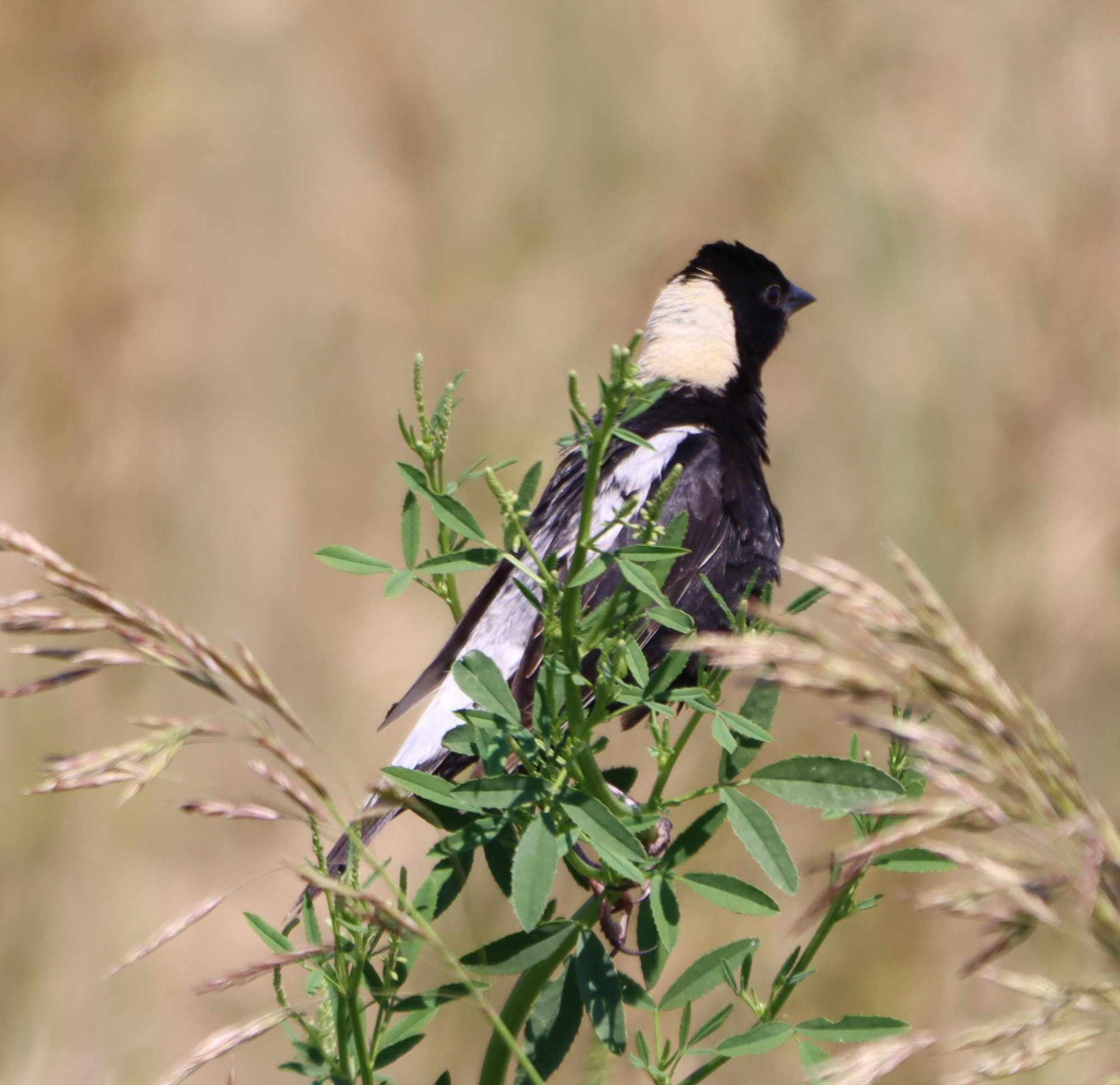
Photo Mary Krieger (opens in a new tab) / iNaturalist, CC BY 4.0 (opens in a new tab)
At a glance
- Size
- About 15 to 21 cm long
- Weight
- About 29 to 56 g
- Habitat
- Hayfields, marshes and grasslands
- Diet
- Insects and seeds, especially rice and grass seeds
- In Georgia
- A common migrant, April to May and August to October
- Voice
- A bubbling, metallic song; a "pink" call in flight
- Rabies vector
- No
Identification
- Male in spring
- Black below; white back and rump; buff nape
- Female and autumn birds
- Buff with brown stripes on the head and back
- Told apart from
- Sparrows, which lack the buff, striped look and pointed tail feathers
- Where to look
- Coastal marshes and fields on migration; heard overhead at night
Behaviour
Bobolinks migrate at night in flocks, calling "pink". In the past they fed heavily in the rice fields of the Southeast, earning the name "ricebird".
Why they matter
Bobolinks travel about 20,000 km a year between North and South America, one of the longest migrations of any songbird. They have declined because hayfields are cut earlier and more often, destroying nests.
Reproduction and lifecycle
Nest — A cup on the ground in hayfields
Eggs — Usually five or six
Incubation — About 11 to 13 days
Chicks — Fed by both parents
Lifespan — Several years
Living around people
- Delayed hay cutting protects their nests in the north.
Misconceptions
- Migratory birds travel by day. Bobolinks migrate mostly at night.
Related species
Seasonal activity
When this species is breeding, and when there are nests on the ground. Mowing during the shaded months is how most nests are found.
| Jan | Feb | Mar | Apr | May | Jun | Jul | Aug | Sep | Oct | Nov | Dec | |
|---|---|---|---|---|---|---|---|---|---|---|---|---|
| Breeding | Jan: no | Feb: no | Mar: no | Apr: no | May: no | Jun: no | Jul: no | Aug: no | Sep: no | Oct: no | Nov: no | Dec: no |
| Active nests | Jan: no | Feb: no | Mar: no | Apr: no | May: no | Jun: no | Jul: no | Aug: no | Sep: no | Oct: no | Nov: no | Dec: no |
| Notes | In South America | In South America | In South America | Migrants passing | Migrants passing | Nesting in northern hayfields | Nesting | Migrants passing | Migrants passing | Last migrants | In South America | In South America |
Where it lives
Recorded in 55 states and provinces. Each one links to the other animals there, and to the rehabilitators licensed for them.
United States
- Alabamapassing through
- Arkansaspassing through
- Coloradobreeding
- Connecticutbreeding
- Delawarepassing through
- District of Columbiapassing through
- Floridapassing through
- Georgiapassing through
- Idahobreeding
- Illinoisbreeding
- Indianabreeding
- Iowabreeding
- Kansasbreeding
- Kentuckybreeding
- Louisianapassing through
- Mainebreeding
- Marylandbreeding
- Massachusettsbreeding
- Michiganbreeding
- Minnesotabreeding
- Mississippipassing through
- Missouribreeding
- Montanabreeding
- Nebraskabreeding
- Nevadabreeding
- New Hampshirebreeding
- New Jerseybreeding
- New Yorkbreeding
- North Carolinapassing through
- North Dakotabreeding
- Ohiobreeding
- Oklahomapassing through
- Oregonbreeding
- Pennsylvaniabreeding
- Rhode Islandbreeding
- South Carolinapassing through
- South Dakotabreeding
- Tennesseepassing through
- Utahbreeding
- Vermontbreeding
- Virginiabreeding
- Washingtonbreeding
- West Virginiabreeding
- Wisconsinbreeding
- Wyomingbreeding
If you found one
Answer a few questions and you will get a specific answer for what you are looking at.
I found an animal