
Species
Barred owl
Strix varia
The dark-eyed owl of Georgia's swamps and woods, famous for its question: 'Who cooks for you?'
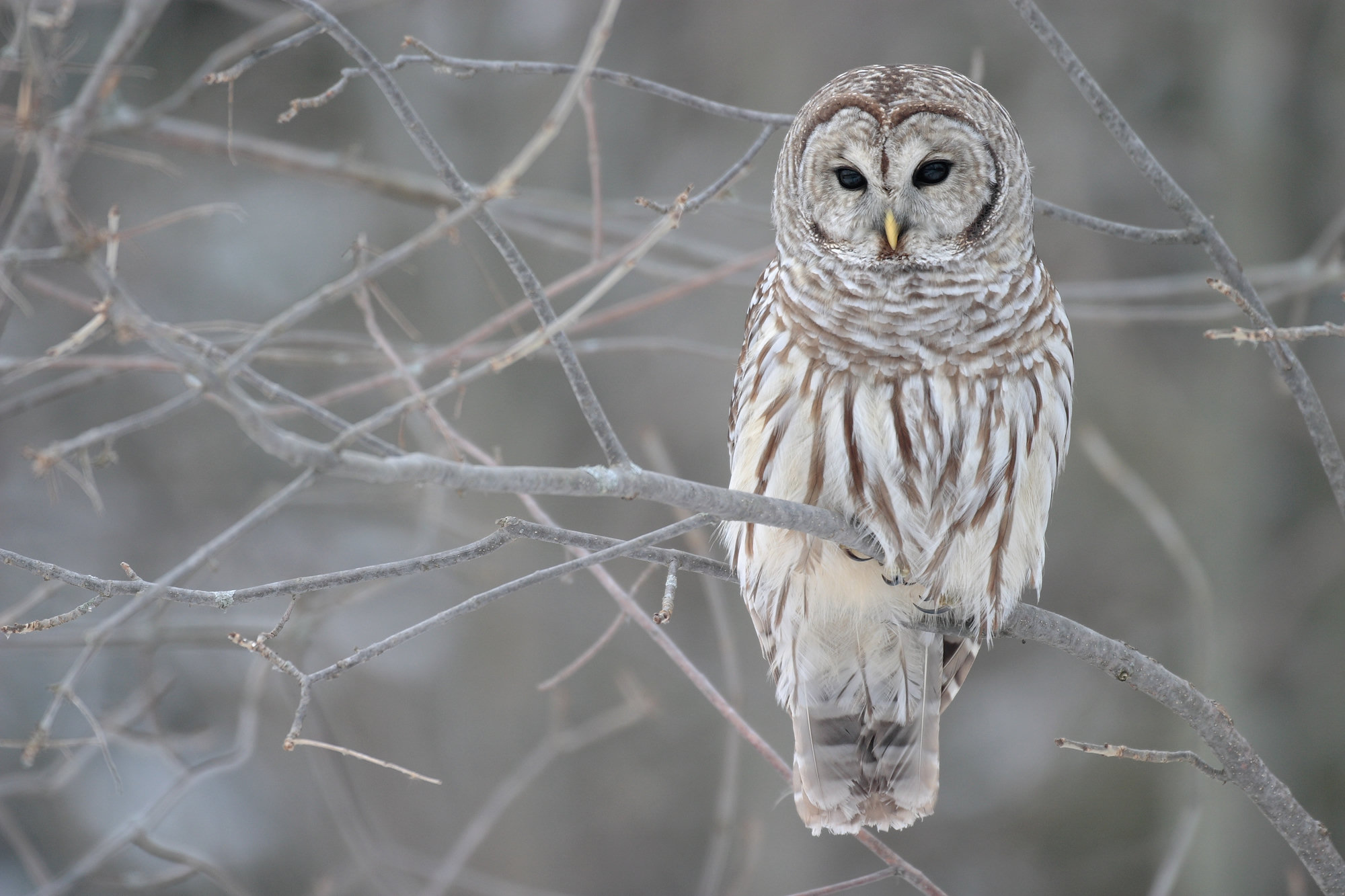
Photo Mdf (opens in a new tab) / Wikimedia Commons, CC BY-SA 3.0 (opens in a new tab)
At a glance
- Size
- About 43 to 50 cm long; wingspan about 1 to 1.1 m
- Weight
- About 470 to 1,050 g
- Habitat
- Swamps, river bottoms, mature woods and wooded suburbs
- Diet
- Mice, rats, squirrels, frogs, crayfish, fish and small birds
- In Georgia
- Common resident statewide
- Voice
- "Who cooks for you, who cooks for you-all"; wild caterwauling duets
- Rabies vector
- No
Identification
- Key marks
- Large, round-headed owl with no ear tufts; dark brown eyes; barred across the chest and streaked down the belly
- Told apart from
- Great horned owl, which has ear tufts and yellow eyes
- Told apart from
- Barn owl, which is pale with a heart-shaped face
- Where to look
- Swamps and wooded neighbourhoods; often calls by day
Behaviour
Barred owls hunt at night and sometimes by day in dark woods. Pairs call to each other in loud, monkey-like duets.
Why they matter
Barred owls are key predators of rodents and crayfish in wet woods. Their calls are among the most familiar night sounds in Georgia, and they live in wooded suburbs as well as deep swamps.
Reproduction and lifecycle
Nest — A tree cavity, broken treetop or old hawk nest
Eggs — Usually two or three
Incubation — About 28 to 33 days
Chicks — Fed by both parents
Leaving the nest — At about four to five weeks, climbing branches before they fly
Flight — At about ten weeks
Lifespan — Wild birds over twenty years are recorded
Living around people
- Owlets out of the nest are usually being cared for.
- Barred owls are often hit by cars when hunting along roads.
- Rodent poisons kill owls.
Misconceptions
- Owls calling during the day are sick. Barred owls often call by day.
- A downy owlet on a low branch has fallen out. It is branching, as young owls do, and its parents are nearby.
Related species
Seasonal activity
When this species is breeding, and when there are nests on the ground. Mowing during the shaded months is how most nests are found.
| Jan | Feb | Mar | Apr | May | Jun | Jul | Aug | Sep | Oct | Nov | Dec | |
|---|---|---|---|---|---|---|---|---|---|---|---|---|
| Breeding | Jan: no | Feb: no | Mar: no | Apr: no | May: no | Jun: no | Jul: no | Aug: no | Sep: no | Oct: no | Nov: no | Dec: no |
| Active nests | Jan: no | Feb: no | Mar: no | Apr: no | May: no | Jun: no | Jul: no | Aug: no | Sep: no | Oct: no | Nov: no | Dec: no |
| Notes | Pairs calling | Courtship | Nesting | Chicks | Owlets leaving the nest | Young fed by parents | Young learning to hunt | Young independent | Present | Present | Present | Pairs calling |
Where it lives
Recorded in 55 states and provinces. Each one links to the other animals there, and to the rehabilitators licensed for them.
United States
- Alabama
- Alaska
- Arkansas
- California
- Connecticut
- Delaware
- District of Columbia
- Florida
- Georgia
- Idaho
- Illinois
- Indiana
- Iowa
- Kansas
- Kentucky
- Louisiana
- Maine
- Maryland
- Massachusetts
- Michigan
- Minnesota
- Mississippi
- Missouri
- Montana
- Nebraska
- New Hampshire
- New Jersey
- New York
- North Carolina
- North Dakotain winter
- Ohio
- Oklahoma
- Oregon
- Pennsylvania
- Rhode Island
- South Carolina
- South Dakotain winter
- Tennessee
- Texas
- Vermont
- Virginia
- Washington
- West Virginia
- Wisconsin
If you found one
Answer a few questions and you will get a specific answer for what you are looking at.
I found an animal