
Species
Argentine black-and-white tegu
Salvator merianae
A large South American lizard, released from the pet trade, now established in a corner of south Georgia.
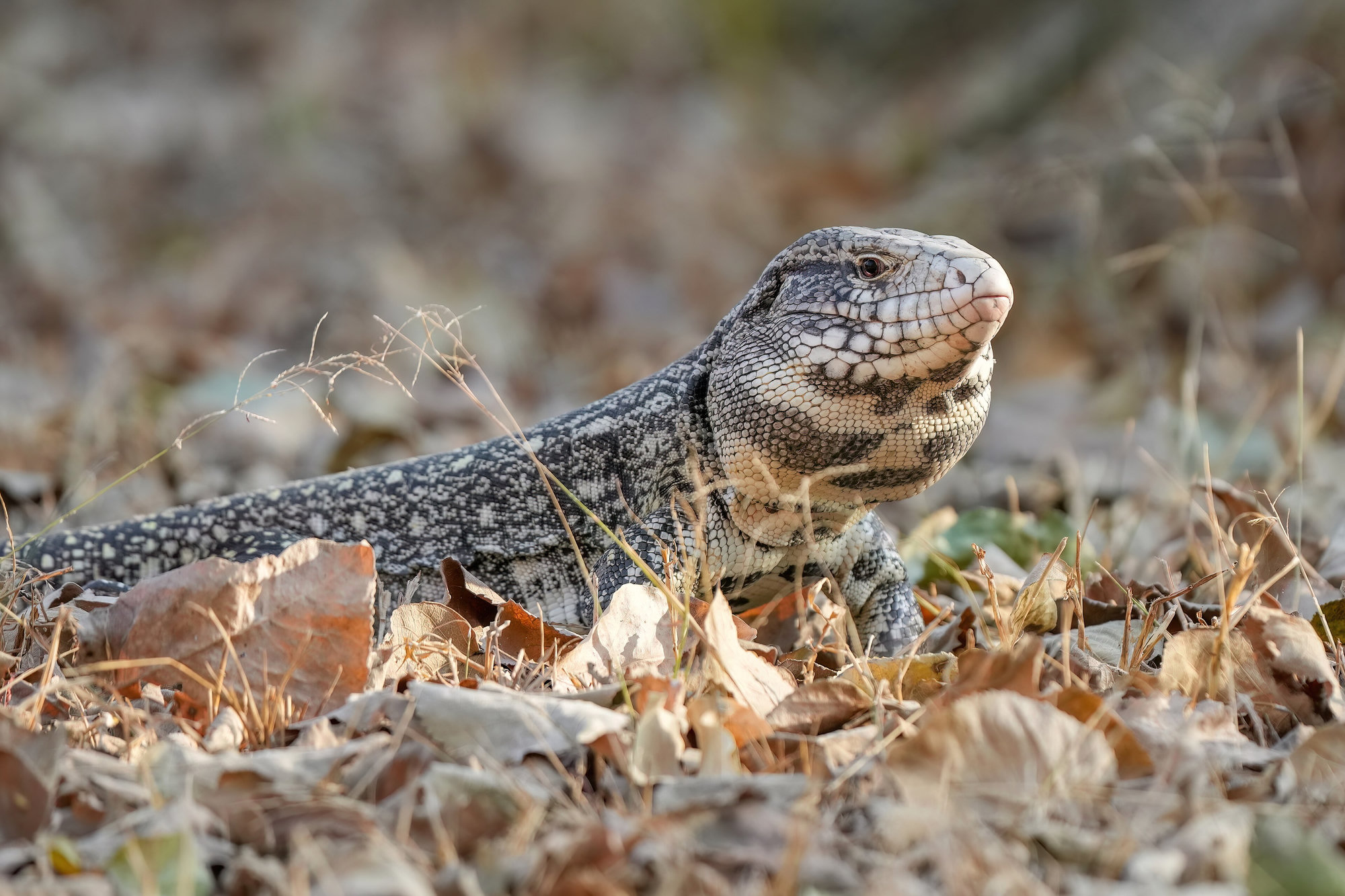
Photo Giles Laurent (opens in a new tab) / Wikimedia Commons, CC BY-SA 4.0 (opens in a new tab)
At a glance
- Size
- Adults up to about 1.2 m long including the tail
- Weight
- Up to about 4.5 kg
- Habitat
- Farmland, forest edges and sandy uplands
- Diet
- Eggs, fruit, insects, small animals and carrion
- In Georgia
- An established population in south-central Georgia; introduced
- Rabies vector
- No
Identification
- Key marks
- Large and heavy-bodied; black with bands of white or cream speckling; forked tongue
- Told apart from
- Native lizards, none of which come close to its size
- Where to look
- Basking or foraging along field and forest edges in warm months
Behaviour
Tegus are active by day in warm weather and spend the winter underground in burrows. They eat almost anything, including the eggs of ground-nesting birds, alligators and turtles. They came to Georgia and Florida as released or escaped pets.
Why they matter
In the wild in Georgia a tegu is a serious threat to animals that nest on the ground, including gopher tortoises and quail. None of that is the tegu's doing: it is an animal in the wrong place because people let it go. Recording sightings helps track where it has spread.
Reproduction and lifecycle
Eggs — Usually 20 to 50
Nest — In burrows or leaf litter
Incubation — About 60 days
Hatchlings — Bright green-headed at first
Maturity — Within a few years
Lifespan — Over 15 years
Living around people
- A tegu seen in the wild in Georgia is worth photographing and recording on iNaturalist; each record helps show where they are.
- Keep a distance: a large tegu can bite and scratch hard when cornered.
- Never release a pet tegu or any other reptile.
Misconceptions
- Tegus are native. They come from South America; Georgia's are descended from released and escaped pets.
Related species
Seasonal activity
When this species is breeding, and when there are nests on the ground. Mowing during the shaded months is how most nests are found.
| Jan | Feb | Mar | Apr | May | Jun | Jul | Aug | Sep | Oct | Nov | Dec | |
|---|---|---|---|---|---|---|---|---|---|---|---|---|
| Breeding | Jan: no | Feb: no | Mar: no | Apr: no | May: no | Jun: no | Jul: no | Aug: no | Sep: no | Oct: no | Nov: no | Dec: no |
| Active nests | Jan: no | Feb: no | Mar: no | Apr: no | May: no | Jun: no | Jul: no | Aug: no | Sep: no | Oct: no | Nov: no | Dec: no |
| Notes | Underground | Underground | Emerging | Active | Breeding | Laying | Active | Hatchlings | Active | Going underground | Underground | Underground |
Where it lives
Recorded in 2 states and provinces. Each one links to the other animals there, and to the rehabilitators licensed for them.
United States
If you found one
Answer a few questions and you will get a specific answer for what you are looking at.
I found an animal