
Species
American robin
Turdus migratorius
The red-breasted thrush of lawns and yards, listening for earthworms and singing before dawn.
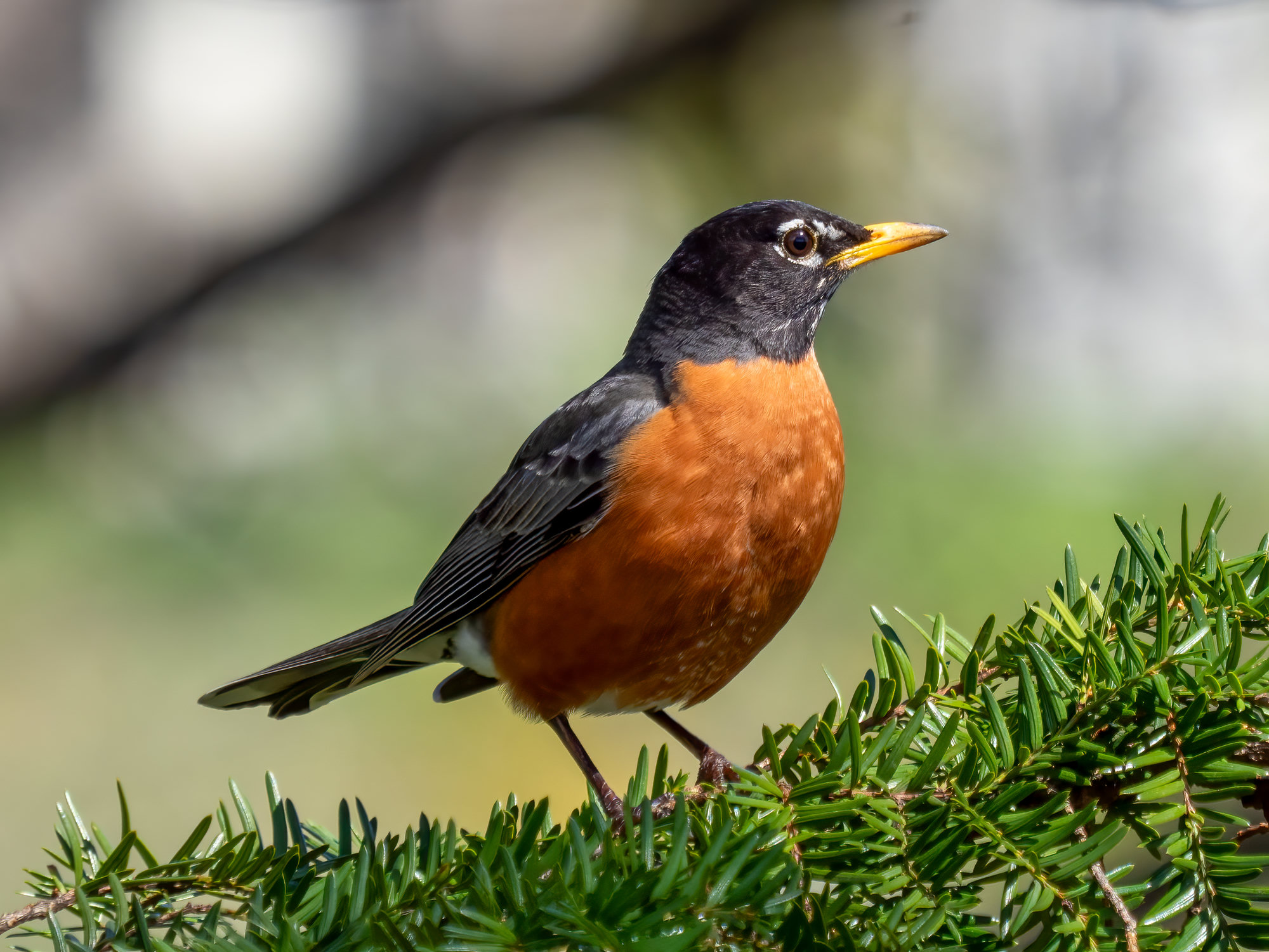
Photo Rhododendrites (opens in a new tab) / Wikimedia Commons, CC BY-SA 4.0 (opens in a new tab)
At a glance
- Size
- About 20 to 28 cm long
- Weight
- About 77 to 85 g
- Habitat
- Lawns, yards, parks, woods and fields
- Diet
- Earthworms, insects and berries
- In Georgia
- Common all year; huge flocks in winter
- Voice
- A cheerful "cheerily, cheer-up, cheerio"
- Rabies vector
- No
Identification
- Key marks
- Grey-brown above; brick-red breast; white around the eye; yellow bill
- Told apart from
- Eastern towhee, which has a black hood and rusty sides
- Told apart from
- Eastern bluebird, which is smaller and blue
- Where to look
- Lawns after rain, and berry trees in winter
Behaviour
Robins hunt earthworms on lawns by sight, tilting their heads to look. In winter they form large flocks that roam in search of berries.
Why they matter
American robins are one of the most familiar birds in North America. They eat many insects and earthworms and spread seeds of berry-bearing plants. Their dependence on lawns also makes them vulnerable to lawn pesticides.
Reproduction and lifecycle
Nest — A cup of grass and mud in a tree or on a ledge
Eggs — Usually three to five, sky blue
Incubation — About 12 to 14 days
Chicks — Fed by both parents
Leaving the nest — At about 13 days, before they fly well
After leaving — Fed by the father on the ground for up to two weeks
Lifespan — Many live only a year or two; wild birds over thirteen years are recorded
Living around people
- Young robins on the ground with short tails are fledglings; their parents are nearby and feed them.
- Lawn pesticides can poison robins that eat contaminated earthworms.
- Robins fighting windows are defending territory against their reflection; covering the outside of the window stops it.
Misconceptions
- Touching a baby bird makes its parents reject it. Birds do not abandon young because of human scent.
- A robin on the ground that cannot fly has fallen from the nest. It is probably a fledgling, which is normal.
- Robins leave for winter. Many stay, and northern robins join them.
Related species
Seasonal activity
When this species is breeding, and when there are nests on the ground. Mowing during the shaded months is how most nests are found.
| Jan | Feb | Mar | Apr | May | Jun | Jul | Aug | Sep | Oct | Nov | Dec | |
|---|---|---|---|---|---|---|---|---|---|---|---|---|
| Breeding | Jan: no | Feb: no | Mar: no | Apr: no | May: no | Jun: no | Jul: no | Aug: no | Sep: no | Oct: no | Nov: no | Dec: no |
| Active nests | Jan: no | Feb: no | Mar: no | Apr: no | May: no | Jun: no | Jul: no | Aug: no | Sep: no | Oct: no | Nov: no | Dec: no |
| Notes | Winter flocks | Flocks | Nesting begins | Nesting | Chicks | Second broods | Young fledging | Present | Present | Flocks forming | Flocks | Flocks |
Where it lives
Recorded in 86 states and provinces. Each one links to the other animals there, and to the rehabilitators licensed for them.
United States
- Alabama
- Alaskabreeding
- Arizona
- Arkansas
- California
- Colorado
- Connecticut
- Delaware
- District of Columbia
- Floridain winter
- Georgia
- Idaho
- Illinois
- Indiana
- Iowabreeding
- Kansas
- Kentucky
- Louisianain winter
- Maine
- Maryland
- Massachusetts
- Michigan
- Minnesota
- Mississippi
- Missouri
- Montanabreeding
- Nebraska
- Nevada
- New Hampshire
- New Jersey
- New Mexico
- New York
- North Carolina
- North Dakota
- Ohio
- Oklahoma
- Oregon
- Pennsylvania
- Rhode Island
- South Carolina
- South Dakota
- Tennessee
- Texas
- Utah
- Vermont
- Virginia
- Washington
- West Virginia
- Wisconsinbreeding
- Wyoming
Canada
If you found one
Answer a few questions and you will get a specific answer for what you are looking at.
I found an animal