
Species
Eastern bluebird
Sialia sialis
A small thrush of open country, sky-blue and rust, whose comeback was built on nest boxes.
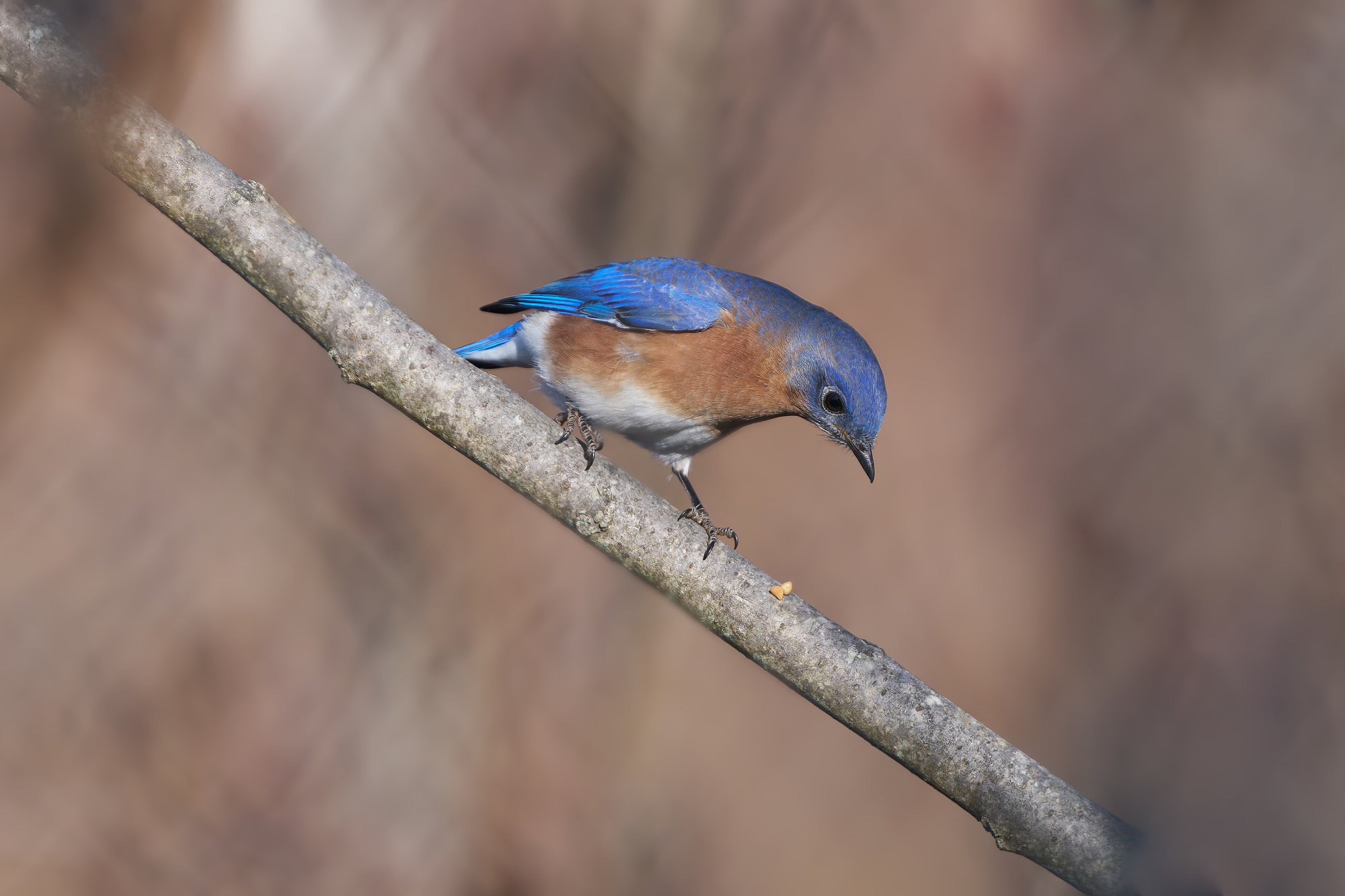
Photo Paul Danese (opens in a new tab) / Wikimedia Commons, CC BY-SA 4.0 (opens in a new tab)
At a glance
- Size
- About 16 to 21 cm long
- Weight
- About 27 to 34 g
- Habitat
- Open fields, pastures, orchards, golf courses and yards with scattered trees
- Diet
- Insects in summer; berries in winter
- In Georgia
- Common resident statewide
- Voice
- A soft, warbled "tu-a-wee"
- Rabies vector
- No
Identification
- Male
- Bright blue above; rusty throat and breast; white belly
- Female
- Greyer with blue in the wings and tail
- Told apart from
- Blue jay, which is larger with a crest
- Told apart from
- Indigo bunting, which is all blue with a thick bill
- Where to look
- Wires, fence posts and nest boxes in open country
Behaviour
Eastern bluebirds hunt from low perches, dropping to the ground to catch insects. In winter they form small flocks and eat berries such as holly and dogwood.
Why they matter
Eastern bluebirds declined in the twentieth century as dead trees were removed and house sparrows and starlings took nest holes. Nest-box trails put up by volunteers brought them back — one of the great community conservation successes.
Reproduction and lifecycle
Nest — A cup of grass in a cavity or nest box
Eggs — Usually three to six, pale blue
Incubation — About 11 to 19 days
Chicks — Fed by both parents; young from earlier broods sometimes help
Flight — At about 16 to 21 days
Broods — Two or three a year
Lifespan — A few years
Living around people
- Nest boxes with a 3.8 cm entrance hole, mounted on poles with predator guards in open areas, are used readily.
- Monitoring boxes and removing house sparrow nests helps bluebirds.
- Native berry-bearing shrubs feed them in winter.
Misconceptions
- Bluebirds leave in winter. Most Georgia bluebirds stay all year.
Related species
Seasonal activity
When this species is breeding, and when there are nests on the ground. Mowing during the shaded months is how most nests are found.
| Jan | Feb | Mar | Apr | May | Jun | Jul | Aug | Sep | Oct | Nov | Dec | |
|---|---|---|---|---|---|---|---|---|---|---|---|---|
| Breeding | Jan: no | Feb: no | Mar: no | Apr: no | May: no | Jun: no | Jul: no | Aug: no | Sep: no | Oct: no | Nov: no | Dec: no |
| Active nests | Jan: no | Feb: no | Mar: no | Apr: no | May: no | Jun: no | Jul: no | Aug: no | Sep: no | Oct: no | Nov: no | Dec: no |
| Notes | Small flocks eating berries | Pairs checking nest boxes | Nesting | Nesting | Chicks | Second broods | Third broods | Young fledging | Families | Flocks | Flocks | Flocks |
Where it lives
Recorded in 68 states and provinces. Each one links to the other animals there, and to the rehabilitators licensed for them.
United States
- Alabama
- Arizona
- Arkansas
- Colorado
- Connecticut
- Delaware
- District of Columbia
- Florida
- Georgia
- Illinois
- Indiana
- Iowa
- Kansas
- Kentucky
- Louisiana
- Maine
- Maryland
- Massachusetts
- Michigan
- Minnesotabreeding
- Mississippi
- Missouri
- Nebraska
- New Hampshire
- New Jersey
- New Mexico
- New York
- North Carolina
- North Dakotabreeding
- Ohio
- Oklahoma
- Pennsylvania
- Rhode Island
- South Carolina
- South Dakotabreeding
- Tennessee
- Texas
- Vermont
- Virginia
- West Virginia
- Wisconsinbreeding
Canada
If you found one
Answer a few questions and you will get a specific answer for what you are looking at.
I found an animal