
Species
American crow
Corvus brachyrhynchos
A clever, social black bird that recognises faces, uses tools and holds 'funerals' for its dead.
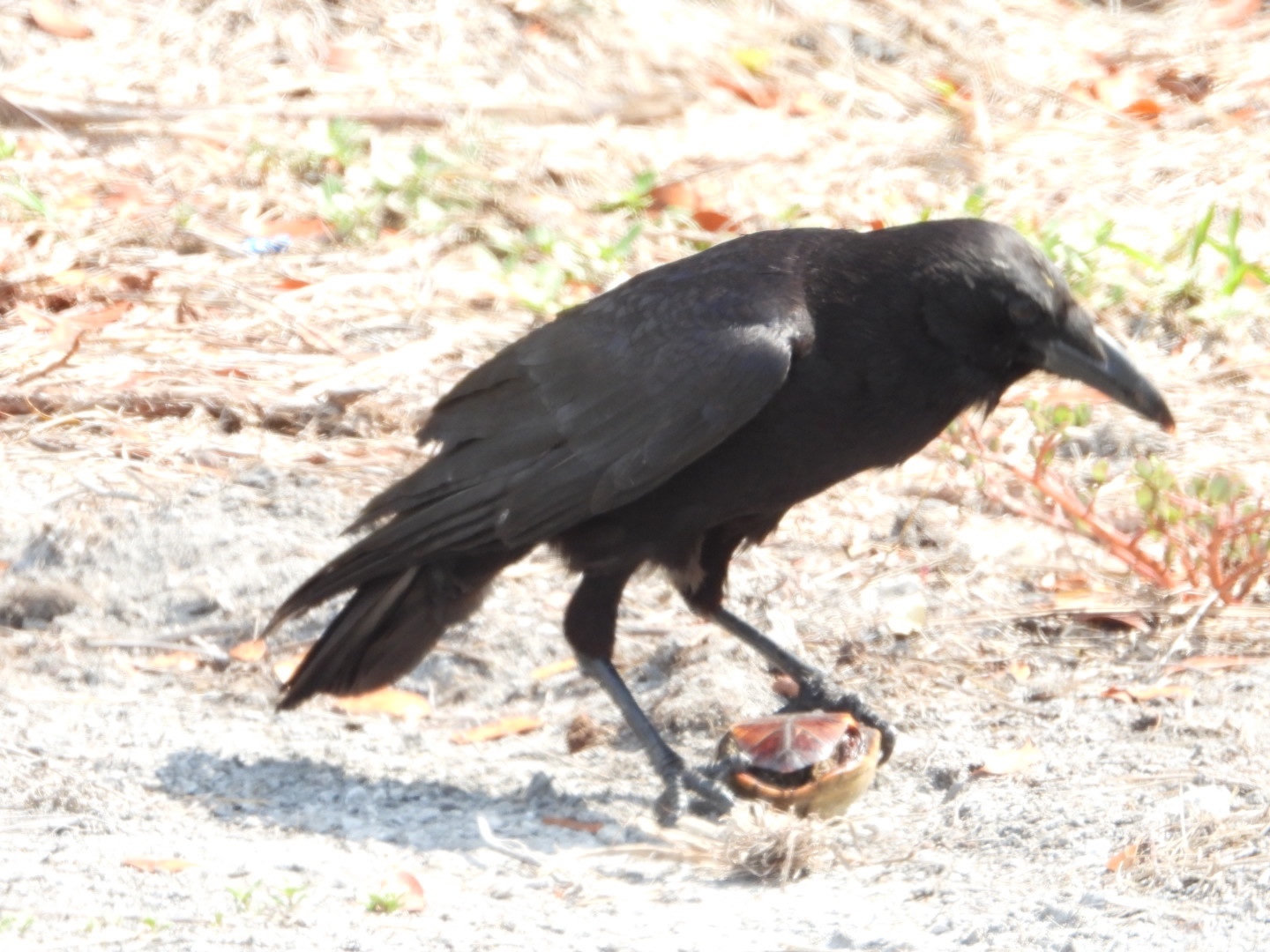
Photo Jacob Malcom (opens in a new tab) / iNaturalist, CC BY-SA 4.0 (opens in a new tab)
At a glance
- Size
- About 40 to 53 cm long
- Weight
- About 320 to 620 g
- Habitat
- Farms, woods, towns, parks and roadsides
- Diet
- Nearly anything: insects, grain, fruit, carrion, eggs and scraps
- In Georgia
- Common resident statewide
- Voice
- A loud "caw"
- Rabies vector
- No
Identification
- Key marks
- All black; heavy bill; square tail
- Told apart from
- Fish crow, which is smaller with a nasal "ah-ah" call
- Told apart from
- Common raven, which is larger with a wedge-shaped tail and croaking call
- Where to look
- Almost anywhere
Behaviour
Crows live in family groups in which young from previous years help raise new chicks. In winter they gather in huge roosts. They remember individual human faces for years and gather around dead crows, apparently to learn about danger.
Why they matter
American crows are among the most intelligent birds, able to solve problems and use tools. They clean up carrion and eat many insects. West Nile virus killed large numbers of crows after it reached North America, and they have been slowly recovering.
Reproduction and lifecycle
Nest — A bulky cup of sticks high in a tree
Eggs — Usually four or five
Incubation — About 18 days
Chicks — Fed by the parents and older helpers
Leaving the nest — At about four to five weeks
Lifespan — Wild birds over fifteen years are recorded
Living around people
- Young crows on the ground in early summer are fledglings, guarded by the family; they need help only if injured.
- Crows raiding bins are best discouraged by secure lids rather than harassment, which they remember.
Misconceptions
- A crow on the ground in summer has fallen. It is probably a fledgling being cared for.
- Crows are pests with no value. They are intelligent scavengers that clean up carrion and eat many insects.
Related species
Seasonal activity
When this species is breeding, and when there are nests on the ground. Mowing during the shaded months is how most nests are found.
| Jan | Feb | Mar | Apr | May | Jun | Jul | Aug | Sep | Oct | Nov | Dec | |
|---|---|---|---|---|---|---|---|---|---|---|---|---|
| Breeding | Jan: no | Feb: no | Mar: no | Apr: no | May: no | Jun: no | Jul: no | Aug: no | Sep: no | Oct: no | Nov: no | Dec: no |
| Active nests | Jan: no | Feb: no | Mar: no | Apr: no | May: no | Jun: no | Jul: no | Aug: no | Sep: no | Oct: no | Nov: no | Dec: no |
| Notes | Large winter roosts | Roosts | Families on territory | Nesting | Chicks | Young fledging | Families | Families | Families | Roosts forming | Roosts | Roosts |
Where it lives
Recorded in 64 states and provinces. Each one links to the other animals there, and to the rehabilitators licensed for them.
United States
- Alabama
- Alaska
- Arizona
- Arkansas
- California
- Colorado
- Connecticut
- Delaware
- District of Columbia
- Florida
- Georgia
- Idaho
- Illinois
- Indiana
- Iowa
- Kansas
- Kentucky
- Louisiana
- Maine
- Maryland
- Massachusetts
- Michigan
- Minnesota
- Mississippi
- Missouri
- Montana
- Nebraska
- Nevada
- New Hampshire
- New Jersey
- New Mexico
- New York
- North Carolina
- North Dakota
- Ohio
- Oklahoma
- Oregon
- Pennsylvania
- Rhode Island
- South Carolina
- South Dakota
- Tennessee
- Texas
- Utah
- Vermont
- Virginia
- Washington
- West Virginia
- Wisconsin
- Wyoming
Canada
Mexico
If you found one
Answer a few questions and you will get a specific answer for what you are looking at.
I found an animal