
Species
American bittern
Botaurus lentiginosus
A streaky brown heron that freezes with its bill to the sky, vanishing among the reeds.
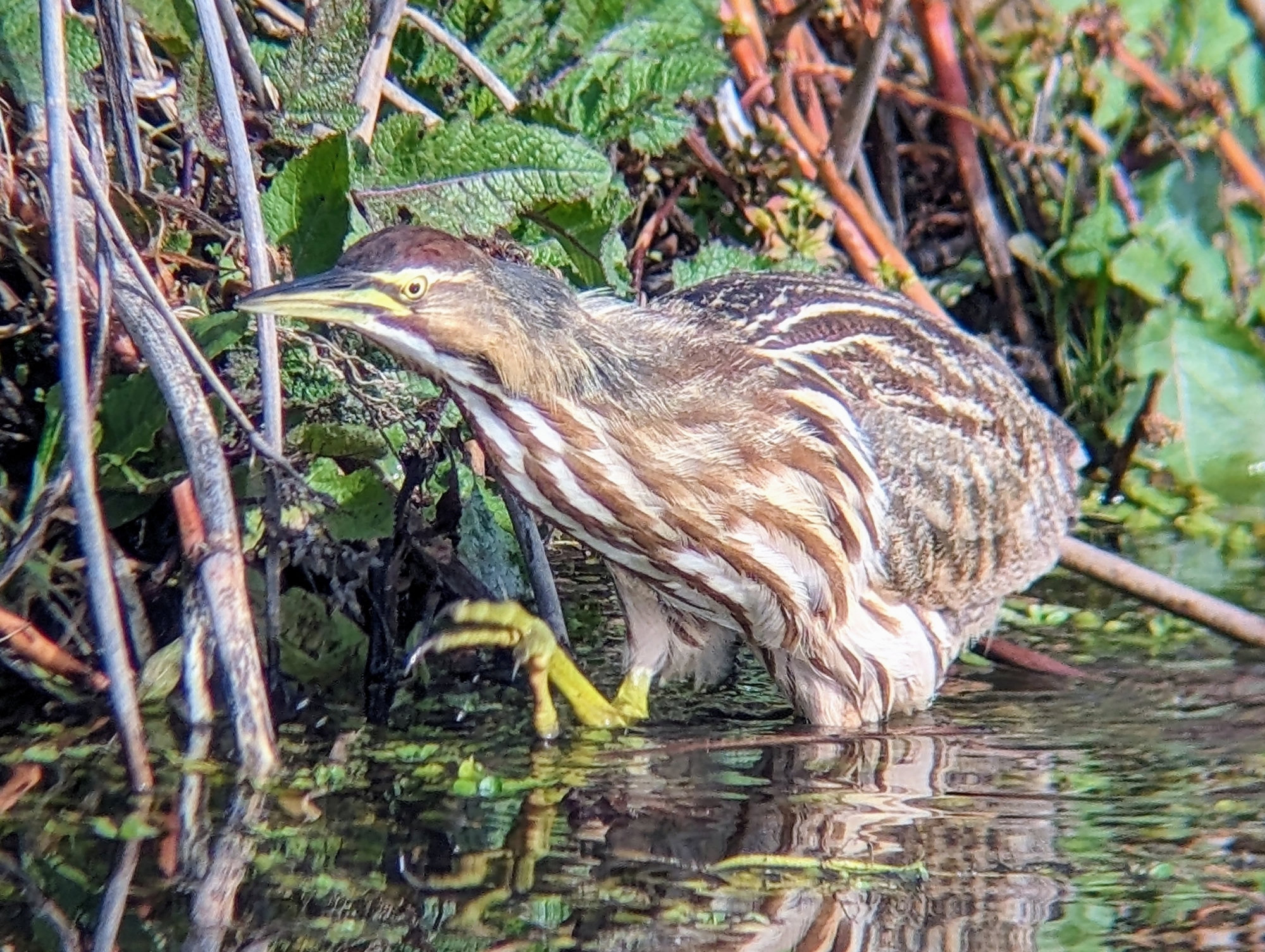
Photo Ken-ichi Ueda (opens in a new tab) / iNaturalist, CC BY 4.0 (opens in a new tab)
At a glance
- Size
- About 60 to 85 cm long
- Weight
- About 370 to 1,070 g
- Habitat
- Freshwater and brackish marshes with tall vegetation
- Diet
- Fish, frogs, crayfish, insects and small mammals
- In Georgia
- An uncommon winter visitor
- Voice
- A deep, gulping "oonk-a-lunk", heard on breeding grounds
- Rabies vector
- No
Identification
- Key marks
- Stocky brown heron; brown-and-white streaks down the neck; black streak on the side of the neck
- Told apart from
- Young night-herons, which are spotted, not streaked, with a heavier bill
- Told apart from
- Least bittern, which is tiny with buff wing patches
- Where to look
- Edges of tall marsh vegetation in winter
Behaviour
When alarmed, the bittern points its bill straight up and stands still, the streaks on its neck blending with the reeds. It may even sway with the wind.
Why they matter
The American bittern depends on large, undisturbed marshes and has declined as they were drained. Its camouflage is one of the best examples in birds of hiding in plain sight.
Reproduction and lifecycle
Nest — A platform of reeds in dense marsh
Eggs — Usually three to five
Incubation — About 24 to 28 days
Chicks — Fed by the female
Flight — At about seven to eight weeks
Lifespan — Several years
Living around people
- A bittern in a yard or car park after a night of migration is disoriented; it needs a rehabilitator.
Misconceptions
- A bird standing stiff with its bill up is dead or stuck. It is hiding.
Related species
Seasonal activity
When this species is breeding, and when there are nests on the ground. Mowing during the shaded months is how most nests are found.
| Jan | Feb | Mar | Apr | May | Jun | Jul | Aug | Sep | Oct | Nov | Dec | |
|---|---|---|---|---|---|---|---|---|---|---|---|---|
| Breeding | Jan: no | Feb: no | Mar: no | Apr: no | May: no | Jun: no | Jul: no | Aug: no | Sep: no | Oct: no | Nov: no | Dec: no |
| Active nests | Jan: no | Feb: no | Mar: no | Apr: no | May: no | Jun: no | Jul: no | Aug: no | Sep: no | Oct: no | Nov: no | Dec: no |
| Notes | Wintering | Wintering | Leaving | Migrating north | Nesting farther north | Nesting | Chicks | Young flying | Migration begins | Arriving | Wintering | Wintering |
Where it lives
Recorded in 78 states and provinces. Each one links to the other animals there, and to the rehabilitators licensed for them.
United States
- Alabamain winter
- Arizonain winter
- Arkansaspassing through
- California
- Coloradobreeding
- Connecticutin winter
- Delawarein winter
- District of Columbiapassing through
- Floridain winter
- Georgiain winter
- Idahobreeding
- Illinoisbreeding
- Indianabreeding
- Iowabreeding
- Kansasbreeding
- Kentuckypassing through
- Louisianain winter
- Mainebreeding
- Marylandin winter
- Massachusetts
- Michiganbreeding
- Minnesotabreeding
- Mississippiin winter
- Missouripassing through
- Montanabreeding
- Nebraskabreeding
- Nevada
- New Hampshirebreeding
- New Jerseyin winter
- New Mexicoin winter
- New Yorkbreeding
- North Carolinain winter
- North Dakotabreeding
- Ohiobreeding
- Oklahomabreeding
- Oregonbreeding
- Pennsylvaniabreeding
- Rhode Islandin winter
- South Carolinain winter
- South Dakotabreeding
- Tennesseepassing through
- Texasin winter
- Utahbreeding
- Vermontbreeding
- Virginiain winter
- Washington
- West Virginiabreeding
- Wisconsinbreeding
- Wyomingbreeding
Canada
Mexico
- Baja Californiain winter
- Baja California Surpassing through
- Jaliscoin winter
- Mexico Cityin winter
- Michoacanpassing through
- Nayaritin winter
- Nuevo Leonpassing through
- Pueblapassing through
- Queretaropassing through
- Quintana Rooin winter
- Sinaloain winter
- Sonorapassing through
- State of Mexicoin winter
- Tamaulipasin winter
- Veracruzin winter
- Yucatanin winter
If you found one
Answer a few questions and you will get a specific answer for what you are looking at.
I found an animal