
Species
Alder flycatcher
Empidonax alnorum
A small flycatcher of northern thickets, told from its twin the willow flycatcher only by its song.
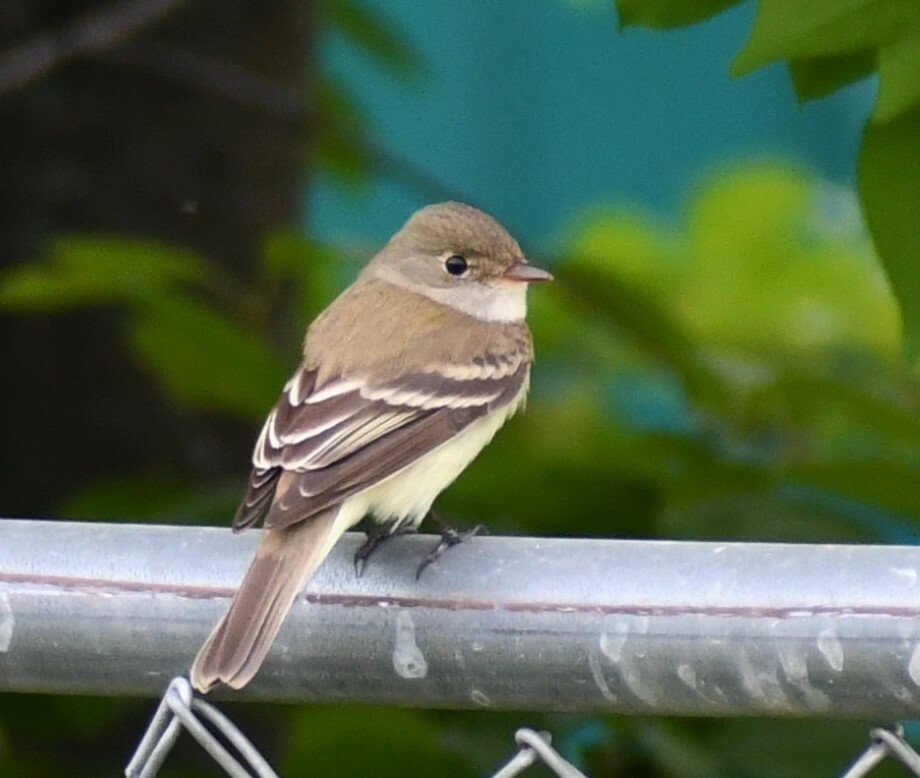
Photo Unknown photographer (opens in a new tab) / iNaturalist, CC0 1.0 (opens in a new tab)
At a glance
- Size
- About 13 to 17 cm long
- Weight
- About 12 to 14 g
- Habitat
- Wet, shrubby thickets in the north; any thicket on migration
- Diet
- Insects
- In Georgia
- An uncommon migrant, May and August to September
- Voice
- A burry "fee-BEE-o"
- Rabies vector
- No
Identification
- Key marks
- Olive-brown; faint eye-ring; two wing bars; almost identical to the willow flycatcher
- Told apart from
- Willow flycatcher, which sings "FITZ-bew"
- Where to look
- Thickets and wet shrubs during migration
Behaviour
Alder flycatchers perch in shrubs and fly out to catch insects. They migrate late in spring and early in autumn.
Why they matter
Alder and willow flycatchers were long treated as one species, "Traill's flycatcher", until their songs showed them to be two. They show how much bird diversity is only audible.
Reproduction and lifecycle
Nest — A loose cup in a shrub
Eggs — Usually three or four
Incubation — About 12 to 14 days
Chicks — Fed by both parents
Lifespan — Several years
Living around people
- Thickets and shrubby field edges are important on migration.
Misconceptions
- Birds that look identical are the same species. Alder and willow flycatchers are told apart by song.
Related species
Seasonal activity
When this species is breeding, and when there are nests on the ground. Mowing during the shaded months is how most nests are found.
| Jan | Feb | Mar | Apr | May | Jun | Jul | Aug | Sep | Oct | Nov | Dec | |
|---|---|---|---|---|---|---|---|---|---|---|---|---|
| Breeding | Jan: no | Feb: no | Mar: no | Apr: no | May: no | Jun: no | Jul: no | Aug: no | Sep: no | Oct: no | Nov: no | Dec: no |
| Active nests | Jan: no | Feb: no | Mar: no | Apr: no | May: no | Jun: no | Jul: no | Aug: no | Sep: no | Oct: no | Nov: no | Dec: no |
| Notes | In South America | In South America | In South America | In South America | Migrants passing | Nesting in the north | Nesting | Migrants | Migrants | In South America | In South America | In South America |
Where it lives
Recorded in 47 states and provinces. Each one links to the other animals there, and to the rehabilitators licensed for them.
United States
- Alaskabreeding
- Arkansaspassing through
- Connecticutbreeding
- Floridapassing through
- Georgiapassing through
- Illinoisbreeding
- Indianabreeding
- Iowapassing through
- Kansaspassing through
- Louisianapassing through
- Mainebreeding
- Marylandbreeding
- Massachusettsbreeding
- Michiganbreeding
- Minnesotabreeding
- Mississippipassing through
- Missouripassing through
- Nebraskapassing through
- New Hampshirebreeding
- New Jerseybreeding
- New Yorkbreeding
- North Carolinabreeding
- North Dakotabreeding
- Ohiobreeding
- Oklahomapassing through
- Pennsylvaniabreeding
- South Dakotapassing through
- Tennesseebreeding
- Vermontbreeding
- Virginiabreeding
- West Virginiabreeding
- Wisconsinbreeding
Canada
If you found one
Answer a few questions and you will get a specific answer for what you are looking at.
I found an animal