
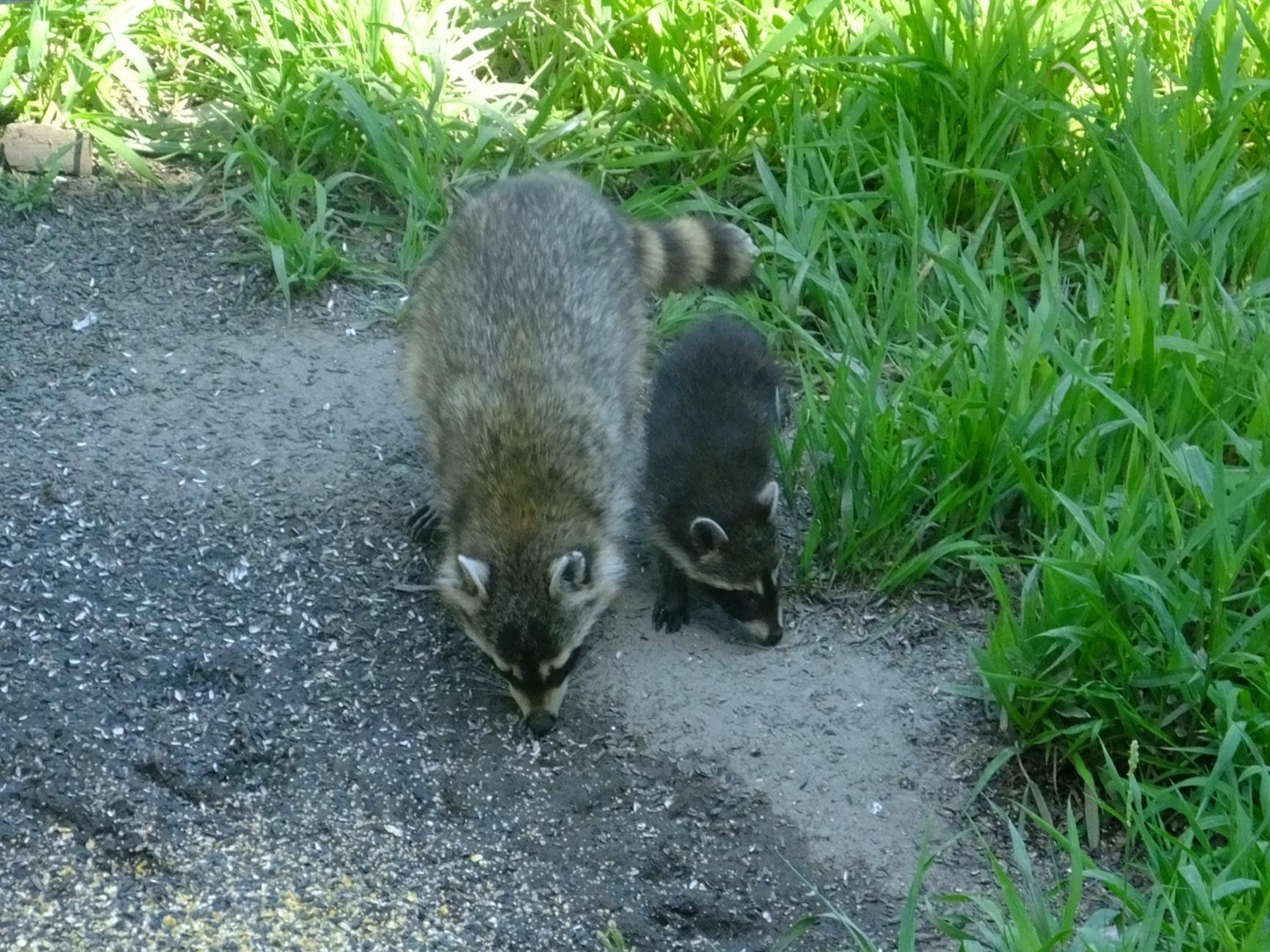
Photo U.S. Fish and Wildlife Service - Midwest Region (opens in a new tab), Public domain (opens in a new tab)
Get the kit safely contained
Get the raccoon kit off the ground, safely contained and indoors until the reunion attempt at dusk.
Raccoons are tree-dwellers. Trees and elevated structures are places of refuge, while the ground exposes them to predators, people and other dangers. A frightened raccoon naturally wants to climb. For a young family living in a tree, the trunk is effectively the driveway between the nest and the surrounding neighbourhood. For a family using a building, a drain pipe, gutter or similar structure may serve the same purpose.
A mother raccoon must leave her young throughout the 24-hour cycle to find food and water for herself and to produce milk for her kits. Seeing a raccoon active during daylight is not, by itself, a reason to assume rabies. Wildlife rehabilitators sometimes summarise this with the saying, "It's not rabies; it's babies."
Use a bunched-up towel to collect the kit and place it into a secure, well-ventilated container such as a cat travel crate. Be gentle and firm and do not hesitate once you have committed to picking it up. Do not allow the kit to bite you. That's what the bunching of the towel is for.
A kit that struggles, vocalizes or tries to defend itself is frightened. From its perspective, the person reaching towards it is an enormous predator. Fear should not be mistaken for aggression.
Bring the secured kit into a climate-controlled building. Keep it contained and away from people, pets and predators until dusk.
Never leave a raccoon kit on the ground outside, even if it is inside a box, crate or other container. A container on the ground does not make the kit safe from predators, and inside climate control is necessary to keep the kit from getting too hot and dehydrated or too cold. Young kits cannot regulate their own body temperature. Usually, they snuggle with their siblings in their nest to maintain correct body temperature.
Do not feed or give liquids
Do not offer the kit food, water, milk, formula or any other liquid unless an experienced licensed RVS wildlife rehabilitator has told you exactly what to give and how to give it.
The wrong food can cause digestive problems. Giving liquid improperly can cause aspiration, meaning fluid enters the airway or lungs rather than being swallowed safely. Either problem can become life-threatening.
A hungry kit may cry loudly. That can be useful during a reunion attempt because its mother is more likely to hear and locate it. Hunger is not a reason to improvise feeding, even the kit's cries of hunger make you feel guilty. Between hunger and life-threatening compromise from digestive problems or aspiration, hunger is by far the lesser of those evils, and babies can survive for multiple days without sustenance or hydration.
Check the kit before attempting reunion
Look closely for injuries, illness, dehydration or unusual behavior before proceeding.
Take close-up photographs and video of the kit. Look especially for:
- Visible wounds, bleeding, swelling or other injuries.
- Flies repeatedly landing on or buzzing around the kit, which may indicate flystrike.
- Unusual weakness, unresponsiveness or abnormal behavior.
- Anything else that makes the kit appear injured or ill.
If you see any of these signs, stop the reunion process and contact a licensed RVS wildlife rehabilitator immediately.
If it can be done safely without risking a bite, gently perform a skin pinch test between the shoulder blades. Lift a small fold of skin and release it. In a well-hydrated animal the skin should return towards its normal position promptly. Skin that remains raised in a "tent" and returns slowly can indicate dehydration.
If the kit appears dehydrated, stop and consult a licensed RVS wildlife rehabilitator about whether the kit is in suitable condition for a reunion attempt.
Find the exact target tree or structure
Stand on the exact place where the kit was found and look directly upward.
This is one of the most important steps in the entire reunion process. It is certainly the most precise step required. A kit found beneath a nest site has fallen directly downward from something above it, even when the nest itself cannot be seen.
Look for the branches directly overhead. Follow those branches back to the trunk they belong to. That trunk is your target tree.
If several trees have overlapping branches above the place where the kit was found, make the best possible judgement about which one is most likely to contain the nest.
If the kit was found beside a building, look directly above for a likely route such as a gutter, drain pipe, hole in siding or another elevated opening. The family may be nesting inside the structure, with that route serving the same purpose as a tree trunk.
Do not simply choose a nearby tree because it looks suitable. The objective is to return the kit to the mother's existing travel route on the trunk of the tree she built the nest in. That means that it's critical that the tree whose branches extend directly over where the kit was originally found be assigned as the target tree.
Build an artificial nest
A disposable five-gallon plastic paint bucket can be turned into a temporary artificial nest.
Drill multiple drainage holes in the bottom so rainwater cannot collect inside.
Gather pine straw and leaves from the ground near the target tree or structure. Put them into the bucket and gently pack them down.
Fill the bucket as high as practical while still leaving enough depth that the kit cannot climb out, even if it's trying its best. The bedding serves two purposes. It gives the kit a more natural resting place and raises it closer to the rim, making it easier for the mother to reach down and retrieve it.
The kit must not be able to escape from the bucket on its own.
Put the artificial nest up at dusk
At dusk, place the kit in the prepared bucket and attach the bucket as high as can be done safely on the target tree or the family's access structure.
Height matters. A raccoon is naturally more comfortable above the ground, and the mother must be willing to approach the unfamiliar bucket despite the risks she associates with coming down towards ground level. Every extra foot of elevation above the ground brings the artificial nest closer to her normal route.
If a ladder is available and can be used safely, it can help place the bucket higher.
On a tree, the bucket can be hung from a secure support. A stronger attachment can be made by driving a lag bolt through the side of the bucket into the trunk. Whatever method is used, the bucket must remain stable throughout the night - even with a 20 pound raccoon mom perched on the side of the bucket.
If the family's route appears to be a drain pipe or another part of a structure, position the bucket as high and as close to that route as can be done safely.
The goal is not merely to put the baby outside. It is to put the baby directly in the mother's path.
Protect the kit overnight
Keep the artificial nest elevated and make it difficult for predators to reach.
Elevation helps protect the kit from predators traveling on the ground. Aerial predators can be discouraged by attaching an obstruction to the tree approximately two feet above the bucket. The aim is to create something like a porch awning that prevents a bird from easily landing on the bucket rim and reaching the kit.
If the night is cold, provide a gentle source of non-burning warmth in the bucket. It must not become hot enough to burn the kit or cause overheating.
Never substitute the elevated artificial nest by placing the kit in a box on the ground. The artificial nest works because it puts the kit above ground and on the mother's normal travel route.
Let the mother do the work
Leave the kit available to its mother overnight.
The mother may travel down the trunk, drain pipe or other route, discover the kit and retrieve it in her mouth. If the original nest has been damaged or disturbed, she may first need time to establish another nest site before returning for the kit.
That delay does not necessarily mean she has abandoned her young.
A mother raccoon has invested heavily in raising her kits. Reunion gives her the opportunity to continue doing the job she is equipped to do.
Use cameras if available
A night-vision camera aimed clearly at the artificial nest can show whether the mother visited during the night.
More than one camera can be useful because a single viewpoint may miss activity on the opposite side of a tree or structure.
Camera footage can help distinguish between a kit whose mother never appeared and one whose mother visited, investigated or began moving her young.
Do not repeatedly approach the bucket during the night simply to check it. Give the mother an opportunity to approach without people nearby.
If there is more than one kit
Keep all healthy kits together and give their mother enough time to retrieve them one at a time.
A mother can carry only one kit at a time. If several kits need to be moved, she must make repeated trips between the artificial nest and her chosen nest site.
Moving an entire litter may take more than one night, especially if her first nest failed. She may have to find a location for a new nest, build the nest itself, and then one by one move each kit from the artificial nest to her new nest. This may take multiple nights.
If some kits remain in the bucket the following morning, bring those kits back inside for the day. Keep them safely contained in a climate-controlled building and do not feed or give liquids unless specifically instructed by an experienced licensed RVS wildlife rehabilitator.
A second, or even third, reunion attempt may be appropriate when the mother has already demonstrated that she is retrieving the litter.
What to do in the morning
Check the artificial nest in the morning.
If the kit is gone, the mother may have retrieved it during the night. Camera footage, when available, can help confirm what happened.
If the kit is still there, bring it back inside immediately. Keep it safe, secure and contained and contact a licensed RVS wildlife rehabilitator for guidance.
Do not leave the kit outside through the day waiting for the mother.
Do not feed or give liquids while waiting for professional guidance.
When to stop the reunion attempt
Stop and contact a licensed RVS wildlife rehabilitator if the kit appears injured, ill, dehydrated or otherwise unsuitable for an overnight reunion attempt.
A reunion protocol is for a kit that is healthy enough to wait safely for its mother. It is not a substitute for treatment.
The photographs and video taken when the kit was first found can help the rehabilitator evaluate what you are seeing and advise whether reunion remains appropriate.
Why reunion should come first
For a healthy raccoon kit, successful reunion keeps the animal with the individual best equipped to raise it: its mother.
She provides more than food. She provides warmth, protection and the normal experience of growing up as a raccoon. The purpose of the artificial nest is not to replace her. It is to correct the immediate problem that separated the family and give her a safe opportunity to take over again.
A kit found alone on the ground can look abandoned when the real problem may simply be that it fell from its nest or became separated while its mother was away.
That is why locating the exact target tree or structure matters so much. Reunion is most likely when the kit is returned not merely to the general area, but to the mother's existing route between her nest and the ground.
If reunion does not succeed
If a kit remains after an appropriate reunion attempt, bring it indoors and contact a licensed RVS wildlife rehabilitator.
If the kit remains in good health, multiple reunion attempts may be tried on consecutive evenings, especially if the 'target tree' can not positively identified but has been narrowed down to a few trees close together - potentially changing the 'acting target tree' each evening.
For a healthy kit that meets the conditions for reunion, this protocol treats reunion with the mother as the first choice rather than automatically removing the kit for hand-rearing. If someone proposes taking a healthy kit without first considering an appropriate reunion attempt, seek another licensed RVS wildlife rehabilitator who will evaluate the possibility of reunion.
Never surrender a raccoon kit to an unlicensed person. A volunteer or transporter acting on behalf of a licensed RVS wildlife rehabilitator may receive the animal as that rehabilitator's proxy.
The best outcome for a healthy separated kit is not simply surviving the night. It is getting back to its mother.