
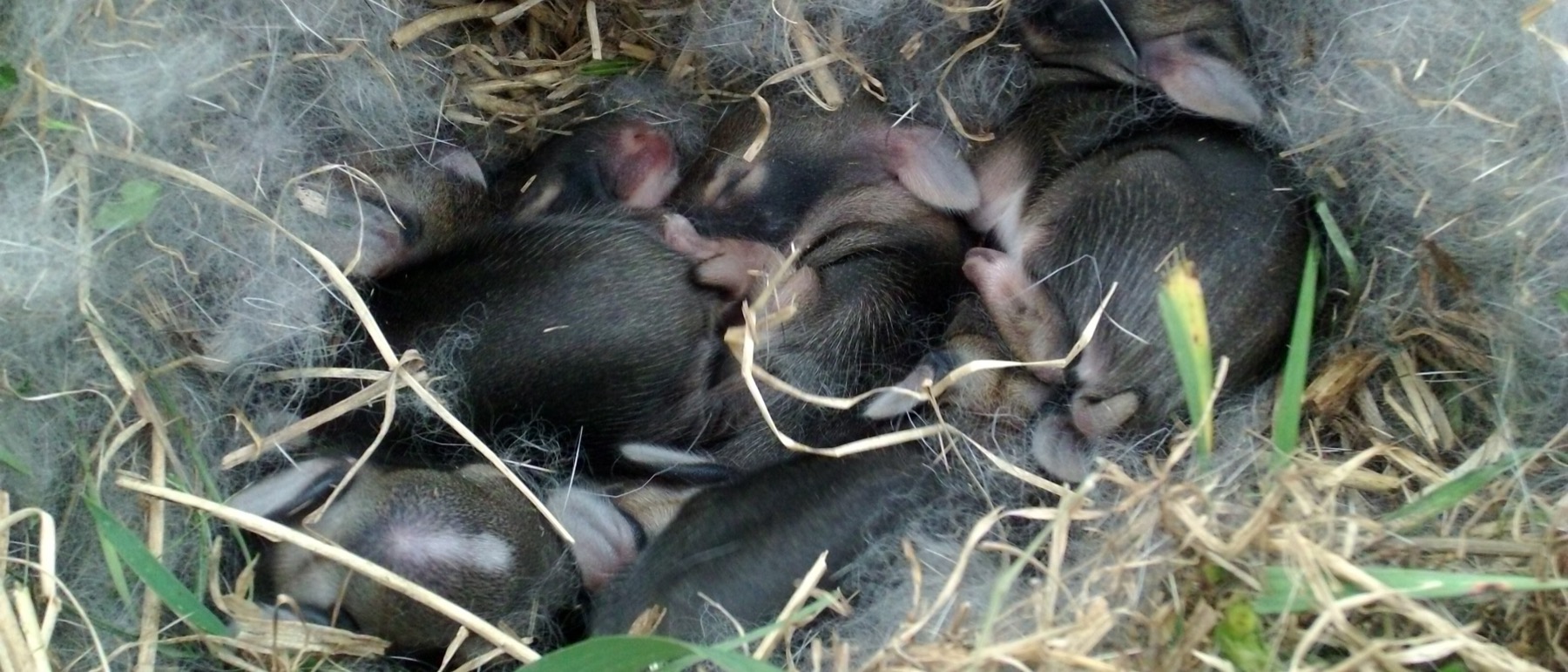
Photo Jhansonxi (opens in a new tab), CC BY-SA 3.0 (opens in a new tab)
Every spring and summer, wildlife clinics across the Southeast take in young cottontails that did not need to come in. The pattern is consistent enough to be predictable. Someone mows a lawn, or a dog noses at a patch of grass, or a small rabbit turns up sitting motionless beside a driveway at nine in the morning. The rabbit does not run. It looks, to any reasonable person, abandoned.
It almost never is. Understanding why requires giving up one assumption: that a parent who is present is a parent who is doing a good job. For an Eastern Cottontail, presence is the thing that kills.
Absence is the strategy
A doe builds her nest by scraping a shallow depression in the ground, lining it with dried grass, and finishing it with fur pulled from her own belly. The whole structure is roughly the size of a cupped hand and sits perhaps an inch below the surface. She then covers her young with the fur and grass cap and walks away.
She returns twice in twenty-four hours, once around dusk and once in the hour before dawn. Each visit lasts about two to five minutes. Rabbit milk is extraordinarily rich — high in fat and protein compared with most mammal milk — which is what makes that schedule possible. In between, she stays away entirely, often feeding within sight of the nest without approaching it.
The logic is straightforward once stated. A doe cannot defend a nest. She has no burrow, no teeth worth the name, and no way to fight a snake, a crow, a raccoon, or a neighbourhood cat. What she has is the ability to not be found. Every hour she spends at the nest is an hour of scent, movement, and noise advertising it to everything that eats rabbits. So she does not spend them.
This also explains the siting. Nests turn up in mown lawns, in the middle of sports fields, in the gap between a driveway and a flowerbed — places that strike people as obviously unsafe. Predators hunt edges and cover, because that is where prey usually is. An open lawn is a poor place to hide and therefore a poor place to search.
Look closely
No wrong answers. Commit before you reveal.
- {{ li.label }}
- Erect ears and open eyes. Both happen around day seven. This animal is well past the nest stage.
- Body length against the grass. Roughly a closed fist. At that size a cottontail is weaned and on its own.
- It is not running. Freezing is the first defence, not the last. It is not paralysed by fear or too weak to flee.
- Coat condition. Dry, smooth, no clumping. A rabbit in trouble looks wet, ruffled, or dirty around the hindquarters.
Look closely
No wrong answers. Commit before you reveal.
PHOTO 4:3 — Single fist-sized cottontail sitting in short grass, ears erect, eyes open, full coat. Eye level, subject sharp, background soft. Must let a reader measure it against the grass blades.
What do you notice about this rabbit?
What a rehabilitator reads here
Three weeks from nest to independent
Cottontails develop fast. Gestation is about twenty-eight days. Eyes and ears open in the first week. By two weeks the young are leaving the nest to nibble greens between feeds, and by roughly eighteen to twenty-one days the nest is finished — not abandoned, finished. The litter disperses a few metres and never returns to it.
This is the single most useful fact for anyone standing over a small rabbit. A cottontail the size of a closed fist, with its eyes open and its ears up, is not a baby that has lost its mother. It is a young adult in the ordinary sense: independent, feeding itself, living in a home range it already knows. Taking it indoors removes a healthy animal from the only place it will ever survive.
Sequence
Tap the stages in the order they happen.
- {{ s.num }} {{ s.label }} {{ s.when }}
Sequence
Tap the stages in the order they happen.
{{ seqFeedback }}
What actually goes wrong
Three things kill young cottontails in human hands, and none of them are the ones people worry about.
The first is feeding. Cow's milk, kitten formula, and water given by syringe all end the same way. A rabbit's gut flora is delicate and specialised; the wrong milk produces diarrhoea that a two-week-old animal cannot survive. Worse, liquid delivered by an untrained hand goes into the lungs rather than the stomach, and aspiration pneumonia is not survivable in a wild rabbit. Rehabilitators are unanimous on this: nothing by mouth, ever, from anyone who has not been trained.
The second is stress. Cottontails are exceptionally prone to it. Confinement, handling, the smell of a dog in the next room, and the sound of a television are all capable of killing an otherwise healthy young rabbit within a day. This is not squeamishness; it is a physiological response that ends in cardiac failure. It is the reason a rehabilitator would rather you left an uninjured rabbit in a lawn with a cat in the neighbourhood than bring it indoors overnight.
The third is delay caused by a cat. A cat's mouth carries Pasteurella multocida, and a puncture too small to find will produce a fatal infection in a day or two. Any animal that a cat has touched — touched, not visibly wounded — needs antibiotics within hours. This is the one case where a healthy-looking rabbit is a genuine emergency, and it is precisely the case that gets deferred until morning.
What would you do?
One answer is better than the others. Choose before reading on.
- {{ o.key }} {{ o.label }} {{ o.response }}
What would you do?
One answer is better than the others. Choose before reading on.
Your dog has just uncovered a nest in the lawn. Five young, eyes closed, scattered across a few feet of grass. None of them appear injured. It is four in the afternoon.
How to know she came back
You will not see her. That is the point of the whole arrangement, and it is why people who watch a disturbed nest for an afternoon conclude, wrongly, that the litter is orphaned. What you can do instead is read the evidence she leaves.
Lay two thin twigs across the nest in an X, or sprinkle a ring of flour around it, and photograph the arrangement. Check it once in the morning without touching the nest. If the twigs have shifted or the flour is tracked, she has fed them. Young rabbits that are being fed feel warm, sit quietly, and have rounded bellies; young rabbits that are not feel cool and slack, and they cry.
Field observation
Something to do outdoors, safely, over one evening and one morning.
- {{ f.label }}
Field observation
Something to do outdoors, safely, over one evening and one morning.
The twig test
If you find a nest and do nothing else, do this. It converts an anxious guess into an observation, and it is the same test a rehabilitator will ask you about on the phone.
Progress is kept on this device only. Nothing is submitted.
The uncomfortable part
Most young cottontails die. Estimates for first-year mortality run well above half, and a doe answers that with volume: three to five litters a season, six or seven young at a time, and a return to breeding within days of giving birth. The species is built to lose most of its young to hawks, snakes, crows, foxes, and cats, and to replace them faster than that can empty the landscape.
This is worth saying plainly, because the instinct to intervene is decent and the arithmetic is not sentimental. Leaving a healthy rabbit where it is does not guarantee it lives. It gives it the odds the species evolved with, which are far better than the odds of a stressed, hand-fed rabbit in a shoebox.
And there is one thing you can do that changes the numbers more than any rescue: keep the cat in. Free-roaming domestic cats are among the largest human-linked sources of mortality for small mammals and birds in North America. A week of indoor cats while a nest empties out does more measurable good than a season of well-meant intervention.
Decision point
You are standing over a rabbit right now.
Three questions and you will have an answer, along with the rehabilitators near you who accept cottontails.
Start the guidance flow