
Species
Eastern Cottontail
Sylvilagus floridanus
The rabbit most people mean when they say "rabbit". Common enough to be invisible until a nest turns up in a mown lawn.
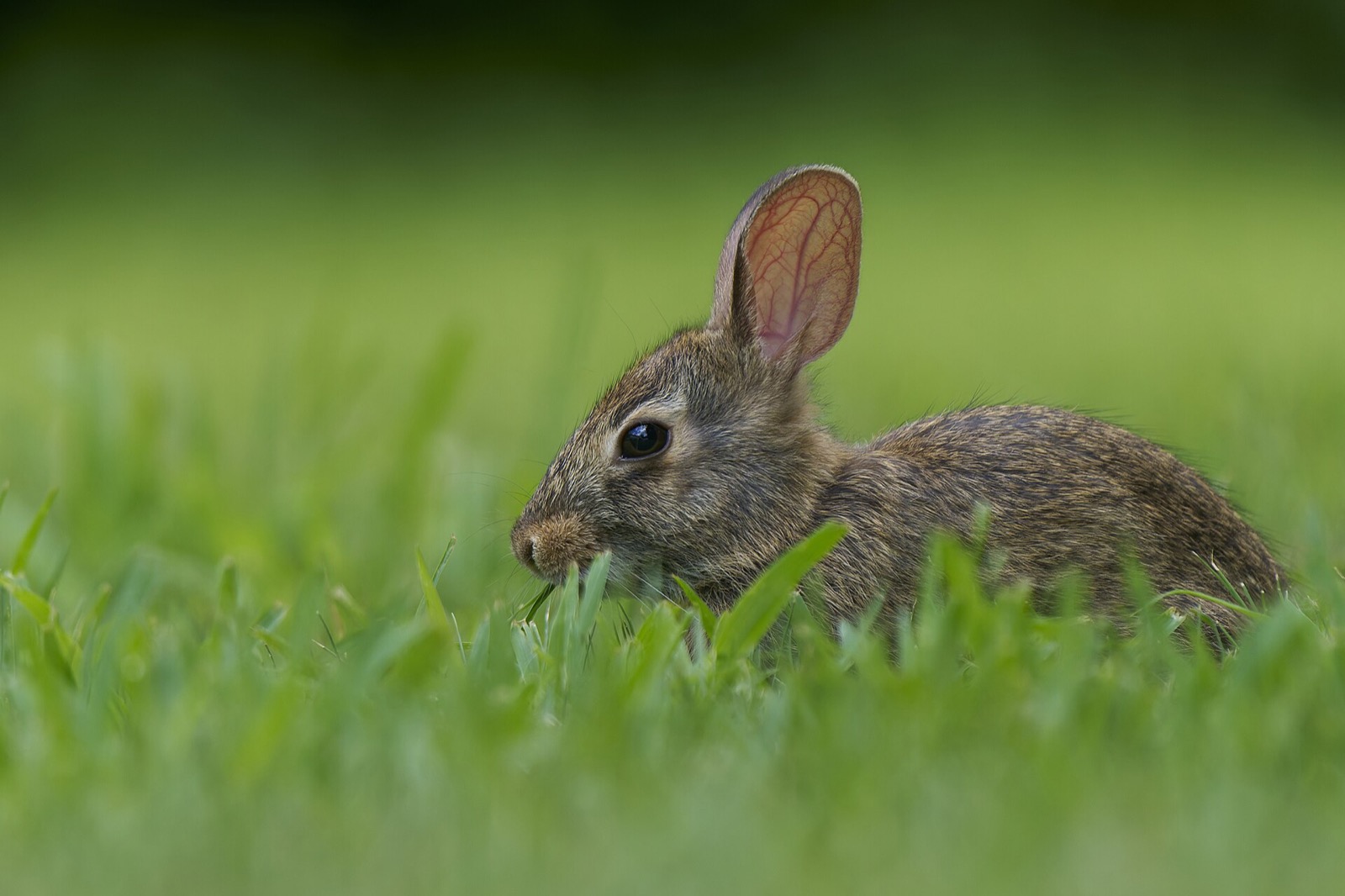
Photo Paul Danese (opens in a new tab), CC BY-SA 4.0 (opens in a new tab)
At a glance
- Group
- Mammal · Lagomorph
- Length
- 15–19 in
- Weight
- 2–4 lb
- Active
- Dawn and dusk
- Diet
- Herbivore
- Litters
- 3–5 a season
- Wild lifespan
- Usually under 2 years
- Status
- Common
Identification
- Size
- A rabbit you can hold in two hands. Adults run 15 to 19 inches and rarely exceed four pounds.
- Nape
- A rusty red patch on the back of the neck, visible whenever the head is down.
- Tail
- Brown above, bright white below. The white flashes only when the animal runs.
- Ears
- Shorter than a hare’s, roughly the length of the head, without black tips.
- Gait
- Short hops when calm; long low bounds in a wide arc when flushed.
- Tracks
- Four prints in a Y, with the larger hind feet landing ahead of the front.
Reproduction and lifecycle
- Day 0Born blind, naked, and helplessAfter about 28 days’ gestation, in a scrape lined with grass and the doe’s belly fur. Litters of four to seven.
- Day 7Eyes and ears openFur grows in. The young begin to move within the nest cup.
- Day 14First trips out of the nestNibbling green vegetation between the two daily feeds.
- Day 18–21The nest is finishedNot abandoned — finished. The litter disperses a few metres and never returns to it.
- 2–3 moOld enough to breedFemales born in spring often raise a litter of their own before the season closes.
Living around people
Beans, lettuce, and tulips disappearing overnight
A two-foot wire fence with the base turned outward solves it permanently. Repellents wash off.
Bark stripped from young trees in late winter
Damage happens when snow or hard frost removes other options. Trunk guards are the fix.
A nest discovered while mowing
Rebuild the cap, mark it with twigs, and mow around it for two weeks. It empties on its own.
Misconceptions
- A doe will reject young that have been touched by a person. She will not. This is folklore, and it is the single most damaging belief about young mammals. Put the young back, rebuild the cap, and check the nest in the morning.
- A rabbit sitting still in the open is injured or in shock. Freezing is the first line of defence and the most common behaviour you will ever see from a cottontail. It is what a healthy animal does when watched.
- A nest in the middle of a lawn was a mistake. Open ground is deliberate. Predators search edges and cover, so an exposed scrape is genuinely harder to find than a hedge bottom.
- Rabbits should be relocated to a park or woodland where it is safer. A cottontail knows a home range of a few acres in detail. Moved animals lose that knowledge, arrive in occupied ground, and usually die within days.
Related species
Marsh Rabbit
Confused with
Swamp Rabbit
Confused with
Eastern Gray Squirrel
Shares habitat
Red Fox
Predator
Great Horned Owl
Predator
Connected topics
Parenting
Predation
Nesting
Urban wildlife
Misconceptions
Seasonal activity
When this species is breeding, and when there are nests on the ground. Mowing during the shaded months is how most nests are found.
| Jan | Feb | Mar | Apr | May | Jun | Jul | Aug | Sep | Oct | Nov | Dec | |
|---|---|---|---|---|---|---|---|---|---|---|---|---|
| Breeding | Jan: no | Feb: yes | Mar: yes | Apr: yes | May: yes | Jun: yes | Jul: yes | Aug: yes | Sep: yes | Oct: no | Nov: no | Dec: no |
| Active nests | Jan: no | Feb: no | Mar: yes | Apr: yes | May: yes | Jun: yes | Jul: yes | Aug: yes | Sep: yes | Oct: no | Nov: no | Dec: no |
| Notes | Bark and buds | Breeding starts | First nests | Peak nesting | Peak nesting | Mowing season | Young dispersing | Late litters | Breeding ends | Young of the year | Cover matters | Woody browse |
If you found one
Answer a few questions and you will get a specific answer for what you are looking at.
I found an animal